Resident Evil: Apocalypse

a line of sinister Umbrella cars moves into Raccoon City

Take a good look at the picture above. That’s going to be the last scenes we’ll see of Raccoon City spread out in the daylight. Soon the cars will go into the suburbs to collect the Umbrella Corporation scientists living there to evacuate them out, leaving the city behind to succumb to the zombie apocalypse. Once that happens it’s all crowded sets, claustrophobic close ups and darkness. But for now it’s still bright, sunny and empty, only those black cars moving in ominously.
Jill Valentine

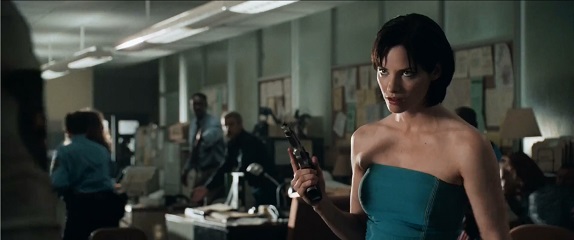
Our first good look at Jill Valentine comes about seven minutes into the movie, after we’ve had the short recap of the first movie, the set up for this one, the black cars have picked up their cargo and the zombie eruption is in full process but not yet recognised. This is the first clear shot of her face, after she’s stormed the police office she used to work for and shot all the zombies being arrested there, her former co-workers still thinking they’re normal criminals. Before that we only saw her in extreme close up: feet in high heels climbing stairs, her arms as she turned on her telly and grabbing a gun when realising what’s going on, cropped shots from behind as she moves into the office and starts shooting. A much more action orientated introduction than that of Alice in the first one, naked and vulnerable waking up in the shower.
Olivera to the rescue. But she is already bitten

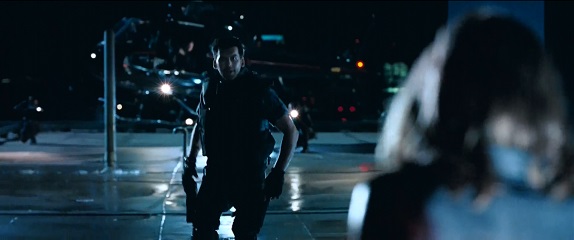
Resident Evil: Apocalypse is a very different movie from Resident Evil; Aliens to its Alien, a survival action story rather than a horror story. The first took its time to start the action, ratching up the tension slowly. Here it starts almost immediately. The first fifteen minutes or so of the movie is all action scenes as we get to meet the main characters and see the apocalypse starting to gather steam.
Just another prick on a wall

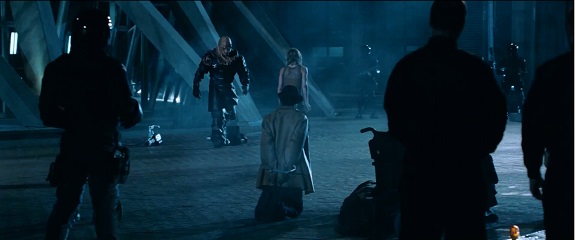
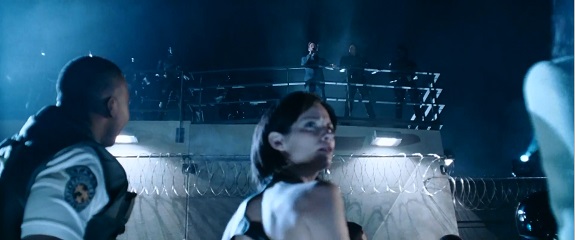
All of which culminates in this scene, in which Raccoon City is closed off by orders of the Umbrella Corporation. It’s a scene that neatly encapsulates both the inherent inhumany of Umbrella and its executive corps, but also its inherent incompetence and stupidity. First of all, closing off the entire city biut for one, not very big escape route isn’t going to get very many civilians out of the city, but then Umbrella is more than happy to sacrifise its own troops on the slightest pretext, which doesn’t say much for the intelligence of its goon squads. And then there’s the arrogance of the main villain to stand there in his business suit in front of an armed, angry and scared crowd telling them they’re going to die. Had I been there with a gun, that fecker would’ve been the first to die…
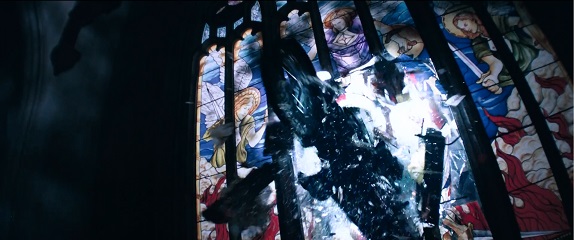
Like a bat out of hell, Alice makes her entrance

Alice and Jill finally meet a third into the movie, as Alice saves Jill and co from an attack by some of the super zombies. As seen in the epilogue to the previous movie and re-established here, she’s been experimented on by Umbrella and turned into a superhuman. It’s another case of Umbrella stupidity because of the way they went about it. The shock ending of Resident Evil had her and one other survivor break out of the Hive, leaving it and its zombies sealed behind them, only for the company to attack them and immediately use them to experiment with the T-virus. Had they been slightly less muhahaha evil and taken the time to debrief Alice, they’d known what was waiting for them in the Hive, they wouldn’t have let the zombies reach the surface and this whole movie would’ve been much shorter.
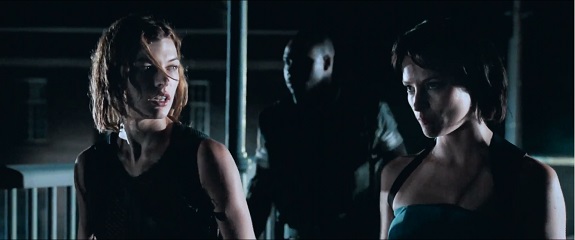
Alice and Jill passing the Bechdel test

One of the things the doesn’t get much credit for is how well it passes the Bechdel test. Both Jill Valentine and Alice are competent, strong heroines who work well together and the only time they clash over a man is when they disagree about whether it’s best to kill an infected team mate immediately. Even the obligatory civilian tag along, reporter Terri Morales, is competent in her own way.

Obligatory end boss fight

It of course all ends in a fight to the death on the roof of some modernist office building monstrosity, as the main villain forces Alice to fight his super zombie monster that he’d already taken for a field test in the last third of the movie. The symbolism here is …not subtle… You got the heavy, bulky, (barely) remote controlled killing machine squaring off against the woman who throughout the movie has tried to keep civilians and innocents alive, no fighting for the lives of her friends and comrades. The forces of evil seem to have all the power, but Alice’s own innate compassion wins the day in the end.

Books read January

That’s the first month of 2015 done and dusted. Eleven books read, ten more reviewed over at the booklog. Which puts me on track for reading a hundred plus books this year, which would be nice. Four fantasy novels, three science fiction, two history books and one disappointing book on steampunk.

A Natural History of Dragons — Marie Brennan
The first in a series about a natural explorer obsessed by dragons in a mock-Georgian fantasy world. Excellently done.

Half Life — SL Huang
The sequel to Zero Sum Game, in which math savant Cas Russell learns how to fake friendship like a normal human being.

Everybody Was Kung Fu Fighting — Vijay Prashad
Excellent overview of the history of intersectionality between the South Asian and Black experiences, largely in the context of US history.

A Wizard Abroad — Diane Duane
The YA wizards series goes to Ireland, the country its author also moved to. Coincidence? Luckily not at all as Oirish as you may expect from an American author dabbling in Celtic myths.

The Golem and the Djinni — Helene Wecker
At the American Book Center they compared this to Jonathan Strange and Mr Norrell and I can see why. They share the same sensibility and willingness to let the story breathe.

The Rise of Cities in North-West Europe — Adriaan Verhulst
A bit of a misnomer as it only looks at roughly fifteen cities in the southern Netherlands between the Somme and the Meuse. Somewhat more worthy than I’d expected.

Steampunk — Paul Roland
A disappointing overview of the steampunk subculture.

Pandora’s Planet — Christopher Anvil
Light hearted semi-libertarian fun about humans outsmarting alien invaders — written from the point of view of the invaders.

The Lion Game — James H. Schmitz
Fifteen year old psionic wonderkind Telzey Amberdon outsmarts a hidden invasion of the Hub. Fun adventure science fiction.

Spies of the Balkans — Alan Furst
Another of Furst’s usually quite depressing spy thrillers set just before and during World War II, this one has what you might call a happy ending.

Wolfhound Century — Peter Higgins
Epic fantasy set in a sort of steampunk fantasy Soviet Russia.

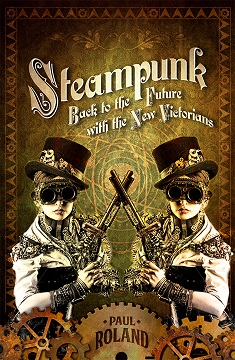
Steampunk — Paul Roland

Cover of Steampunk


Steampunk
Paul Roland
191 pages including index
published in 2014

If I felt more nasty Reginald Pikedevant’s excellent cri de coeur against steampunk fakery would be my whole review. I spotted Steampunk: Back to the Future with the New Victorians in the library among the new books and thought “great, just the sort of field guide I need to come to grips with this newfangled steampunk nonsense”. Sadly though this turned out to be just a shallow cash in which told me little I didn’t know written in an irritating manner that had my hackles up halfway through the first chapter.

Read more…

Pandora’s Planet — Christopher Anvil

Cover of Pandora's Planet


Pandora’s Planet
Christopher Anvil
192 pages
published in 1972 (original in 1956)

Libertarianism has a well deserved bad reputation in science fiction, largely because so many writers who profess to be adherents also are godawful people who write jack off fantasies about how freedom requires there jackbooted thugs putting their boot in somebody else’s face, whether it’s Heinlein’s repeated wish to kill off all the lawyers or Kratman resurrecting the Waffen SS to deal with an alien invasion. But once upon a time there was a gentler, more humane sort of libertarianism, one that still catered to the prejudices of Analog notorious editor John Campbell Jr, but that hadn’t quite lost its humanity. H. Beam Piper was its best known representative, but there were others, like Christopher Anvil.

Anvil is one of those writers I only ever had heard about, but had never read simply because I’d never seen any of his work for sale, new or secondhand. He was never translated in Dutch as far as I know, one of those minor Analog writers who’d been reasonably popular in the sixties and seventies but was passed by when the genre moved on. From what I gather he specialised in stories in which clever humans put one over militaristic aliens and Pandora’s Planet is in that mold, gently cocking a snoot at authority in general in the process. It’s gentle and not very humourous satire, but much better than the modern libertarian habit of genociding every alien race that looks at Earth funny.

Read more…