The Black Cat teaches judo

The Black Cat teaches judo tricks from Black Cat 7

Decades before Felica Hardy poured herself into a slinky furred cat suit, stunt woman and movie star Linda Turner strut the comics pages in bathing suit, buccaneer boots and opera mask as the Black Cat. First appearing in Pocket Comics #1, she was a headliner in Speed Comics before she got her own series in 1946, which ran a respectable sixtyfive issues, though she had to deal with the usual genre switches as superhero comics stopped selling.

Unlike a lot of other golden age comics, the Black Cat had actually a decent line up of second features. Usually there were two Black Cat stories, the obligatory two pages text story (needed to keep up second class mail privileges), with the rest filled up by the usual boring “humour” one pagers as well as some interesting secondary strips. Simon and Kirby had The Duke of Broadway and The Vagabond Prince, there was Invisible Scarlet O’Neil, one of the first superheroines and others like His Honor and the Red Demon, about a judge turned superhero.

And then there were the judo pages. Starting from issue 7, each issue has two pages of judo tricks in which the Black Cat tells her readers how to get away from and subdue any ruffians, ably illustrated by her main artist, the underrated Lee Elias. So I thought, why not make these a regular feature?

The remarkable hostility of comics criticism against context

Noah Berlatsky hits the nail on the head when describing a certain defensiveness with which the comics world has talked about the context in which the Charlie Hebdo massacre took place:

Since McKinney urges context, I should say that the context of his own remarks is clear enough. At least since Frederic Wertham pointed out that comics were often racist, sexist, violent, and kind of crappy, the comics community has been exceedingly sensitive to any criticism that calls into question the moral or social content of cartooning. On top of that, comics have long been seen as childish, largely aesthetically worthless pulp crap; comics scholars have waged a long, difficult campaign to get them recognized as complex artistic expression, worthy of study. McKinney, then, is not really trying to add nuance to the Charlie Hebdo discussions, which is why he adds none. He is instead repeating (under the validating mantle of scholarship) the same arguments that comics has used for decades to defend itself against hostile critics. To wit, comics are complicated and moral, and if you disagree, you’re a Puritan thug and a fool.

The thing is that Wertham and the other fifties critics of comics were right about the worthlessness of a lot of comics, the sexism, racism and crudeness that tainted a lot of the medium. Their mistake was that this was inherent to comics as a medium, rather than just a reflection of the societies these comics were published in. Wertham was a progressive critic, but his work was largely used and abused by conservatives and those who’d rather retard the medium to safeguard their profit than allow it to mature. This sordid history has saddled comics with an often justified persecution complex, making it hostile to anything and anybody wanting to look at wider societal concerns when criticising the medium.

Not so much superheroes these days, when Islamophobic advertising is defaced with Ms Marvel cartoons and nobody bats an eye. It’s more the serious comics press that still has this problem and it’s come out the strongest in the aftermath of the Charlie Hebdo massacre as a) obviously nobody wants to sound even remotely like they blame the cartoonists for being murdered and b) all the old self defense reflexes come back to the surface. We also saw that during the original Mohammed cartoon saga back in 2004 when the coverage in the comics press revolved around the right of the cartoonists to draw what they wanted.

Which, to be honest, is not a bad first principle in the wake of organised terror or state suppression, but it does make it difficult to talk about the limits of cartoon satire and lampooning and where it shades into Islamophobia or racism. The temptation to believe that because they were murdered for their cartoons, that makes these cartoons retroactivily justified. Not something said in so many words perhaps, but I taste that in a lot of the coverage surrounding Charlie Hebdo, the desire to absolve the murder victims from any sin of racism or sexism, when of course that shouldn’t matter. Nobody believes that the victims were to blame for their own murders, especially since they appear to have been chosen to get the maximum publicity for their murderers, rather than because of the supposed offence they caused.

If we really believe comics are worthy of study, of being taken seriously, we need to be able to also study and criticise them in a broader context than just the artform, we need to be able to talk about what Charlie Hebdo did and didn’t do wrong, whether or not their satire of rightwing tropes actually shaded into using these same rightwing tropes and what their impact was, positive or negative. without shouting down discussion with freedom of speech. That’s a given.

We need to defend negative reviews now?

So the Nerds of a Feathers site held a blog table on the positive value of negative reviews, because apparantly negative reviews are a problem now:

I have a real problem with the online review culture of ‘if you can’t say something nice, don’t say anything at all’ that seems to have emerged from some of the review/rating websites. It’s a disservice to the reader, and I think to the writer as well. It’s hard to make a judgement about a book without at least the possibility of dissenting reviews existing, while I’d argue that a writer should at least be aware that not everyone loves everything they do, even if they actually don’t read the reviews themselves. A world in which everyone agrees about everything, and every book is a five-star read and the best thing ever, is a world which is bland and in which there is no incentive to do better or to do something different.

I think a lot of fan coteries miss the fact, as they rally round their authors and go after the so-called bullies, that we all exercise critical judgements every day. Something as mundane as ‘I prefer apples to oranges’ is a critical judgement, but I’ve never noticed orange-lovers hounding apple-lovers because of it. There is a clear understanding that a preference for one fruit is not a judgement about the people who prefer another kind of fruit. And yet, these days even a slightly less than totally stellar review can have people behaving very oddly, trying to suppress reviews or silence an errant reviewer.

This whole review culture is strange to me. I’ve been keeping a bookblog since January 2001 and the only time somebody objected to a slightly negative review was when a relative of Theodore Cogswell disagreed with what I wrote about one of his short story collections. I blame Goodreads and that whole reviewing as social activity scene for that idea that reviewers should just be unpaid publicity agents for mediocre writers in return for free books.

It’s a common fandom fallacy, not just in book reviewing or science fiction, to be an enthusiast first and critical second, because we’re all in our fandom together and it’s rude to point somebody else’s flaws. The strange thing is, it’s rarely the good writers who get snippy about bad reviews: it’s the self promoters and Funky Flashmans who take offense. Or the deranged, like Anne Rice a few years ago. Most professionals know getting bad reviews is part of the job, that even if you write a good book, not everybody will necessarily like it. Or that it’s even desirable for everybody to like your novel.

Fans are different. If a novel or a series or a tv show is important enough for us, we can get really, really angry if somebody disparages it. The most poisoneous form of that is of course GamersGate, where a particularly obnoxious subset of gamers led themselves be used in a vendetta by notorious sleazeball Eron Gjoni to get back at his ex-girlfriend, all because they get really, really angry at any suggestion of sexism in videogames and the videogaming industry.

So in conclusion, objecting to negative reviews in general is insane and we should be careful in stamping that attitude out in science fiction.

Your Happening World (January 15th through January 21st)

  • Losing Weight and Building 6-Pack Abs – Scooby’s Home Workouts – It’s not that hard and its not that complicated. The changes you need to make to lose weight and reduce your bodyfat are much smaller than you fear and they are easier to live with than you could possibly imagine! A common sense approach involving exercise and nutrition is all that is required to get ripped, washboard abs. When most people think about losing weight, what comes to mind is words like “hunger”, “deprivation”, “diet”, and “agony”. No! Losing weight properly will not result in any of these, the key is in the above two words “common sense”.
  • Morning Star :: Fantastically profound – Joyce was intensely proud of his roots and once said: “I’ve taken a conscious decision to explore the lives of people who are still ignored by a majority of writers.” He enjoyed his success but expressed sadness at feeling “educated out” of the environment and culture into which he was born.
  • This is a jar full of major characters  … | Time-Machine? Yeah! – Actually it is a jar full of chocolate covered raisins on top of a dirty TV tray. But pretend the raisins are interesting and well rounded fictional characters with significant roles in their stories.
  • Amazon.com: The Man in the High Castle [HD]: Amazon Instant Video – Free pilot of the television series
  • Sleeps With Monsters: I Want More of Everything I Like | Tor.com – I’ve spent the past little while, in fact, dwelling on the kinds of books I’ve read (and reread) in the last year, and considering the kinds of books I would give a wisdom tooth to see more of.

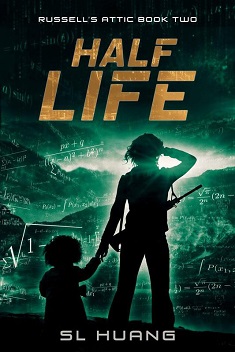
Half Life — SL Huang

Cover of THalf Life


Half Life
SL Huang
150 pages
published in 2014

SL Huang’s first novel, Zero Sum Game was a tightly plotted, fast paced technothriller, which I only got to know about because I’d been following her blog. The sequel to it I got to read because SL Huang offered a review copy, which is always appreciated. It’s actually the first time that any author has done this, so it’s a bit of new terrain for me as a reviewer. What about ethics in science fiction reviewing? No matter; I would’ve bought this anyway and getting a free book is nice, but had I not liked Half Life I would’ve said so too.

Now when we met Zero Sum Game Cas Russell was an amoral math savant making her living doing …retrieval… work for anybody who could pay. Thanks to the events of that novel she went from being bad at ordinary relationships and not worrying about it to being still bad at them but working on them. In Half Life she goes further; it can be best summed up as “Cas learns the value of friendship through the medium of extreme violence”. It all starts when she gets a somewhat particular retrieval mission, to rescue the daughter of Noah Warren, an ex-engineer laid off from Arkacite Technologies, who claims that they hold her for experiments. Cas is weirdly possessive about kids and even though she immediately notices during the rescue mission that Liliana isn’t a real girl, but an extremely advanced robot, that doesn’t stop Cas from wanting to protect her.

Read more…