- Special Prostitution Courts and the Myth of ‘Rescuing’ Sex Workers | VICE | United States – Police are violent in general, and violent specifically to women they think are sex workers. According to a 2012 study by the Young Women's Empowerment Project for young people who have sold sex, a third of all reported abuse came at the hands of the police. Sources told me officers had called women "sluts," groped them during arrests, even made jerking-off motions with their batons in court. In the Brooklyn HTIC, RedUP saw a black woman who claimed to have been beaten so savagely by police that she landed in the hospital.
- Superhero showdown: Which comic book rumble was the real Battle of the Century? | Ars Technica – What should constitute the Battle of the Century? To these comics, it's two main things. First, the two combatants must both be at the top of their game. That's more in terms of popularity and relevance than pure ability (Lil' Abner versus Superman wouldn't be fair otherwise). The second requirement is as easy—the battle itself has to somehow be epic. While doing research, we didn't limit candidates to books using the word "battle"; we also included things like "fight," "bout," and "showdown." The extravagant claim simply had to appear on the cover.
- Science every day | Day 1 | Signe Cane –
- On Rolling Stone, lessons from fact-checking, and the limits of journalism – It was as both a feminist and former fact-checker that I watched with rage on Friday as Rolling Stone distanced themselves from the account of a gang rape at UVA they published last month, covering for their own journalistic missteps by throwing Jackie, the rape survivor at the center of the piece, under the bus. And the rage is only growing as many of the journalists now rushing to condemn Rolling Stone are starting to spin a tale of how a “Believe the Victims” mentality got in the way of good journalism in this case. Feminism’s to blame, as always.
- The Digital Comic Museum – Free and Public Domain Comic Books –
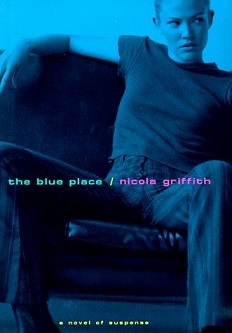
The Blue Place — Nicola Griffith
The Blue Place
Nicola Griffith
308 pages
published in 1998
I can’t remember the last time I’ve been as frustrated with the ending to a novel as I am with The Blue Place. I had seen it building up from at least halfway through the story, hoping that its seeming inevitable conclusion would be subverted at the last minute, the same way Nicola Griffith did earlier in the novel, with another plot point that seemed to descent into hardboiled cliché until it didn’t. But the ending wasn’t subverted, was hardboiled cliché, did upset me and yet fitted perfectly with what is an incredibly smart, engaging novel by a writer who has never gone for the easy route in her stories. So what’s going here? To try and find out will take some effort and certainly some spoilers.
Let’s start with Nicola Griffith herself first. Yorkshire born, she moved to Seattle to live with her wife, the writer Kelley Eskridge. Her first fiction was published in the late eighties, her first novel in 1993. So far she’s written six novels, of which I have now read half. As you may have guessed, The Blue Place is a hardboiled detective novel, her third, the first two being Ammonite and Slow River, both science fiction. she would go on to write two sequels to the The Blue Place, while her latest novel, Hild, is a historical novel about 7th century CE saint Hilda. So far all her novels have had lesbian protagonists and The Blue Place is no exception.
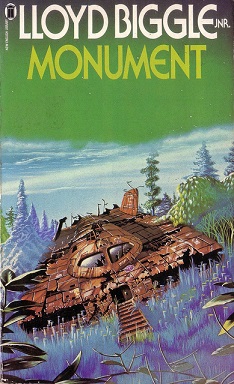
Monument — Lloyd Biggle
Monument
Lloyd Biggle
173 pages
published in 1974
It’s been a while since I’d read any of Lloyd Biggle’s novels; the last one had been The World Menders back in 2007. I’ve always liked his writing, quietly liberal and anti-colonialist in a way that few other science fiction authors of his generation were. His belief in the idea that “democracy imposed from without is the severest form of tyranny” seemed especially apt during the darkest days of War Against Terror triumphalism. He is however, not a writer much read these days, having done the bulk of his writing in the sixties and seventies. He died relatively recently, in 2002, after a long illnes, having written only some six novels since the seventies.
Science fiction is often an imperialist, colonialist genre, in which it’s taken as natural or even desirable for there to be a galactic imperium to which newly discovered worlds should be gently or firmly — depending on the author’s preference — be persuaded to join. Sometimes this is dressed up as the need to avoid interstellar wars and even in stories with a Galactic Federation rather than an empire the need for newly discovered worlds to be assimilated is rarely questioned. Not so with Lloyd Biggle; several of his books question this mentality and Monument is one of them. Taken its lead from what was happening in e.g. Polynesia at the time, it’s an sfnal attack on ill considered economic development imposed from the outside.
Books read December
Ten books read in December brings the total for 2014 up to eightyeight in total, six up from 2013. I’d hoped to have more of an end spurt, but a short illness put paid to that. 2014 has been the most unbalanced reading year since I started keeping count in 2001: seventyfour fiction books, of which fortysix science fiction and twentysix fantasy, against only fourteen non-fiction.
There are a couple of reasons for this of course. Because I went to Worldcon this year I got to read the Hugo Voters Package, meaning July and August were spent reading through that, while I also got interested in Dutch language science fiction again, reading a lot more Dutch sf than I had in a long time. Nevertheless I want to read more non-fiction this year.
Genderwise I’m still trying to fix the balance in my reading, having calculated back in 2010 that less than ten percent of the books I read had been written by women. So of the fortysix science fiction books, thirtyone were by female writers as were eighteen of the twentysix fantasy books. Since the only crime novels I read were by Nicola Griffith, the total for my fiction reading was fiftyone books by female versus twentythree books by male writers. Non-fiction on the other hand was male dominated: four women versus ten men. Something to pay attention to this year.
Though to be honest I’m less bothered by this, then I am with keeping my science fiction and fantasy more balanced and diverse; those are the genres I like the best and read the most of. What I like to do in 2015 is to keep reading more books by women, but also start reading more stories by authors from outside the UK or US. There’s a wide world of fantasy and science fiction outside these two countries and I want to know more about it.
In any case the last books I read in 2014 were the following:
The Violent Century — Lavie Tidhard
What if, only a few years before WWII, one particular quantum physics experiment creates a probability wave that gives some people superpowers?
The Dark Colony — Richard Penn
A self published, hard science fiction police procedural set on an asteroid belt colony.
De Scrypturist — Paul Evanby
A great steampunkesque Dutch fantasy story by what I suspect is one of Holland’s best sf&f writers.
The Nemesis from Terra — Leigh Brackett
Another of Brackett’s tightly plotted Mars adventures.
Meeting the Sculptur — Floris M. Kleijne
A clever little time travel story.
The Martian — Andy Weir
One of the sleeper hits of the year, this hard science fiction novel of an astronaut stranded on Mars and how he’s saved through ingenuity, can do spirit and NASA led teamwork.
Falling Free — Lois McMaster Bujold
The last novel in Bujold’s Vorkosigan saga I hadn’t read yet, set 200 years before the main series and showing how the Quaddies got their freedom in a sort of eighties update of The Moon is a Harsh Mistress.
The Story of the Stone — Barry Hughart
The second in Hughart’s series of fantasies set in mystical China and the only one I hadn’t read yet.
High Wizardry — Diane Duane
The third in the Young Wizards series: great YA fantasy adventure.
Monument — Lloyd Biggle Jr
A classic anti-colonialist science fiction story.
WALL-E: thriumph of the nice guy
So seeing WALL·E over Christmas again got me thinking. That love story between WALL·E and EVE, that’s pretty much the nice guy fallacy in a nutshell, isn’t it? WALL·E falls in love with EVE and pesters her while she’s doing her job, not taking no for an answer. He keeps hanging around and bringing her gifts she doesn’t need, isn’t honest about his feelings for her but seems to think that if only he brings the perfect gift she’ll like him. That by accident he does bring her just the thing she needs doesn’t alter anything. After this he stalks her to her home, interferes with her work again, makes her an accomplish in his jail break from the mental hospital for robots, keeps her in trouble with lawful authority and finally guilts her in loving him when she sees how he took care of her when she was incapitated. All that’s missing is the negging.
Yes, this may be tongue in cheek