Geneviève Bergeron (b. 1968), civil engineering student.
Hélène Colgan (b. 1966), mechanical engineering student.
Nathalie Croteau (b. 1966), mechanical engineering student.
Barbara Daigneault (b. 1967), mechanical engineering student.
Anne-Marie Edward (b. 1968), chemical engineering student.
Maud Haviernick (b. 1960), materials engineering student.
Maryse Laganière (b. 1964), budget clerk in the École Polytechnique’s finance department.
Maryse Leclair (b. 1966), materials engineering student.
Anne-Marie Lemay (b. 1967), mechanical engineering student.
Sonia Pelletier (b. 1961), mechanical engineering student.
Michèle Richard (b. 1968), materials engineering student.
Annie St-Arneault (b. 1966), mechanical engineering student.
Annie Turcotte (b. 1969), materials engineering student.
Barbara Klucznik-Widajewicz (b. 1958), nursing student.
25 Invisible Benefits of Gaming While Male
Books read November
Nine books read this month, which began strongly but petered out a bit as a couple of tough books slowed me down.
Schitterende Wereld — Mel Hartman
A disappointing collection of sf short stories based on an interesting concept: twelve stories based on the work of six world famous scientists.
Broken Homes — Ben Aaronovitch
Fourth in a series about a hapless London police officer being caught up in its magical underworld.
Styx — Bavo Dhooge
A bent cop in Oostende returns from the death as a zombie to bring a serial killer to justice
Ter Ziele — Esther Scherpenisse
Sometimes Death has pity for a dying person and brings them to its palace….
A History of the Vandals — Torsten Cumberland Jacobsen
A decent introduction to the history of the Vandals, one of the few such actually available in English.
Captain Vorpatril’s Alliance — Lois McMaster Bujold
The latest so far in the Vorkosigan saga, now starring Miles cousin, that idiot Ivan.
Furies: War in Europe 1450-1700 — Lauro Martines
A distressing look at warfare in Early Modern Europe.
Who Fears Death — Nnedi Okorafor
Okorafor’s first adult novel, a harrowing coming of age tale & quest story.
Het Laatste Verhaal — Guido Eekhaut
In the near future republic of Flanders, two street outcasts team up with a Japanese woman from an alternate world who has a sword that can cut through time and space…
The Dark Colony — Richard Penn
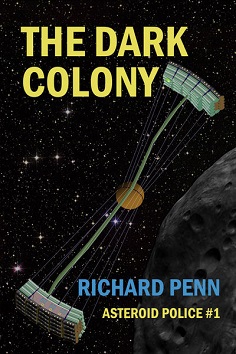
The Dark Colony
Richard Penn
327 pages
published in 2014
James Nicoll is a longtime science fan active on Usenet and Livejournal, who has been working as an internal reviewer for various publishers. As that work started to dry up earlier this year, he started doing sponsored reviews, where people (but not authors) can buy reviews of books they’re interested in, suspect James would like, or at least would have an enjoyable reaction to. I’ve known James for a long time and he’s one of the people I absolutely trust their taste in books of, so I pay attention when he says something he’s worth reading. Which is exactly what he did with Richard Penn’s The Dark Colony and since it was cheap on *m*z*n, I bought it.
Now there was a risk with this. At times James’ fondness for exactly the kind of setting The Dark Colony provides — near future, the real Solar System, no magical rocket propulsion to let people pootle around it in hours or even days, no cheating — can blind him to some of the other qualities (or lack thereof) of a book. Fortunately however, in this case, the book’s appeal exists beyond its setting. Basically, this is a police procedural: it starts with the discovery of a body floating around in the the giant free fall hangar of Terpsichore Station. What’s remarkable is that it’s the body of a stranger to the Terpsichore colony, which only has a few hundred people living in the station and the asteroid itself. It’s up to constable Lisa Johansen to find out where the stranger comes from and in the process she finds herself unravelling a huge conspiracy in the heart of her community and beyond. Yes, this is not just a police procedural, it’s a gloomy Scandinavian one…
The real shock is having Fanta publish it
Greg Hunter reviews Fukitor for The Comics Journal:
Intentionality becomes a consideration while reading comics like this. Here are two ways to consider “Operation Cockblock!”: 1) Karns uses satire as a pretext to include content that’s upsetting by design; 2) Karns’s ambitions as a satirist outstretch his gift for satire to such a degree that the story is a near-total failure. Not all art has a social intent, and not all art is best viewed in these terms, but we can certainly judge ostensible social comment by its follow-through. Fukitor manages little with respect to race except the visual parroting of hateful tropes.
It’s possible Karns doesn’t consider the reactions of readers while drafting his work. Not likely, but possible. If he does consider reactions, we can posit that shock is not merely expected but desired. So criticizing Fukitor because of its harsh content feels uncomfortably like playing a game that Karns has arranged. But Fukitor can also be critiqued on the grounds of its eventual boringness. By the end, viscera fall with plodding monotony.
As I’ve said before, there’s nothing shocking about Fukitor, satirical or otherwise. It just draws on the same wellsprings of racism, sexism and bullying as everything it’s “inspired” by. It’s the alternative comix version of Identity Crisis, a deeply cynical attempt to exploit aging fanboys’ confusion of maturity and adult material with asshole behaviour. Are we sure, in fact, that Jason Karns isn’t a Mark Millar pseudonym, because the trolling style is the same.
And if Fukitor is just a giant troll attempt, it’s overshadowed by that of its new publisher. The first book in Fantagraphics new F. U. imprint (and I see what you did there), it’s a clear statement of intent, and a giant troll to pretend that this book, out of all the interesting work being done, is good enough to launch this new imprint. One of the great things about Fantagraphics is that it has always been in the forefront in the fight for artistic freedom in comix, but it does lead them sometimes into tedious épater le bourgeois territory, like it seems to have done here. You can, if you squint, draw a line from certain of Crumb’s racist fantasies and Bagge’s more outrageous libertarian strips to what Karns does here, but it doesn’t make it more interesting, here in 2014, to again see yet more racist, sexist power fantasies get preferable treatment just because it offers the illusion of transgression, when in actuality it does nothing but riff on the same tired old stereotypes already all over mainstream media offerings.