Put Butler on the World Fantasy Award!

Daniel José Older continues his campaign to replace Lovecraft with Butler for the World Fantasy Award:

“Why Butler?” people asked me when the petition went up, and I remembered how entrenched we all get in our own corners within the genre. Butler’s prose soars where Lovecraft’s stumbles. Her characters live and breathe, confront complexities of power and privilege amid fantastical, terrifying dreamscapes steeped in history and nuance. My SFF community is mostly black and brown, and Butler inspired many of us to start writing in the first place. These folks congregate more often than not in online communities like the Nerds of Color, Black Girl Nerds and the Fan Bros, because outside of ComicCon, SFF cons have historically not been safe spaces for women and people of color. These are the online communities that signed the petition in the thousands, which is what transformed it from being just another attempt at dethroning Lovecraft as the face of one of fantasy’s highest awards (there have been several) to a global conversation with coverage in Salon, the Guardian, NPR and countless blogs.

I still think Older is wrong to diss Lovecraft’s writing talent. It distracts from the real argument and puts hackles up that don’t need to. But what I am coming round to is the idea of replacing Lovecraft with Butler, even if her work isn’t quite the first thing you think of as fantasy. It doesn’t matter that she isn’t the perfect fit for the World Fantasy Award; it’s the symbolism of replacing of replacing a dead white racist man with a dead black woman. It’s not enough just to make the WFA over into a neutral award like the Nebulas because that would still leave most of the major sf awards named after dead white men and even dead white racist men, as is the case with the two Campbell awards. Putting Butler forward as the face of one of the major fantastika awards would send a signal that science fiction and fantasy have changed, are trying to shed their racist history.
#MetalGate: you’re joking, right?

I saw some brief references to #MetalGate on Twitter before the weekend and assumed it was GamersGate loons trying to stir shit. I was right:

Similar to how “#Gamergate” was coined by Adam Baldwin while linking to videos about Zoe Quinn’s sex life, then famously retconned to actually be about ethics in journalism, the origins of #Metalgate seem to be unimportant. #Gamergate has established a template. Throw a hash in front of a word and a “-gate” behind it, and you send out a veritable Bat-Signal to thousands of angry people on the internet: “Social Justice Warriors are doing… something. We may not be clear on what they’re actually saying or doing, but they must be stopped.”

Proof once more, if any was needed, that GamersGate is just another rightwing kulturclash project, just another attempt by “South Park Republicans” and professional culture warriors to seem even vaguely relevant and use the fears and prejudices of unthinking white men to get some sort of rightwing cultural backlash going, gain some foothold in youth culture. Yes, it’s all sound and fury and rape threats that accomplishes nothing except the harassment of more women but hey, it beats working for a living.

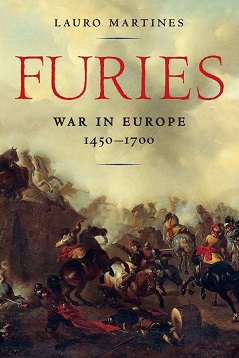
Furies — Lauro Martines

Cover of Furies


Furies: War in Europe 1450 – 1700
Lauro Martines
320 pages, including index
published in 2013

A lot of history books about war and warfare, even when they look at the impact war had on wider society, on the civilians and soldiers caught up in it, are remarkably clinical and dry about the violence it brings with it. Not so Furies: War in Europe 1450 – 1700. Before it’s good and well started, you get the first grizly massacre to process, no horrid detail spared, all the better to prepare you for the rest of the book. This is not an easy read, not your average military history wankfest, this is a book with a message and that message is that war in Early Modern/Renaissance Europe was hell, a total war where nobody cared if you lived or died.

That period from roughly 1450 to 1700 was one in which a military revolution took place, with Europe emerging from feudalism and war as a noble pursuit for knights and aristocrats giving way to mass warfare by any means necessary. It was a revolution brought about through the introduction of gundpower weapons making possible new ways of making war, as well as the growing strength of the emerging European nation-states. Add to that increasing religious schism and you have a recipe for warfare on an apocalyptic scale and Martines is not afraid to show what that meant on the ground, for the people caught up in the war.

Read more…

Your Happening World (November 26th through December 8th)