Free speech isn’t consequence free

Bill Purcell is a volunteer at Comic Con International, apparantly on the committee for San Diego Comic Con, which as you know Bob, is the largest comic con in the English language area and possibly the world. He’s also a racist asshole who’s been aggressively tweeting about the Ferguson verdict ever since the grand jury reached its decision not to prosecute yesterday. It’s the standard entitle white man obnoxiousness coming out in public, a reflex action he can’t help, with of course the usual threats against people taking offence at him. Bigot gotta bigot.

Disappointing but not unexpected is some of the response he’s had. Rich Johnson is jealous:

We don’t have the same freedom of speech laws like the US does, and I wish we did. Part of defending free speech tends to be defending the speech of people you find abhorrent – otherwise what value does it have? I’m reminded of the ridiculous attempt from Lawrence O’Donnell to censor the free speech of Comic-Con organiser Jackie Estrada‘s husband, Batton Lash.

While Mark Waid and Tom Spurgeon argue people shouldn’t call for Purcell to be fired:

The whole thing sounds dumb, right? It is! But this is also an interesting thing. I agree with Mark Waid when he suggests here that calling for Purcell’s position or volunteer job or whatever based on expressions of stomach-turning dumbassery isn’t something that communities should do as a general rule. One hundred percent. But there’s a growing element in comics culture that feels differently, and I think most institutions have to account for that in some way. I also think there’s a line to be drawn between staking out a position, no matter how loathsome or stupid, and engaging with your customer base in a way that’s carries even a hint of threat, or is simply so unpleasant and bothersome so as to disrupt and distract someone from the business of their day.

Now I do understand where they’re coming from; the US comics field has had a great many traumatic experiences with censorship, from the original Comics Code Authority to the Friendly Franks prosecutions in the eighties and the first reflex is always to defend the right to free speech, no matter the content. But free speech isn’t consequence free speech and it’s not censorship to point out that somebody like Purcell isn’t helping the San Diego Comic Con more friendly toward people of colour.

And lord knows comics don’t need more problems with white male entitlement and hostility towards people of colour; it’s history in this regard is just as troubling as its censorship troubles have been, but self imposed. To have somebody who has been quite open in his ties to San Diego be able to spout more of this hatred without consequences just reinforces the idea that people of colour are unwelcome in comix. It makes the convention that less safe to visit, knowing such an outspoken bigot is involved, somebody who has actually been threatening people with violence as well. And those are not idle threats in a country where lynching as a white people’s passtime is still within living memory, while on average two black people are killed by cops each week.

There’s a choice here that we have to make. Either we make it clear by deeds as well as words that hatred and threats like Purcell’s have no place in comix, or we sacrifice the safety of people of colour, of women, on the altar of free speech, which always seems to favour the incrowd, the already connected, the white. Because of what he said and the way he said it, Purcell should be removed from any involvement with the Comic Con unless the con thinks the rights of a bigot to have his free speech be consequence free outweights the rights of people of colour to be safe at their convention.

Romance ALL the things!

Richard Cobett talks about Bioware’s continuing evolution of sex ‘n romance in their games:

With each game though, Bioware has gone out of its way to Do Better, and not always by heading down the obvious path. Dragon Age 2 for instance infamously made all of its romanceable characters (the entire party save for Varric and Aveline) bisexual so that any player would be able to get with anyone they wanted. Dragon Age Inquisition and Mass Effect 3 reverses that approach, deciding that sexuality is an important part of the characters and that it can be as jarring for everyone you meet to be an option as to be politely refused. Some characters are still bisexual. Most now have their preferences, with Dragon Age expanding on gender to factor in species as well. Qunari especially seem limited in who they can give the horn.

From a Watsonian, in-game point of view I can understand this, but from a Doylian, gamer point of view I’d rather the gaming world did reshape itself around my romance preferences. One of the greatest disappointments coming to the Mass Effect series years after everybody else and hearing so much about the incredible romance options –some of which may have been sarcasm, in hindsight– was finding out that actually, my options as Femshep were either Kaidan, the Dullness that Walks Like A Man, or Liara, with no options to woo Garrus, let alone Ashley. From a game playing point of view, for games like this, I’d like the option to romance everybody, even if this doesn’t make that much sense from within the game world. I don’t want the game to decide for me who is and isn’t romanceable, just like I don’t want the game to do decide what I look like.

Ashley and Femshep on Horizon. By FraeuleinWunderlich

That’s the whole point of open world RPGs like the Dragon Ages, Mass Effects and Elder Scrolls after all, that freedom to create your own character within the larger storyline. Freedom of romance fits in with that.

And no, the idea that everybody you romance has to be bisexual if you can romance them in both your female and male persona is wrong, though an understandable error. It’s just that in one leg of the trousers of time Ashley happened to be gay, in another straight…

Blind book dates at ABC

window dressing for the ABC blind book date

So yesterday I went to the Blind Book Date at the American Book Center. This was an idea that their sf book buyer Tiemen Zwaan had come up with, an extension of his own experiments in selling books wrapped in brown paper with only crypic clues to reveal their identity. Now it was our turn to both baffle our fellow readers and crack their own codes. It made me realise one thing: I’m woefully under read.

I’d expected only sf or fantasy books would be represented, but in fact there was a wide spread of books, both fiction and non-fiction being offered by the 17-18 or so participants. Some of the clues were obvious, some obvious with hindsight, some had me racking my brains trying to remember what book this had to be, while some were brilliant but impossible to guess, like the book shown above. The woman who brought the book on the left had actually hidden her clues in the wrapping paper itself. Clever but perhaps too clever and it was only because somebody else brought the same book with more conventional clues, that people were able to guess which book it was…

As for my book, the clues I brought were:

  • Secret History
  • Kim Philby
  • Cold War Magic
  • Mount Ararat

Can you tell what book it is?

Incidently, the smartypants at Making Light have been hosting their own blind book date party, not just writing cryptic clues, but writing them in the style of a different author, which is far too clever by half.

Better than Spider Robinson’s fanfic any day

The person who wrote this little The Rolling Stones vignette really has Heinlein’s writing patterns down pat:

“Chief Engineer Grandma?” Meade said sweetly, ducking her head into the room. “Would you please tell Buster to stay out of my garden? He may think he’s clever, but he’s killing my broccoli. I’d tell him myself, but he obviously doesn’t listen to me.”

Hazel looked across the chessboard at Lowell. “Best do as she says, Junior,” she commented.

“But she’s wrong about the salinity gradients-” he protested.

“Grandmother dearest,” Meade said, her hands on her hips. “Why does everyone aboard this ship assume I am incapable of doing math?”

“Beats me,” Hazel said. “I tutored you myself; you can handle a differential with the best of ‘em.”

Really. The voices, the way the characters speak, that mixture of banter and infodumping, it’s all prime Heinlein and Kalirush has done a great job capturing it. I wish they’d do more Heinlein stories.

Broken Homes — Ben Aaronovitch

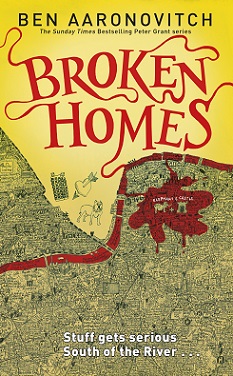
Cover of Broken Homes


Broken Homes
Ben Aaronovitch
357 pages
published in 2013

Peter Grant was a normal copper until he noticed he could talk to dead people in Rivers of London/Midnight Riot. Now he’s part of the Folly, the Metropolitian Police’s special unit for magic, which apart from him consists of one elderly but backwards aging survivor of the glory days of British wizardry before the war, as well as his colleague Lesley May, Toby the dog and Molly, the folly’s housekeeper of indefinitive species, currently experimenting with cooking from one of Jamie Oliver’s recipe books, to mixed results.

Broken Homes is the fourth novel in the Rivers of London series. There has been a mini boom in London based fantasy these past few years and Aaronovitch isn’t the only one either who has his protagonist working for the Met. There’s a sort of inevitability about the idea. London with its long history and dominant presence in the psyche of not just Britain, but arguably the world, just fits as a nexus of magic in a way that say Amsterdam wouldn’t. Of course the Met would have its own magical police force, some hangover from Victorian times, staffed with aging public schoolboys, into which the thoroughly modern London figure of police constable Peter Grant fits awkwardly. That tension between the gentlemanly tradition of magic and modern policing is part of the charm of the series.

Read more…