The real shock is having Fanta publish it

Greg Hunter reviews Fukitor for The Comics Journal:

Intentionality becomes a consideration while reading comics like this. Here are two ways to consider “Operation Cockblock!”: 1) Karns uses satire as a pretext to include content that’s upsetting by design; 2) Karns’s ambitions as a satirist outstretch his gift for satire to such a degree that the story is a near-total failure. Not all art has a social intent, and not all art is best viewed in these terms, but we can certainly judge ostensible social comment by its follow-through. Fukitor manages little with respect to race except the visual parroting of hateful tropes.

It’s possible Karns doesn’t consider the reactions of readers while drafting his work. Not likely, but possible. If he does consider reactions, we can posit that shock is not merely expected but desired. So criticizing Fukitor because of its harsh content feels uncomfortably like playing a game that Karns has arranged. But Fukitor can also be critiqued on the grounds of its eventual boringness. By the end, viscera fall with plodding monotony.

As I’ve said before, there’s nothing shocking about Fukitor, satirical or otherwise. It just draws on the same wellsprings of racism, sexism and bullying as everything it’s “inspired” by. It’s the alternative comix version of Identity Crisis, a deeply cynical attempt to exploit aging fanboys’ confusion of maturity and adult material with asshole behaviour. Are we sure, in fact, that Jason Karns isn’t a Mark Millar pseudonym, because the trolling style is the same.

And if Fukitor is just a giant troll attempt, it’s overshadowed by that of its new publisher. The first book in Fantagraphics new F. U. imprint (and I see what you did there), it’s a clear statement of intent, and a giant troll to pretend that this book, out of all the interesting work being done, is good enough to launch this new imprint. One of the great things about Fantagraphics is that it has always been in the forefront in the fight for artistic freedom in comix, but it does lead them sometimes into tedious épater le bourgeois territory, like it seems to have done here. You can, if you squint, draw a line from certain of Crumb’s racist fantasies and Bagge’s more outrageous libertarian strips to what Karns does here, but it doesn’t make it more interesting, here in 2014, to again see yet more racist, sexist power fantasies get preferable treatment just because it offers the illusion of transgression, when in actuality it does nothing but riff on the same tired old stereotypes already all over mainstream media offerings.
Retreat, postpone, avoid

Matt Zoller Seitz’s 2010 essay about the death of his wife and remembering her afterwards hit home on so many levels:

Sondheim. Kander and Ebb. “Feed the Kitty.” “Deadwood.” In the last few years, to greater or lesser degrees, these things and others have been off-limits.

A song, a poem, a scene from a film triggers memories. You’re startled, moved, shaken. And you’re faced with two options: 1) engage with the work and the memories it calls up, or 2) retreat, postpone, avoid.

Option 2 is very attractive. You’re buying Tums and hand soap at the drugstore and a song comes on, a song you associate with somebody you loved — a shared reference point, an in-joke, an anthem, a confession — and suddenly you’re a mess, a wreck, useless, so you leave the store without buying anything. You’re watching a movie in a multiplex or in somebody’s living room and here comes a character that reminds you of somebody you miss — a parent, a sibling, a lover, a friend — and you excuse yourself for a while and go into another room or take a walk around the block, and when you’ve regained control, you go back. (“Hey, where were you?” “Nowhere. Just taking a break.”)

Retreat, postpone, avoid.

Omnitopia Dawn is a novel I won’t reread anytime soon, because it was the novel I’d finished and reviewed the night Sandra died. I’d left her in the hospital on that Sunday night, three years ago, in the full confidence I’d see her again on Monday, had watched some telly and written an indifferent review, then gone to bed to be woken up at 2 AM with the news she’d passed away. Just rereading that review, paging back through the blog to it, is enough to trigger that response Seitz’s talking about.

I dreamt of Sandra again last Friday night, one of those dreams that started out as something else entirely and then I dreamt I was walking through the market near the flat we first lived together and I heard my name called and turned around and there she was. I’d been worrying sometimes about forgetting what she looked like but my subconscious rememembered. The shock of it woke me up. As such it was a gentler dream than the ones I’ve sometimes had where I was aware she was dead, but it had all been a huge mistake and she was still in hospital, alone…

October and November are always bad months for me now, because this is when the reality of Sandra’s death, her absence, is the strongest. Most of the rest of the year it’s easier to avoid it, live with it, remember the good times rather than the end, but as November 7th comes around, it becomes unavoidable. It’s what I need to become used to, but never quite can and hope I never quite will, strange as it sounds.

Kitty jailbait

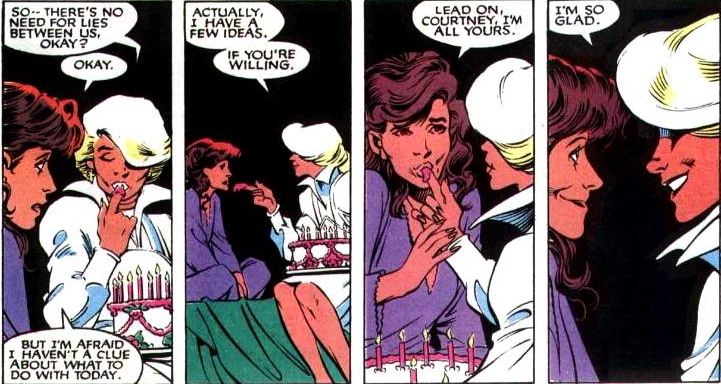
Kitty and Courtney enjoying some birthday cake

This post by Sigrid Ellis, about Chris Claremont, the X-Men, Kitty Pryde, hiding in hindsight pretty blatant lesbian flirting from the Comics Code Authority and telling Rogue you think you might be gay is adorable in its dorkiness:

I re-read this scene over and over again. I knew, now, in 1992, what this looked like. This looked like Spin-the-Bottle or Truth-or-Dare, it looked like the drunk and stoned random kissing games people played in the dorms on a weekend night. It looked like a challenge thrown down and accepted. I stared at the art. Courtney or Sat-Yr-9 or whoever was seducing Kitty Pryde. And Kitty was saying yes.

[…]

Davis knew something about Claremont’s intentions that I did not know, and drew what he thought a lesbian relationship, with willing participation from both parties, would look like. Kudos to him, it looked rather a lot like the same-sex flirting I saw monthly at the GLBUnion dances – licking of the fingers, et cetera. What I did not know is that Claremont included this sort of girl-on-girl sensuality in all of his comics, hiding it from the CCA as heterosexual female friendship. It wasn’t until 1992 and Davis’s fairly blatant art that I got the hint; actual straight women maybe don’t feel this way about their friends. It was entirely possible, I realized slowly, that finger sucking and licking was not a strictly heterosexual activity among friends.

I can blame Claremont – and I do – for my not coming out earlier than I did. But I also have to credit him for slipping queers into my comics when the CCA forbade it. When I did finally come out to myself, the X-Men didn’t judge me. They accepted this new form of oddball difference the same way they’d always accepted me; with open hands and an invitation to be a hero once more.

The flirting and licking of fingers all happened in Excalibur #24, which was in hindsight quite blatant about it, but which went completely over my head when I first read it back in 1992 or so as an out of context back issue. I just thought it was a fun wish fullfillment story, but with the subtext, well, text visible behind it, i’ts slightly creepy as well?

Not for the not so hidden lesbianism of course, but because you have an adult woman seducing a fifteen year old girl. As the very first page points out this is Kity’s fifteenth birthday, so Courtney Ross, clearly an older woman, getting all flirty with her is a bit dodgy. Though not as dodgy as Kitty’s previous relationship with Collossus, when she was thirteen and had just joined the X-Men and he was at least eighteen. The inappropriateness of that relationship was never brought up in the books as far as I know, certainly not when I was still reading them. The only time people were upset with Pyotr was when he broke off the relationship.

Of course, reading The X-Men as a teenager all this passed you by. Kitty may have nominally been thirteen or fifteen but since she was thirteen for years it was easy to lose sight of it, especially as she was usually drawn slightly more mature than that, though she never suffered from/enjoyed the most common super power as much as her team mates…

Your Happening World (November 21st through November 25th)