Books read October

October was a fruitful month for me, with twelve books read in total.

The Zero Stone — Andre Norton
A great, fast paced space opera adventure story made somewhat weird by the conspicuous lack of female characters.

Ordeal in Otherwhere — Andre Norton
This instead had an actual female protagonist and was a good coming of age/first contact story.

Exiles of the Stars — Andre Norton
Sequel to a novel I haven’t read, but readable enough on its own.

Between Giants — Prit Buttar
The story of the Baltic states (Estonia, Lithuania and Latvia) in World War II caught between Nazi Germany and the Soviet Union. Not a happy story.

Storm over Warlock — Andre Norton
What turned out to be the novel I should’ve read before Ordeal in Otherwhere. When the Throg attack the survey camp on Warlock, the sole survivor, Shann Lantee, has to keep himself alive as well as find some way to take revenge…

Judgement on Janus — Andre Norton
A young man sells himself as indentured labourer on a forest world, then catches a mysterious illness that transforms him into one of the planet’s long died out natives. From there his troubles begin…

Victory on Janus — Andre Norton
Andre Norton goes Lovecraftian in the sequel

Ancillary Sword — Ann Leckie
Highly anticipated sequel to Ancillary Justice which didn’t disappoint.

The Stone Boatmen — Sarah Tolmie
I think I found my number one pick for the Hugo Awards.

The Lost Steersman — Rosemary Kirstein
The third volume in the Steerswoman is as brilliant if not better than the first two novels.

Orlando — Virginia Woolf
Orlando starts out a young noble man at the time of Elizabeth I, becomes a young noble woman while an ambassador from Charless II in Constantinople and merrily lives through the 18th, 19th and early 20th centuries as such.

A Night in the Lonesome October — Roger Zelazny
There’s an ancient tradition in sf fandom (where ancient tradition equals something done twice) to read A Night in the Lonesome October in October, one day at a time. So I did. Perhaps Zelazny’s last great novel.
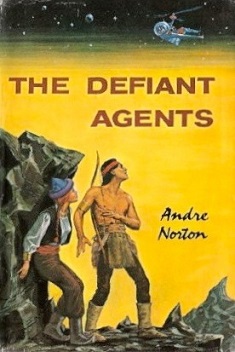
The Defiant Agents — Andre Norton

Cover of The Defiant Agents


The Defiant Agents
Andre Norton
222 pages
published in 1962

The danger with relying on Project Gutenberg for your reading is that you end up missing things, like in this case, where the first novel in a series, The Time Traders was available, but the sequel wasn’t and I only noticed once I had started to read this, the third in the series. Luckily the first chapter is all setup and infodumping, explaining how in Galactic Derelict time travel led to the discovery of a fully functioning alien spaceship, from the same aliens as see in the first novel and that in turn led to a warehouse full of navigation tapes. Those tapes were divided by lot ver various countries, including Soviet Russia and of course with the Cold War raging between the West and the USSR, spying is rife. As The Defiant Agents opens, one Soviet plant has manages to get his hands on the navigation tape for one of the most promising planets the west has in its possession, which means a crash expedition has to be launched to colonise it before the Russians do.

That crash expedition becomes literal when it turns out the Soviets are already there and have hunter/killer satellites in orbit, shooting down the expedition’s spaceship. Thanks to a bit of luck and a bit of skill the ship, though damaged, still manages to crash land on Topaz in such a way that their enemies think they’re dead. With the crew dead, the colonists, now less than forty, all volunteers from an Apache tribe, have to build a new home on a world with not just hostile nature to contend with, but also hostile humans as the Soviets who have poached the planet are still there. And it’s up to Travis Fox, once Time Travel Agent, to guide his people.

Read more…

For Hugh, but you weren’t listening

Robert Wyatt talks to the Grauniad about the Soundtrack of his Life:

When I’m not watching Russia Today, obviously, I’m watching pop TV. Even my son’s embarrassed by the infantilism of my tastes, but there’s some good stuff out there now. Pharrell Williams’s Happy– that’s absolutely fucking knockout. Williams is as good as any 60s soul singer and the song is brilliantly put together. It’s a great drum track, and there are only four chords or so, but they’re just enough. It’s really subtly done, absolutely spot-on. My granddaughter tells me I should totally disapprove of that other song he did, though. With someone else… something lines? Blurred Lines! That’s the one. Take it from me that I don’t like that one at all.

Cult prog rock hero, Robert Wyatt was of course one of the founders of Soft Machine as well as part of ur-Canterbury group the Wylde Flowers before that. He has the sort of sense of humour that left him to call his own group after leaving the Softs Matching Moles, as a pun or play of words by way of the French Machine Molle. Not to mention calling his first solo album after having become paralysed from the waist down after a nasty fal out of a window dead drunk, “Rock Bottom”. That sort of humour explains why his one and only brush with hitdom was with a Monkees’ cover:


Wyatt is no rockist snob:

There was a bit of mischief there, too. I didn’t like the fact that hierarchies had developed between what people thought was “serious” rock music and pop music– that was all rubbish. I was very uncomfortable with that. That was exactly the kind of situation I thought our generation had got rid of. I’ve always admired pop music, because I think it’s the modern post-industrial folk music. Everybody can join in, you don’t have to be a specialist. You can sing along with it. But there’s not much room in pop music for all the things I want to do. It’s a bit like food: I like all kinds of interesting food, but in the end, I can just sit down with an egg sandwich and really feel great.

Wyatt actually reminds me a lot of Alan Moore, carving out a similar uncompromising career in writing and with some of the same concerns and interests in magic and parascience, as well as magnificent bushy beards. In Wyatt’s case, there’s pataphysics:

Wyatt was introduced to ‘pataphysics in 1967, when Soft Machine—already established, alongside Pink Floyd, as darlings of the London underground scene, and about to tour the States with the Jimi Hendrix Experience—performed a live soundtrack to Ubu Enchaîné at the Edinburgh Festival. By the time of their second album, Wyatt was introducing the band as “the official orchestra of the College of ‘Pataphysics,” going on to prove these credentials by singing the letters of the alphabet in reverse.

Though sometimes the idea of Wyatt’s music appeals more to me that actually listening to it, at his best he’s brilliant, both solo and with groups like Matching Mole:


Your Happening World (October 24th through October 29th)

  • The Scientific 7-Minute Workout – NYTimes.com –
  • Various – Beat The Bands Of Modern Dance (Vinyl, LP) at Discogs –
  • 72 Hours of #Gamergate — The Message — Medium –
  • Confessions of a white Oxbridge male – FT.com – Like the communist rulers in 1989, we white Oxbridge males cannot defend our dominance with arguments. Most of us know we didn’t get here through individual brilliance. Perry is wrong when he says, “Default Man will never admit to, or be fully aware of, the tribal advantages of his identity.” I’m very aware of those advantages. That’s why, although I currently have a decent job at a good newspaper, I feel very little sense of achievement. My dad went to Cambridge. I was born to be a minor establishment functionary. That’s also why I’m not desperate for my children to join the establishment. What would it prove?
  • Head Nurse: Conclusions.** – Conclusion the first: The first reaction on the part of everydamnbody has been to blame the nurses. From the first inkling that Mr. Duncan's diagnosis was missed to the news that a second nurse was infected, the director of the CDC and the administration of Presbyterian Dallas have pointed to the RNs as the weak links in a chain.