It’s not gonna hurt me when you cry


I’m still here, but yet I’m gone
I don’t play guitar or sing my songs
They never defined who I am
The man that loves you ’til the end
You’re the last person I will love
You’re the last face I will recall
And best of all, I’m not gonna to miss you.

“I’m Not Gonna Miss You” is Glen Campbell latest and last ever song. Diagnosed with Alzheimer’s disease back in 2011, he embarked on his farewell tour which finished 2012. Now checked into a long term Alzheimer’s care facility, “I’m Not Gonna Miss You” is his farewell song to his wife in the knowledge that the disease is taking away his memories of her.

Not a video you can finish with dry eyes.

Your Happening World (October 8th through October 13th)

  • Guest Blog: Imagining Future Africa: Sci Fi, Innovation & Technology. | CONNECT/ZA –
  • The Daily Targum :: Neither man nor woman: life as a non-binary student – On the bottom of my column, I use the pronoun “they.” This isn’t a typo, despite what many writers at The Guardian and Telegraph assumed as they reported on my Trigger Warning activism. Indeed, I do not identify as a man, the gender I was assigned at birth. I identify as a non-binary student.
  • From the Heart of Europe – Refugees of Casablanca –
  • The First Female Gamers – Could it really have been so unthinkable to Gygax that a woman would purchase Dungeons & Dragons? His game went on to wild, unprecedented popularity, and women constituted no small part of its long-term audience. To appreciate the situation in 1974, we must understand the market Dungeons & Dragons entered, and the curious consumer group it targeted: gamers.
  • Retired NSA Technical Director Explains Snowden Docs – Well, they participate in the parallel reconstruction. So, in other words, when you can't use the data, you have to go out and do a parallel construction, means you use what you would normally consider to be investigative techniques, go find the data. You have a little hint, though. NSA is telling you where the data is, it makes you look really good. If you have it quickly. So then you can justify, taking it into court and use that in court. And so I call that perjury. In fact, I call this a 'Planned Program Perjury Policy' run by the Department of Justice of the United States. And, it's not just affecting our democracy, it's subverting our entire court system. It's not only subverting ours, it's subverting everybody's in the world that has a relationship with the FBI or the DEA. So this is infecting entire democracies, all of the world.

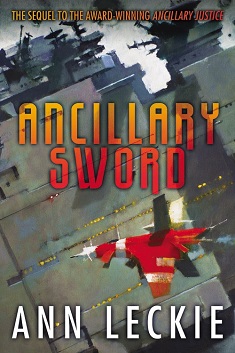
Ancillary Sword — Ann Leckie

Cover of Ancillary Sword


Ancillary Sword
Ann Leckie
356 pages
published in 2014

Ann Leckie’s debut novel, Ancillary Justice, won about every major science fiction award going: the BSFA, the Clarke, The Nebula and the Hugo, the first time any author won the four most important awards in the field with the same book, let alone with their debut novel. Anticipation has therefore been high for the sequel, not least on my part. Would Leckie been able to keep up the high standard of her debut? Would Ancillary Sword build up on it or be more of the same? Is Ann Leckie really the major new sf talent she seems to be or just a flash in the pan?

The main reason for Ancillary Justice‘s impact was Leckie’s use of gender. The Radchaai culture she created uses female pronouns exclusively, making no distinction between male and female in their language. but it goes further than just mere language. Leckie’s protagonist, Breq, struggles with establishing gender, has to consciously evaluate gender clues even when she does speak a gendered language. Possibly this is because she’s an ancillary — one of the meat puppet extensions of a ship AI — because from what we saw in the first novel other Radchaai had no such difficulties. Breq is also the last surviving part of her ship AI because her ship, The Justice of Toren was killed by the immortal ruler of the Radch, Anaander Mianaai, at war with herself.

Read more…

comics need more fan run conventions

Allow me to hijack the ongoing controversy in the online comix communities about the evils of cosplayers and how they don’t spent enough at comic conventions to make a tangentially related point:

I think Denise Dorman’s railing against the ‘instagram’ generation is hilarious but actually has a point–she’s just not using the best terminology to describe what is an actual phenomenon–before 5 years ago, no one (in their right mind) would go to a show thinking that they were an ‘attraction’ without buying themselves an exhibition space, a booth, an artist alley table, something. However, in the last few years the number of people who think that a badge (whether paid for or comped) entitles them to an audience within a convention space is on the rise dramatically. It’s been pegged as cosplayers, and honestly there are more cosplayers at shows than ever, and more professional cosplayers who are going to shows to make money and build an audience. Cosplayers attending shows as businesspeople, who aren’t contributing to the economy of the show.

As you know Bob, comics cons started as spinoffs of existing sf fandom, by people who were steeped in the mores and history of fandom and the original comics cons were very much like the sf cons, by fans for fans, with little to no distinction between fans and pros and without looking to make a profit. Where comics fandom went wrong was that conventions went commercial in the first place, which started at the very latest in the mid eighties. As the comics industry itself collapsed but cons like San Diego grew year on year, that commercialisation just grew more blatant. It’s the same thing you see with niche cable channels: they may start out with all kind of lofty aspirations and call themselves The Learning Channel, but if the money’s in crappy reality shows, that’s what they’ll end up doing. There’s no money in selling comics, so you get expensive nerd toys instead.

Cosplay meanwhile, for all its “professional” cosplayers, is still pretty much done for the love of the characters and the art itself. At worst it’s a symptom, not a cause of the difficulties comics have in being visible at comics cons. Chris Butcher is right when he says that:

The changing convention landscape is inherently shitty for people who make comic books. Art comix, indy comics, mainstream comics, whatever comics, the changing makeup of conventions is hostile to people who want to make and sell comics at comic conventions. And let me be clear, this is comic books and graphic novels, as opposed to ‘prints’ or crafts or whatever manner of tchotchkes makeup most exhibitor tables these days. Basically, comic book conventions are aggressively attracting an audience who don’t necessarily value books, or comic books.

What seems to be missing in the (American) comics convention landscape is what you still have in science fiction: a thriving fan run, non-commercial con scene. There’s Dragoncon, but there’s also Worldcon. And whereas science fiction writers may drown in the media orientated atmosphere of the former, they can thrive in the latter. The fan conventions help build and retain an audience that might otherwise not exist.

But perhaps the dismal state of mainstream comics cons is due to the dismal state of the (supposedly mainstream) superhero comic. Superheroes are more popular than ever, but the actual comics seem to be bought only by an aging and shrinking fanbase. New fans meanwhile are drawn in by movies, tv shows and cartoons, anything but comics and hence are at best interested in comics as a tertiary activity. In such a climate it’s no wonder people like Dorman find themselves struggling. They’re cut off from their audience and the new people don’t know who they are nor why they should spent $50 or more on a sketch. That’s not going to change by banning cosplayers. That can only change if you get more comics cons not run for profit, not aiming to maximalise its audience at the expense of a focus on comics, have more people, pro and fan both, go there for the love of comics, not as a business.
Judgement on Janus — Andre Norton

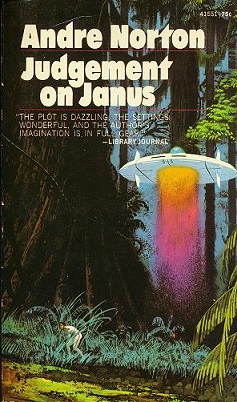
Cover of Judgement on Janus


Judgement on Janus
Andre Norton
188 pages
published in 1963

It’s a miracle: I actually managed to start an Andre Norton series in the right order: Judgement on Janus is the first of a duology, together with Victory on Janus. Another minor miracle is the fact that my copy lasted long enough for me to read it as the cover was flaking off something fierce. Normally Ace paperbacks hold up better. This is actually one of the first Norton novels I’d bought, years ago, but had never read so far.

Naill Renfro is a young man who, caught up in the slums of the Dipple, sells himself as indentured labour (just like Charis Nordholm) in order to have enough money to give his mother a dignified death. He ends up on the planet Janus, where dour religious fanatics fight a never ending battle against the primeval forests covering the planet. These forests they consider a source of evil, as they do many things, especially the alien relics or treasures occassionally found. These are supposed to be reported and destroyed immediately. Those who don’t report it and try to keep them for themselves are punished by god with the green sick and left in the forest to die. Three guesses what happens to Naill.

Read more…