- Where Should We Bury the Dead Racist Literary Giants? – The Awl – At the same time, focusing on race in Lovecraft can also lead to a greater appreciation of his work, and a better understanding of its horror. Joshi may think he's protecting Lovecraft's legacy by minimizing the role of race in his stories, but the truth is that, to the extent that Lovecraft is still meaningful, it's in large part because of his portrait of his own racism. Lovecraft isn't a great artist despite being a racist, as Joshi would have it. Nor is he a lousy artist because he's a racist, as Older says. He's a great artist and he's a racist: Lovecraft's world is one in which racism poisons everything, in which the fear of anyone who isn't white is so overwhelming that it fills the seas and the skies and everything in between with gibbering demons and cosmic despair. The bleak, clotted hatred with which he renders that world is precisely what makes his work valuable.
- What to read on the Tory proposals for a “Bill of Rights” | Jack of Kent –
- GUEST POST: Of Meat Hooks and Desire by Max Gladstone | Brian Staveley – There’s more to life than stabbing people in the gut. Or melting their faces off with a fireball. Or being dropped out of a helicopter, or tortured with a potato peeler.
- Fantasy-Faction World Tour of Wonderment: The Netherlands | Fantasy-Faction –
- Marvel & Jack Kirby Family Settle Long-Running Legal Dispute – Page 5 – So what happened wasn't that the Kirby family sued Marvel just because they one day decided to up and want more money. They didn't even sue. What they did was file for termination of copyright assignment — the very thing that the law allows creators to do. They didn't do this against the wishes of Kirby himself — Kirby had been all for doing it, ever since the law had been changed. But they had to wait a certain amount of time, and Kirby didn't live long enough to see it happen. But he was always on board with it.
Exiles of the Stars — Andre Norton
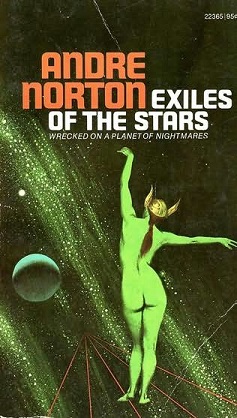
Exiles of the Stars
Andre Norton
249 pages
published in 1971
It was clear from the first page that Exiles to the Stars was a sequel and a quick trip to Librarything confirmed that this was a sequel to Moon of Three Rings, which I’ve never read. It’s neither the first nor likely the last time I’ll read a sequel before the original novel and in Norts on’s case, since she wrote before the rise of the epic fantasy series, her novels always tell complete stories, with anything you need to know from earlier books neatly explained. In Exiles of the Stars the things that need explaining are the protagonists, Krip Vorlund and his companion Maelen. Both are not what they seem. Krip outwardly looks like a Thassa, a humanoid alien race, but his midn is human, having taken over the thassa body when his original was destroyed. The same thing happened to Maelen, now inhabiting the form of a glasssa, a small four footed hunting animal where she once had been a woman and priestess on a planet where the priesthood was adept at body switching. All this of course the result of the action from the previous novel.
Their prediciment shows up the important role psi powers and mind control play in Norton’s space opera, as it does here. Many of her heroes either encounter ESP or discover their own talents during their adventures. It can feel a bit old fashioned, on a par with the navigation tapes used to steer the spaceships. But in this case it also shows how large and strange Norton’s universe is, where her heroes are lucky to survive, let alone thriumph. Occasionally in the wrong body.
GamersGate: Intel lets spoiled manchildren think they’re important
So GamersGate. A bunch of petulant man children from the open sewer of the internet got roped into some creep’s crusade against his ex-girlfriend under the banner of “objective gaming journalism”, spewed the usual mix of rape and death threats against her, but Zoe Quinn, their intended victim, turned out to be smarter than the lot of them and had infiltrated their main planning channel for weeks. These losers are still sputtering on, the 101st chairborne brigade fighting a losing war against the forces of social justice on blogs and Twitter, a tweet too far.
What kind of lame company would let themselves be roped into their campaign and feel pressured to withdraw advertising from a gaming site just because they say so? Intell, that’s who:
GamerGate’s ballyhooed success with Intel reveals them to be a movement for “journalistic integrity” that is willing to use major corporate sponsors to dictate the editorial content of a website for no reason other than the fact that they disagree with it. As a “consumer revolt,” it has shown itself to be a neoliberal nightmare wherein large corporations are the heroes and plucky independent journalists are the “elite” villains who need to be toppled.
(Incidently, the habit of Feministing here to blank out the Twitter accounts sending death threats in their screenshots but not those of the victims of said threats is mildly annoying.)
By giving in to blackmail, Intel has enabled the most whining, dumbest and aggressive part of videogaming “culture” to terrorise more women and the websites that publish them, in exchange for much more negative p.r. than it would’ve had, had it refused to play ball. The LoserGaters are a noisy and obnoxious part of gaming, but they’re only a minority. Normal people, sane people, want nothing to do with them.
Books read September
Guess what? I actually read some non-fiction this month, in the shape of a history of the 1953 Iranian coup. Apart from that, I’ve also dipped my toes in the troubled waters of Dutch science fiction and fantasy, thoroughly enjoyed Kameron Hurley’s new novel but was slightly dissappointed to still have only read six books in total this month. UPDATE: seven actually, as I completely forgot I’d read The Secret Feminist Cabal this month too.
Zwarte Sterren — Roelof Goudriaan (Ed.)
An anthology of Dutch science fiction I got from the library to find Dutch authors worth reading.
The Mirror Empire — Kameron Hurley
One of the biggest sf&f books of 2014 and it lived up to its hype.
Otherbound — Corinne Duyvis
A Dutch author writing in English, this is Duyvis’ first novel, a well written YA fantasy with one of the more original ideas I’ve seen in fantasy behind it.
The Secret Feminist Cabal — Helen Merrick
A cultural history of feminism in science fiction, science fiction fandom and academic research into science fiction. This is essential reading for anybody interested in the history of science fiction and women in science fiction.
All the Shah’s Men — Stephen Kinzer
An overview of the 1953 coup that ended democracy in Iran and the role the British and Americans played in it. Comes close to victim blaming at points.
The Outskirter’s Secret — Rosemary Kirstein
The second novel in the Steerswoman series of science fiction disguised as fantasy.
Roadside Picnic — Boris & Arkady Strugatsky
A classic of Russian science fiction and the inspiration for the 1979 movie Stalker as well as the more recent S.T.A.L.K.E.R. video horror games.
Your Happening World (September 25th through October 3rd)
- BBC News – Cat Watch 2014: What’s it like being a cat? –
- The Radical Ellen Willis | Dissent Magazine – Maybe we’re oblivious, or maybe just stretched thin, but not enough people are talking about this. The late cultural critic Ellen Willis did—and years before the worst of it hit. With a clarity of thought and the kind of fury that pangs and never scabs over, she diagnosed, snarled, and illuminated what she considered a central plague of her day: the way our economy limits our creative expressions. As she put it in her essay “Intellectual Work in the Culture of Austerity”: “On the crudest level, the lives of American intellectuals and artists are defined by one basic problem: how to reconcile intellectual or creative autonomy with making a living.”
- Black and Blue. – Free Online Library – The violence perpetrated by the P.G. cops is a curious development. Usually, police brutality is framed as a racial issue: Rodney King suffering at the hands of a racist white Los Angeles Police Department or more recently, an unarmed Timothy Thomas, gunned down by a white Cincinnati cop. But in more and more communities, the police doing the brutalizing are African Americans, supervised by African-American police chiefs, and answerable to African-American mayors and city councils. In the case of P.G. County, the brutality is cast against the backdrop of black America's power base, the largest concentration of the black middle class in the country.
- kankedort: On Diversity: Two Sadnesses and a Refusal – don't refuse the issues. I accept them fully. But I refuse the sense of scarcity and shrinkage. I refuse a world this small. I refuse to believe that there are only so many seats at the table, that I have to fight for scraps against all other possible representatives of diversity. You guys, I refuse this EVEN IF IT'S TRUE. Daniel José Older and Saladin Ahmed, who were mentioned in the Nation piece, are my friends. I'm thrilled for them. Is it possible to recognize that there is a problem with women of color being ignored, and still be thrilled for them? I intend to believe the answer is yes.
- Marooned Off Vesta: Confusion and understanding: one post about The Stone Boatmen – Though I try always to extend sympathy at least, it is difficult for me to approach any new work of sf with anything other than suspicion. But very early on in my first reading of Sarah Tolmie's The Stone Boatmen — I am no longer able to say when or where, exactly — I decided to trust: to have faith in the work, and in Tolmie's ability and above all responsibility in pursuit of it. Or — can this really be characterized as a decision? Perhaps better to say that I found myself trusting her, that something palpable but not quite locatable in or between her words made such trust not only possible but natural, even unavoidable. Tolmie does not betray this trust.