Wiscon again

Elise Matthesen talks about what happened after she reported being harassed at Wiscon 37, in a post also posted at: C. Lundoff, Mary Robinette Kowal, Stephanie Zvan, Sigrid Ellis and John Scalzi‘s respective blogs.

Last year at WisCon 37, I told a Safety staffer that I had been treated by another attendee in a way that made me uncomfortable and that I believed to be sexual harassment. One big reason I did was that I understood from another source that he had reportedly harassed at least one other person at a convention. I learned that she didn’t report him formally, for a lot of reasons that aren’t mine to say. I was in a position where I felt confident I could take the hit from standing up and telling the truth. So I did.

I didn’t expect, fourteen months later, to have to stand up and tell the truth about WisCon’s leadership as well.

Let’s get some backstory to this, shall we?

As discussed here previously, Elise Matthesen was harassed by somebody who was later identified as Tor editor Jim Frenkel. Shortly after this, he was no longer. It turned out that Matthesen’s experience with Frenkel wasn’t unique; he’d long had a reputation in some circles in fandom. Wiscon at first seemed to take the harassment complaint as seriously as Tor had done, but then it turned out that not only had Frenkel been allowed to attend, he had also been allowed to volunteer at this year’s Wiscon.

That was in late May. Wiscon was slow to react to this but eventually formed several subcommittees, one to look into the general problem of harassment and safety and two to look into specific allegations, with the one looking into what happened to Elise Matthesen finally reporting its verdict on the 18th of July, formally banning Frenkel:

WisCon will (provisionally) not allow Jim Frenkel to return for a period of four years (until after WisCon 42 in 2018). This is “provisional” because if Jim Frenkel chooses to present substantive, grounded evidence of behavioral and attitude improvement between the end of WisCon 39 in 2015 and the end of the four-year provisional period, WisCon will entertain that evidence. We will also take into account any reports of continued problematic behavior.

Allowing Jim Frenkel to return is not guaranteed at any time, including following WisCon 42; the convention’s decision will always be dependent on compelling evidence of behavioral change, and our commitment to the safety of our members. If he is permitted to return at any time, there will be an additional one-year ban on appearing on programming or volunteering in public spaces. Any consideration of allowing him to return will be publicized in WisCon publications and social media at least three months before a final decision is made.

Responses to this announcement were largely critical, with e.g. Kameron Hurley calling for Wiscon to be abolished completely while others said they’d be unlikely to attend Wiscon in future. Elise Matthesen herself had already said she wouldn’t, despite the loss in revenue this would cost her. EDIT: to clarify, she said she would stay away for a year, not forever; see the comments to this post.

In response to this criticism, one of the members of the subcommittee handling Matthesen’s case wrote two blogposts in a personal capacity explaining and apologising for the process with with the committee had handled the case.

From the discussion in those two posts it became clear Wiscon had been doing what Rose Fox had warned about two years earlier, in the context of a similar harassment case at Readercon:

When someone does something we find noxious, they become the focus of attention: how will they be punished? Will they apologize? Can they be brought back into the fold? Meanwhile, the person they targeted with their noxious behavior is forgotten, dismissed, or scorned. Harassers are often charismatic, which is how they get close enough to harass, and they often target the shy and vulnerable, who are that much easier to ignore if they manage to speak up at all. We are all intimately familiar with the narrative of sin-repentance-redemption, and it’s startlingly easy to try to follow someone through it while all but forgetting that they wouldn’t have even started down that road if they hadn’t treated another person badly.

They also pointed out that focusing on the harasser’s redemption means at least two other people would no longer be comfortable at Wiscon.

Following up on all this criticism, Wiscon put out an update saying that

1) In light of the intense community response to the Frenkel subcommittee’s decision, and the concom’s own concern about the “provisional ban,” the WisCon concom is itself currently appealing the subcommittee’s decision and will vote on the matter this week.

2) Debbie Notkin has resigned as Member Advocate, effective immediately.

3) The Bergmann subcommittee is assessing if they can continue given the valid concerns about Wiscon’s existing process.

To which Elise Matthesen’s post was a response.

Further reading:
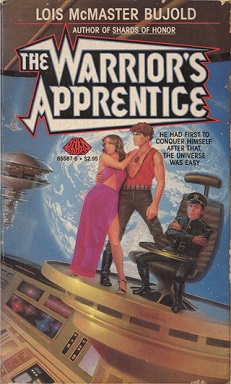
The Warrior’s Apprentice — Lois McMaster Bujold

Cover of The Warrior's Apprentice


The Warrior’s Apprentice
Lois McMaster Bujold
315 pages
published in 1986

As you probably know, Bob, The Warrior’s Apprentice is the second novel in the Vorkosigan Saga series of mil-sf adventures and came out in the same year as the first, Shards of Honor. Whereas that book starred Miles parents, this is the introduction of Miles Vorkosigan, the just under five foot crippled before birth by a neurotoxin attack on his mother, insanely charismatic, insanely hyperactive military genius who, at the start of the novel is trying to make it through the eliminations for officer candidacy in the Barrayaran Imperial Military Service. The written exam is no problem; it’s the physical tests that are a challenge for somebody who could break his bones just by sitting down hard.

His strategy is to take it slow and careful, but being seventeen he lets himself get goaded by one of his fellow candidates, takes an unnecessary risk and breaks his legs, with it shattering his chances to get into the military. Worse than his own disappointment is his grandfather’s, the liberator of Barrayar of the Cetegendans, who dies the next night — Miles convinced he killed him by breaking his heart. In his despair and sorry he’s glad to get away from Barrayar and, because of the political situation his father too would like to see him visit his mother’s family on Beta Colony, a nicely civilised part of the galaxy where aristocratic notions of honour are held for the anachronisms they are. He doesn’t travel alone; his bodyguard, sergeant Bothari, of course has to travel with him and he manages to persuade his mother to ask Bothari’s daughter, Elena, to come with him as well. He’s of course half in love with her and thinks a trip to another planet and perhaps the chance to learn more of Elena’s long dead mother, would get him into her good graces. Yes, Miles is somewhat of a nice guy but trust me, he grows out of it.

Read more…

Skip the movie, watch the video: Falcon and the Snowman


Part one in what may become a series. Way back in the stone ages, or the eighties as it was know at the time, the movie footage videoclip became a common way to both promote a movie and provide a band with a cheap videoclip. For many of us growing up that time who were too young or lacked the opportunity to catch these movies in the cinema, these clips were the only way in which we saw some of the eighties’ biggest movies. And often once you did watch them, they were nowhere near as good as the video. Case in point, The Falcon and the Snowman, late Cold War spy thriller that never lived up to the promise of its melancholy Bowie theme song.

Hugo Awards: Best semiprozine and Best fanzine

The next two Hugo Awards categories are Best semiprozine and Best fanzine. The differences between these two categories are slight, especially in the day of the internet zine; of the titles nominated iirc only Interzone was originally a paper zine. The main difference is whether or not your zine contributes to your income and either has to be paid for to read or pay its contributors, or both.

Because I don’t follow magazine science fiction and because there has been such an explosion of them in the past couple of years, I find it difficult to judge the candidates here. What I’ve decided upon was to look at a) which writers they publish, b) what sort of stories and non-fiction, c) diversity and d) just general online presence. To be honest, any of these magazines would be a worthy winner.

  1. Apex Magazine edited by Lynne M. Thomas, Jason Sizemore, and Michael Damian Thomas
    This is the most diversive of the candidates, looks great and has published some great stories, including Hugo candidate “If You Were a Dinosaur, My Love” by Rachel Swirsky.
  2. Lightspeed Magazine edited by John Joseph Adams, Rich Horton, and Stefan Rudnicki
    Lighspeed publishes both science fiction and fantasy, new and reprint, with some very well known authors contributing.
  3. Strange Horizons edited by Niall Harrison, Brit Mandelo, An Owomoyela, Julia Rios, Sonya Taaffe, Abigail Nussbaum, Rebecca Cross, Anaea Lay, and Shane Gavin
    Strange Horizons is the one semiprozine I do read regularly, mostly for their reviews as well as their features about diversity in science fiction, like the annual SF count. I’ve always seen it as more a blog than a magazine though; they don’t do issues as such.
  4. Beneath Ceaseless Skies edited by Scott H. Andrews
    According to their mission statement, “Beneath Ceaseless Skies will feature exciting stories set in awe-inspiring places that are told with all the skill and impact of modern literary-influenced fantasy.” Not entirely my cup of tea, or at least not as a biweekly magazine, but I like that everything they’ve published seems to be made available with the appropriate Creative Commons license. The magazine itself is basic: you got a cover, two stories, that’s it.
  5. Interzone edited by Andy Cox

    I’m sorry to say that this is currently the most boring of the candidates, as it used to be a hugely influential magazine back in the nineties and eighties.

Onto the fanzine nominations. I won’t be considering Elitist Book Reviews, for reasons described in my first post, leaving me with a strong field to consider. Because most of the nominees are blogs rather than paper fanzines, I know Pornokitsch, The Book Smuggles and A Dribble of Ink already even when I don’t read them regularly. Journey Planet I didn’t know and turned out to actually be an oldfashioned fanzine and just as good as the other candidates. Again, any of these would make a worthy winner.

  1. A Dribble of Ink edited by Aidan Moher
    Worth the nomination just for having published We Have Always Fought, but this is one of the best sf orientated blogs I know anyway.
  2. Journey Planet edited by James Bacon, Christopher J. Garcia, Lynda E. Rucker, Pete Young, Colin Harris, and Helen J. Montgomery
    An old skool paper zine only available in PDF online, but the articles published make up for that annoyance. They don’t seem to have published anything since last December though.
  3. Pornokitsch edited by Anne C. Perry and Jared Shurin
    Pornokitsch looks at geek culture in the broadest sense, is a well written chatty blog.
  4. The Book Smugglers edited by Ana Grilo and Thea James
    Review orientated, they do what they do well but it’s not a blog I regularly read or want to read.

Your Happening World (July 22nd through July 25th)

  • As Reason’s editor defends its racist history, here’s a copy of its holocaust denial “special issue” – For them, FDR was a tyrant and a criminal, an American Hitler, only no one else could see things their way, because the real Hitler was widely believed to be one of the worst figures in history. Therefore, libertarian “historical revisionism” had to convince these Americans that Hitler wasn’t nearly as awful as they believed, which meant that the Holocaust couldn’t have happened — if the goal was to discredit FDR and the New Deal.
  • The Top 200 Ways Bleacher Report Screwed Me Over – In my three years at Bleacher Report, I covered the San Jose Sharks while studying in the Bay Area, and the Twins, Wild, Timberwolves, and Vikings upon returning home to Minnesota. I wrote over 500 articles, generated nearly three million page views, and received $200 for my services.
  • Jim Frenkel at WisCon 38 – Geek Feminism Wiki – In 2014, serial harasser Jim Frenkel attended Wiscon 38 despite complaints about him harassing a Wiscon 37 attendee, and previous reports. The Wiscon 38 organisers reported that they did not have a systemic way to track such issues. They reviewed the situation and provisionally banned Frenkel for several future years, a response that did not satisfy many onlookers.
  • Under the Beret » The Readercon Thing – I’m sure that most people on my friends lists are already aware of the sexual harassment incident at Readercon, but here’s my attempt at a link round-up
  • Readercon: Safety Procedures –