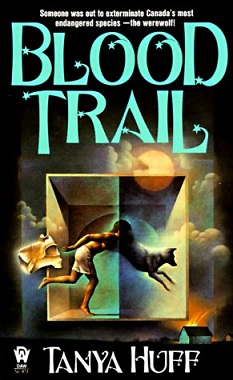
Blood Trail — Tanya Huff

Cover of Blood Trail


Blood Trail
Tanya Huff
304 pages
published in 1992

What do you call urban fantasy when it moves to the countryside? Because that’s what happens in Blood Trail as Vicky Nelson, ex police officer turned private dick and her vampire partner Henry Fitzroy trade the familiarity of Toronto for the charming wonders of the Canadian countryside. Vicky had met Fitzroy in the first novel of the Blood series, Blood Price, now in the second — as seems to be de rigeour in urban fantasy — she gets involved with werewolves. But these aren’t your average, shirt ripping, feauding with vampires werewolves: these are sheepfarmer werewolves, leading a quiet existence near London, Ontario, just another Dutch-Canadian family. Until somebody starts killing them, somebody who seems to know that they’re werewolves.

Which is when they call Henry Fitzroy, who first met the Heerkens wolf clan during WWII, when he was a member of the British secret service and they were in the Dutch resistance. Because the wer could obviously not involve the police without their secret getting known and since they’re mistrustful of outsiders anyway, Henry was their only option. And Henry of course in turn wanted Vicky to come along and use her investigative talents. Meanwhile, back in Toronto detective Mike Celluci, Vicky’s ex-colleague and still occasional love interest is convinced Henry is hiding something. Of course not knowning he’s a vampire, it may just be jealousy that’s driving his investigation…

Read more…

Banana creme

It’s when you scrablle in dark cupboards to find the hand mixer and then realise that it hasn’t been turned on since she died, that you miss your wife again. Every time I try a new or unfamiliar recipe again that calls for a bit of kitchen kit I’ve rarely or never used and find out that yes, of course Sandra had bought it long ago, I’m reminded of how good a cook she was. She could whip together a great meal with minimal effort and make it healthy too.

Me, not so much. Between being fundamentally lazy and only having to cook for myself and what’s the point of going to all that extra effort if you’re just cooking for one?

But sometimes I do find something that looks tasty and easy to make and I get that itch to make it, hence banana creme as blogged by Michel yesterday, seemed like the perfect dessert today on a hot summer day. Had to make some changes though; the local supermarket only had sweetened condensed milk and for some reason no lemons, so had to get lemon juice, but the recipe stayed the same:

A couple of leftover bananas, a can of condensed milk, blitz with the mixer, add a bit of lemon juice to sharpen it up a bit et viola:

bananana creme

Your Happening World (July 14th through July 22nd)

  • 1974 -1986: A Spotlight Chronology (work in progress/draft) | Bits of Books, Mostly Biographies – What is perhaps most notable in placing a series of press reports on abuse scandals over any period of time is that there’s a lot of shock and outrage and not much action from anyone in a position of duty, responsibility or power to do anything except to apparently express more shock and outrage, this time on our behalf, before swiftly moving on. Something the collection of press reports at SpotlightOnAbuse ably demonstrate and which forms the spine of this chronology.
  • BBC – Blogs – Adam Curtis – WHAT THE FLUCK! – That at the same time as the police pursue the dodgy private investigators, like AIS, who are bugging and hacking their way into thousands of peoples' lives, the very same police – along with the security services, GCHQ and the NSA – are doing exactly the same to millions of other people. The only difference is that it's legal – because the Regulation of Investigatory Powers Act of 2000, and other laws, allow them to do it.
  • How to find the missing Buk system | KoreanDefense.com –
  • i believe you | it’s not your fault – Can we use our collective life experience to be a safe haven for kids who need it? Can we tell stories and answer questions and offer solidarity and resources and maybe break some cycles before they begin? Can we do it with humor and transparency, and without coming across like dorky, hand-wringing moms? After all, so many of us are still those kids. So many of us will always be those kids. Well, we can try. … We’re just people who’ve been through stuff, and we’re here. Ask us anything. It’s not your fault. We believe you.
  • Rick Remender, Alleged Statutory Rape, and Jet Black – If your discomfort with the whole Captain America #22 issue is simply the fact that sex had happened between two consenting adults in the presence of alcohol, this isn’t for you. You’re free and completely entitled to hate that and view it with great disdain but my attitude and problem with the fandom is not because of people finding issue with that overused plot device to get two people to finally be comfortable enough to do it but because of people making claims that Jet Black is 14 years old (when she’s not) and thus stating that despite her even saying she’s beyond those years to dare accuse Remender writing a statutory rape scene and faulting Sam Wilson as a rapist. If you had any of these thoughts, this is for you. Before you continue your crusade, please at least let me provide you with some facts.
  • The End of Fan-Run Conventions? | Cheryl’s Mewsings – My point is, however, that there is no upside to running fan conventions anymore. There is no satisfaction in a job well done. The only probable outcome is that you will spend the weeks after the convention dealing with angry and disappointed attendees, and avoiding social media because you don’t want to have to read the awful things that are being said about you.

(not the) Hugo Awards: John W. Campbell Award for Best New Writer

Awarded with the Hugos, but not a Hugo Award, the John W. Campbell Award for Best New Writer has been awarded since 1973, in honour of the editor who for better or worse has shaped American science fiction the most. Writers are eligible for two years after their first sale and indeed three of the candidates below are in their second year of eligibility, indicated by an asterix:

  • Wesley Chu
  • Max Gladstone *
  • Ramez Naam *
  • Sofia Samatar *
  • Benjanun Sriduangkaew

Save for Wesley Chu, whose The Lives of Tao I’d seen in the local sf bookstore, none of these were writers I knew before I got my hands on the Hugo Voters Package (hurhur). I’ve been slowly working my way through the books and stories in it and have now almost finished reading through the Campbell nominees. I’m still reading Ramez Naam’s Nexus but I already know that he, though not a bad writer, is the least of the five candidates.

To determine the best was more difficult. Sofia Samatar, with her excellent fantasy picaresque A Stranger in Olondria quickly went to the top, but Benjanun Sriduangkaew, represented with three excellent short stories Silent Bridge, Pale Cascade, Fade to Gold and The Bees Her Heart, the Hive Her Belly, was a strong challenger. Sriduangkaew has a vivid imagination andis at home in both science fiction and fantasy, but in the end I still had to give the nod to Samatar.

In the middle of the pack are Wesley Chu, who wrote a decent but not spectacular first novel and who I ended up putting in fourth, while Max Gladstone wrote a much better steampunk fantasy novel. I wouldn’t mind seeing him win the Campbell either, though I do think Sriduangkaew and Samatar both are a quantum leap ahead of him. If either Chu or Naam win thought that would be a disappointment, as their work is no more than competent adventure science fiction. My final ranking therefore:

  1. Sofia Samatar
  2. Benjanun Sriduangkaew
  3. Max Gladstone
  4. Wesley Chu
  5. Ramez Naam

Hugo Awards: Novelettes

Novelette is one of those categories that seem largely unnecessary to me: too long for a short story, too short for a novella, what’s the point here other than length? Can anybody really tell the difference between a short story and a novelette or at the other end, between it and a novella? Better split this category up between the other two and be done with it.

However, since it still exists, let’s take a look at the candidates:

  • “The Exchange Officers” by Brad Torgersen (Analog, Jan-Feb 2013)
  • “The Lady Astronaut of Mars” by Mary Robinette Kowal (maryrobinettekowal.com / Tor.com, 09-2013)
  • “Opera Vita Aeterna” by Vox Day (The Last Witchking, Marcher Lord Hinterlands)
  • “The Truth of Fact, the Truth of Feeling” by Ted Chiang (Subterranean, Fall 2013)
  • “The Waiting Stars” by Aliette de Bodard (The Other Half of the Sky, Candlemark & Gleam)

The two entries I struck through I won’t judge, as I explained before, leaving three candidates. Below I’ve listed them in the order I’ll vote for them.

“The Waiting Stars” — Aliette de Bodard
An excellent slice of Banksian space opera, a story of love, family and two incompatible views of the world.

“The Lady Astronaut of Mars” — Mary Robinette Kowal
A retired astronaut on Mars, in an alternative history where an asteroid landing on Washington DC in the early fifties meant a much strong space programme, is asked to go on one last mission to a newly discovered extrasolar planet, but it would meaning leaving her husband behind to die, as he only has a year left to live. This is an unabashedly emotionally manipulative story, in that the dilemma at the heart of it does not make sense — why not wait a year if she’s the only one who can undertake the mission, why insist on her having to go right now– but the truth at the core of it, of watching a loved one, a husband, in the final stages of a terminal disease with all that entails, that truth is real.

“The Truth of Fact, the Truth of Feeling” — Ted Chiang
A story in which Chiang draws parallels between the introduction of literacy in a tribal society and the near future takeup of almost perfect lifelogging and recall software. Not entirely convincing.

All three stories are good in their own right, but the Aliette de Bodard story stands out head and shoulders for me. I definately need to read more of her.