Cons should worry about victims, not harassers

Thinking more about Wiscon, I came back to the point Rose Fox made two years ago, in the wake of the harassment problems at Readercon:

When someone does something we find noxious, they become the focus of attention: how will they be punished? Will they apologize? Can they be brought back into the fold? Meanwhile, the person they targeted with their noxious behavior is forgotten, dismissed, or scorned. Harassers are often charismatic, which is how they get close enough to harass, and they often target the shy and vulnerable, who are that much easier to ignore if they manage to speak up at all. We are all intimately familiar with the narrative of sin-repentance-redemption, and it’s startlingly easy to try to follow someone through it while all but forgetting that they wouldn’t have even started down that road if they hadn’t treated another person badly.

That is, that too much of the focus in this is on the harasser and that cons even when starting to address harassment do this, sometimes with the best of intentions. As with Wiscon, you get all those pseudolegal procedures and folderol to make sure that harassment policies are fair and balanced and while having due process is important in the justice system, if you run a con it should be more simple to expell people who hassle and harass other congoers. There’s no need to reinvent the legal system.

And at the forefront of every conrunner’s mind should be the simple idea that for every harasser treated with kid gloves and not expelled, several victims or potential victims will feel unsafe and not go to their convention.
Wiscon still favouring harassers

As you know Bob, Wiscon has had problems getting its house in order after Jim Frenkel was accused of harassment. After Elise Matthesen reported being harassed by him last year you would’ve expected him not to have been welcome this year, but that turned out not to be the case. Fianlly, after lots of anger online and elsewhere and more incompetence from the con, Wiscon finally established a subcomittee to look at the Frenkel case and come to a decision about what to do with him. Today it reached its decision:

The WisCon committee announces the following actions:

WisCon will (provisionally) not allow Jim Frenkel to return for a period of four years (until after WisCon 42 in 2018). This is “provisional” because if Jim Frenkel chooses to present substantive, grounded evidence of behavioral and attitude improvement between the end of WisCon 39 in 2015 and the end of the four-year provisional period, WisCon will entertain that evidence. We will also take into account any reports of continued problematic behavior.

Allowing Jim Frenkel to return is not guaranteed at any time, including following WisCon 42; the convention’s decision will always be dependent on compelling evidence of behavioral change, and our commitment to the safety of our members. If he is permitted to return at any time, there will be an additional one-year ban on appearing on programming or volunteering in public spaces. Any consideration of allowing him to return will be publicized in WisCon publications and social media at least three months before a final decision is made.

Based on the policies adopted by WisCon’s Harassment Policy Committee before WisCon 38 in 2014, Jim Frenkel has the right to appeal this decision to SF3, WisCon’s governing body. If he enters an appeal, we will make public statements both when he does so and when the appeal ruling is issued.

Which really isn’t good enough? Because if I read this right, in the worst case scenario, if Frenkel is really really sorry, he could be back at the con in two years time, the year after it back as volunteer. Even a straight four year ban seems too little for somebody who harassed at least one woman at Wiscon, perhaps more. How could his victims feel safe there with this resolution? In everything this statement seems more concerned with Frenkel’s rights than with that of his victims, especially as it offers some sort of vague rehabilitation process he could undergo to be allowed back in less than two years.

Note that Elise Matthesen has already said she’d rather not come back to Wiscon regardless of the economic consequences for her business; I can’t imagine this ruling will change her mind. By bending over backwards to give Frenkel options for redemption, Wiscon keeps driving away his victims, not to mention those who have no desire to become his victim. The con had an opportunity to make a statement here, by banning Frenkel either for life or for a long enough period that it would actually have inconvenienced him; by not doing this they confirm that his rights to come to their con trumps the ability of any woman to feel safe at it.

This is not how a serious con deals with harassment.

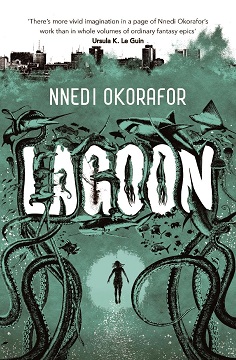
Lagoon — Nnedi Okorafor

Cover of Lagoon


Lagoon
Nnedi Okorafor
306 pages
published in 2014

There has been a bit of a spat about the use of dialect and “non-standard” English in science fiction lately, as various people were critical about using dialect all together, finding it gimmicky or too difficult. As Juan Diaz put it “Motherfuckers will read a book that’s one third Elvish, but put two sentences in Spanish and they [white people] think we’re taking over” which is more true than it should be. A novel like Lagoon therefore, which is not only set in a city and country –Lagos, Nigeria — unfamiliar to the average science fiction reader, but which is (partially) written in Nigerian English, using Nigerian vocabulary and grammar, may be somewhat of a challenge. Because while we as science fiction readers supposedly crave the shock of the new, often it’s only if it’s cloaked in familiar language and cultural expectations.

And I have to admit, I did have to struggle a little bit with Lagoon, getting used to the language and the setting, though to nowhere near the extent I had to get used to Feersum Endjinn. For me this was a turn-on rather than a turn-off; I don’t mind working harder for my entertainment if a book is worth it and Lagoon certainly is. This is a novel of first contact where the people encountering the alien are not square jawed space marines but a marine biologist (Adaora), a troubled soldier (Agu) and a world famous rap star (Anthony), taken as representatives of humanity into the sea as the aliens landed there, to be returned to Lagos with Ayodele, an envoy from the aliens who needs to meet up with the president of Nigeria to discuss the future of the country now they’ve made their home there.

Read more…

Comic shop Lambiek has to move

Lambiek is probably the world’s oldest continuing comics store, founded in 1968 in the Kerkstraat in the centre of Amsterdam and still located there fortysix years later. However, after the summer this will change as Dutch newspapers report Lambiek has to leave the Kerkstraat due to high rents. Worse, according to Micheal Minneboo Lambiek might close altogether.

That would be an incredible blow to Dutch comics; Lambiek has ben a driving force in alternative and art comics here, as a shop and gallery and since 1994 also through its comiclopedia, still the best source for information about more obscure cartoonists. For Amsterdam, the loss or move of Lambiek out of the centre would mean another loss of a prominent independent shop.

But Boris Kousemaker, the son of founder Kees Kousemaker, is still optimistic about Lambiek’s chances: the advantage of a long history is having a large group of customers and friends willing and able to think and work along for a solution.