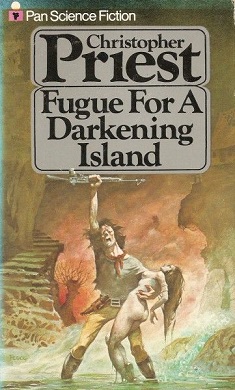
Fugue for a Darkening Island — Christopher Priest

Cover of Fugue for a Darkening Island


Fugue for a Darkening Island
Christopher Priest
125 pages
published in 1972

There are certain protocols you have to take into account as a reviewer when discussing the books of a new, young writer. Protocols that are still in effect when the author has aged more than forty years since the first publication of his novel and has become a grand old man in the meantime, prone to gently correcting younger writers. Anything that can be said about Fugue for a Darkening Island has to be tempered by the realisation that it is a fortytwo year old novel, not necessarily indicative of the writer Priest now is.

But the truth remains that Fugue for a Darkening Island is a problematic work, a novel with its heart I think in the right place, but which features certain unfortunate themes in Priest’s work that will return in later novels, somewhat muted. I’m thinking of last year’s The Adjacent, featuring a near future Islamic Republic of Great Britain as well as the much earlier A Dream of Wessex which had parts of Britain as a caliphate, but also of The Separation and its naive story of a better world created by a separate peace between nazi Germany and Britain. In short, Priest sometimes goes for settings you’d sooner expect to see in the stories of the more reactionary Baen writers and A Fugue for a Darkening Island is one of those novels, a near future Britain ripped straight from the front pages of National Front propaganda, as the country is flooded by a never ending stream of African refugees destroying the British way of life, its hero a decent middleclass Englishman trying to find a new home for him and his family.

Read more…

Your Happening World (June 22nd through June 24th)

Blog fodder for June 22nd through June 24th:

  • The War Nerd: Like it or not, what’s happening in Iraq right now is part of a rational process | PandoDaily – I just wish Americans would stop assuming every place is like us. Let me tell you, for a Sunni Kurd to say, “I have Shia friends, I have Christian friends” is about as brave and radical as it gets, short of suicide, in the Middle East. I never heard any of my Saudi students say anything remotely like it. Well, how could they? By law, Shi’ism and Christianity are banned in the Kingdom. So they didn’t have the opportunity, even if they’d had the mindset (which they didn’t).
  • Genre needs a lot more cruel and nasty reviews | Damien G. Walter – We need writers and reviewers like Priest who have the expertise and willingness to reflect back the problems in modern genre fiction. Because the problems are very real. Violence of the flattened, meaningless kind Priest pinpoints in Barricade is endemic in the genre.
  • Editor’s blog: I am sexist • Eurogamer.net – This is a realisation that has slowly dawned on me over the last few years. Without really meaning to do so, I have been going around saying and doing things that demean women and casually downplay the importance of issues of gender discrimination all my life. It's a horrible thing to recognise about yourself, gradually or not. I try to be a generous and caring person and I am pretty sensitive, so the idea that I have been ignorantly treating half of the people I know and love in this way makes me feel awful.
  • Tony Blair, dread creature of the forbidden swamp | Idiot Joy Showland – Tony Blair rises every couple of months, like a bubble of swamp gas. First there’s an uneasy buried rumbling, then small tremors shake the surface, and then suddenly he bursts through, a gassy eruption stinking of farts and sulphur. It doesn’t matter how many rounds you fire into his shambling frame; he just won’t die. Whenever something unpleasant happens in the Middle East, whenever some huge corporation is discovered to be starving people to death or poisoning them through calculated negligence, whenever the chaos of the international order reaches a starts to wobble into another death-spiral, a damp wind blows through a graveyard somewhere in England and Tony Blair emerges from his tomb.
  • WW2 Drawings –

That’s what sf needs: more men writing sexbots

So yeah, Jon Wallance, the next heavily hyped British male science fiction writer thinks making his female character into a sexist, misogynist cliche is a-okay because that how she was built in the story:

Then, in my late twenties, I came to write Barricade: my first real attempt to write a complete novel: the perfect opportunity to showcase my improved skill at creating proper female characters.

Only something odd happened: I ended up doing the complete opposite. The lead female character, Starvie, is in many respects a construct of unrealistic male expectation and base desire. Why? Because she was designed that way.

Read, as they say, the whole thing and be astonished at the lack of self awareness.He may think he matured as a writer, but if you justify shitty, sexist characterisation with but that’s just how it is in the world you created you haven’t really understood what being a writer is about. You choose to write the story this way, you can’t then justify your decisions using in story reasons. As Suw Charman-Anderson puts it:

Many authors talk about being surprised by what comes out when they write, but the unexpectedness of their creative process does not relieve them of responsibility for what the final story says. Wallace wrote Starvie because he wanted to, because he chose not to stop himself, because he didn’t change her, or Kenstibec for that matter, as he edited and rewrote his work.

His juxtaposition of his efforts to write “believable, fleshed-out female characters” with the fact that he “ended up doing the complete opposite” implies that this was some sort of freak occurrence, inevitable and outside of his control. This is Wallace glossing over his conscious decision to write Starvie exactly as she reads, it’s him attempting to abdicate responsibility for how she turned out by blaming… what? The story itself? It doesn’t wash.

Christopher Priest was just as critical in his review of Barricade:

There’s also a distinctly dodgy passage in the middle of the book, when the unappealing Fatty and the unemotional Kenstibec plan to send a compliant Starvie out as a sexual lure for a gang of randy Reals. “Listen,” Fatty says to Starvie, after he has bound her wrists with plastic cuffs, “I know you’re upset about having to go whoring, but no more of your looks, okay?” Her response is to tilt her head, and say sweetly, “You don’t like the way I look at you?” Soon the Real sentries are predictably drooling over her, as only men can do when a shackled sex goddess is dragged past. The sequence goes on in the same lacklustre way for several inconsequential pages. The whole of this scene seems likely to start an argument I don’t want to get drawn into, but I think when your book has been read by a few more people you might well be.

Indeed. We don’t need more grimdark, violent for violence sake, sexist stories about abusive men and the realdolls that love them in science fiction; there are plenty of those already. It’s depressing to see that British science fiction has difficulties keeping any female writer in print, but no problems getting this sort of crap published.

Your Happening World (June 19th through June 22nd)

Blog fodder for June 19th through June 22nd:

  • Arcfinity – We’re reading BARRICADE by Jon Wallace – In case you are thinking otherwise, I was not scouring the text for these solecisms, setting out to set you up, but like all people who are preparing a review I was keeping notes throughout the reading. The protocols around a first novel by a young writer do matter. I kept noting all the bad stuff (much more than reported here), but I was looking for good bits with which to try to encourage you. I found none. It gradually dawned on me that I was wasting my time. Barricade was unyielding in its awfulness. It was a book I did not wish to write about.
  • Tomgram: Rebecca Solnit, The Archipelago of Arrogance | TomDispatch – Yes, guys like this pick on other men's books too, and people of both genders pop up at events to hold forth on irrelevant things and conspiracy theories, but the out-and-out confrontational confidence of the totally ignorant is, in my experience, gendered. Men explain things to me, and other women, whether or not they know what they're talking about. Some men.
  • Lesbian Historic Motif Project at The Rose Garden – My goal here — beyond the selfish utilitarian aspect of organizing my research — is much in parallel with that of sites like the Medieval People of Color blog, or Kameron Hurley's award-nominated essay "We Have Always Fought". I want to help change the unexamined assumptions about the place and nature of lesbian-like characters in historic fact, literature, art, and imagination. I want to do it to help other authors find inspiration and support for the stories they want to tell. And I want to do it to affect the reception of my own writing.
  • All Quacked Up: Steve Gerber, Marvel Comics, and Howard the Duck « The Hooded Utilitarian – This article is a history of the editorial and business relationship between Marvel Comics, their representatives, and the late writer Steve Gerber (1947-2008). Its focus is their dealings over Howard the Duck, Gerber’s signature character.
  • Ptak Science Books: Ueber-Spectacular Understatement Department: the Happy Post-Apocalyptic America and the “Awkwardness” of Holocaust, 1962 – How rich we'd all be after the bombs dropped!

England out — what did you expect?

So Costa Rica surprised everybody except those paying attention by beating Italy 1-0, sealing England’s early exit from the Worldcup. Let the wailing and gnashing of teeth begin.

But should we really be surprised that England didn’t qualified from the group stages? They’re after all a decentish team which had the bad luck to be drawn into the same group as a great team rebuilding itself (Italy), another decent to good team with some world class players which went much further in the last Worldcup than everybody thought possible (Uruguay) as well as a team that should’ve been there just to make up the numbers but turned out to hold their own against a team that supposed to beat them (Costa Rica).

Both the idea that England should of course qualify from this group and the idea that now it seems unlikely they will, some sort of special circumstances need to be found to explain this are a symptom of how overrated England is.

Spain is the surprise knockout because they won an European Cup, World Cup and another European Cup one after another, had therefore arguably been the best team in the world for the best part of a decade. When Italy and France were knocked out in the previous tournament, these had been WC winners/contenders not long before.

England on the other hand has been striving for mediocrity for most of that time, not noticeably better than a team like Poland, Portugal or Greece. Had they had a bit of better luck this game they could’ve qualified, but their luck was back so they didn’t.

Par for the course.