Your Happening World (June 17th through June 18th)

Blog fodder for June 17th through June 18th:

  • The Abstinence Method – Modern Farmer – But the Netherlands’ success demonstrates this isn’t true. The country is tiny, but its livestock-raising is intensive and high-tech: 17 million people and about 118 million farm animals share a space only the size of Maryland, yet the Netherlands is Europe’s leading meat exporter. So if the Netherlands can reduce routine antibiotic use without harming its farmers’ survival, maybe other countries can, too.
  • BUTT THEN | Good Dogs –
  • Jennifer in paradise: the story of the first Photoshopped image | Art and design | theguardian.com – In this way, Jennifer in Paradise became the first colour image used to demonstrate the software they had started to call Photoshop.
  • Silence is Complicity — The Radish. – I don’t know how we can make this right to the hundreds, if not thousands, of people who have been injured by our complicity in these horrors. And yes, I am including myself in this because I have been part of fandom for more than a decade now and I have not spoken loudly enough, if there is even one person still standing who thinks this is okay. Our community must become an unwelcome place for predators.
  • On doing a thing I needed to do – Janni Lee Simner / Desert Dispatches – I read and reread her daughter’s words this week. I read, too, portions of MZB’s own court deposition (from her husband’s trial, also for child abuse) that I hadn’t read before. Then yesterday I took a deep breath, and I added up the advances from my two Darkover sales, my Darkover royalties, and (at his request) my husband Larry Hammer’s payment for his sale to MZB’s magazine.
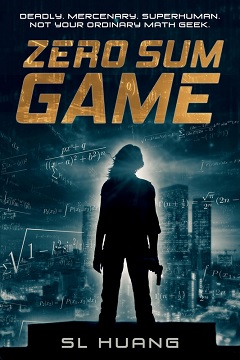
Zero Sum Game — SL Huang

Cover of Zero Sum Game


Zero Sum Game
SL Huang
305 pages
published in 2014

If it wasn’t for her blogging about the renewed SFWA controversies back in January, I would never have heard of SL Huang or Zero Sum Game, her first novel. She’s not the first author I bought books from on the strength of their online writing. I knew Jo Walton and Charlie Stross as Usenet posters before I’d read their fiction and Ian Sales as a blogger before I read his Apollo Quartet books. It’s of course not guaranteed that somebody who’s a good blogger or poster is also a good fiction writer, but so far I haven’t been disappointed.

Zero Sum Game opens with its heroine tied down to a chair watching the fist of Rio, the one man in the whole world she trust coming at her face hard and fast enough to break her jaw. As she watches, lines of force, numbers and probabilities dance before her eyes, giving her a way to take the blow without getting more damage than a split lip. Barely a minute later she sees a way in which she can free herself, kill the four Columbian mobsters in the room and knockout Rio, all while evading the thugs’ gunfire, and takes it, escaping just as more thugs come barreling in. Jumping through the only outside window calculated in such a way as to not get herself torn to pieces, shen then doubles back to get the woman she needed to rescue from the gang, knocks out the guards outside with perfectly aimed rocks thrown to their foreheads and escapes in a hotwired jeep. All in a day’s work for Cas Russell, math savant extraordinaire.

Read more…

That Breendoggle: much, much worse than you think

As we learned earlier, fandom basically covered up for the child abuser Walter Breen (and his enabler, Marion Zimmer Bradley) for fifty years until he got caught and convicted. Even when Stephen Goldin put up the court documents documenting his abuse and MZB’s enabling, this was largely ignored. It was ancient history, an old fan controversy and something that was described mainly in terms of the affect it had on Berkeley fandom and beyond. What has struck me every time I’ve been reminded of it and started looking for it, was that the original oh so cutesy named Breendoggle fanzine setting out the case against Breen was often referenced but never available.

Well, thanks to one Ruthless Ames, it’s up now, in a redacted form with the names of the victims removed, and it doesn’t make for nice reading. The flippant, dismissive tone in which this abuse is described, the victim blaming, the idea that it was enough for children just to barricade themselves in their bedrooms if Breen came to visit their parents (!), the confusion between honest homosexuality and pederasty, the idea that the children wouldn’t be harmed by this abuse, or actually seduced him, it’s all godawful — and it’s all coming from a writer in favour of expelling Breen.

But what really struck me, what was at the heart of why I wrote that earlier post, is the following:

And they swung between two points of view. “We must protect T—-” and “We’re all kooks. Walter is just a little kookier than the rest of us. Where will it all end if we start rejecting people because they’re kooky?” So they swung from on the one hand proposing that if Walter wasn’t to be expelled, then the banning from individual homes should be extended so that club meetings were only held in such homes, and on the otherhand calling the whole series of discussions “McCarthite” and “Star Chamber”. “I don’t want Walter around T—-, but if we do such a horrible thing as expelling him, I’ll quit fandom.”

The idea that it’s worse to expell a harasser than to let him continue his harassment is, unlike much of what’s describe above, one that’s still alive in fandom today. It’s why people like Frenkel could return to the con they were caught harassing people at the previous year, why Ed Kramer could get away with his activities at Dragoncon for decades.

Your Happening World (June 15th through June 16th)

Blog fodder for June 15th through June 16th:

  • Activists warn of trans suicide risk in England as surgery delayed | Gay Star News – Activists have claimed the time for trans people to get male to female gender reassignment surgery has skyrocketed in England from seven months to three years.
  • David Brothers: Quitting the Big Two – Changing those habits takes effort, which leads me directly to why it isn’t difficult to stay away from the Big Two these days: I succeeded at changing my thinking. Wednesdays aren’t new comics days any more. I don’t read comics news sites when I can help it. I discover new comics via word of mouth or Tumblr. I unplugged in a way that let me maintain my decision instead of waffling and crumbling.
  • BBC News – Study: Deforestation leaves fish undersized and underfed – Deforestation is reducing the amount of leaf litter falling into rivers and lakes, resulting in less food being available to fish, a study suggests.
  • Hauntology: The Past Inside The Present – This postcard haunts and is haunted. In 1989, its utopian promise haunted a reality that was unable to make good on it, and in turn the postcard was haunted by the increasingly dystopian qualities of reality. In 2009 this haunting-problem now haunts the present as an example of the Marxist hauntology Derrida wrote about. The problems of our imagined Utopias and Dystopias haven’t gone away – the postcard is a ghost of the GDR, exploding like a spectre the neat symbolic binaries we put our faith in by being both nice and nasty, wrong and right, innocent and guilty, present and absent. It’s also the ghost of childhood, of innocence personal or ideological, imploring us to know its killer, manifesting to us so as to haunt and correct injustice in the same way that ghosts traditionally do. It’s a poignant lie about reality and reality is a poignant inadequacy compared to it.
  • German tank problem – Wikipedia, the free encyclopedia – In the statistical theory of estimation, the problem of estimating the maximum of a discrete uniform distribution from sampling without replacement is known in English as the German tank problem, due to its application in World War II to the estimation of the number of German tanks.

Living as a woman in a science fiction future

Go, read Kari Sperring about living as a woman in a science fiction future

But I kept reading, and, at around 15, I found Samuel R Delany’s Babel 17. I had wanted to be Uhura, because she got to help Kirk and Spock in their adventures. I *really* wanted to be Rydra Wong. The book was all about her: every character, every situation, every concept revolved around her and her talents and skills and actions. Rydra Wong saved the world because she was who she was. She wasn’t in the right place at the right time, she wasn’t an assistant or a prop to be rescued. She didn’t take time to stop and nurture her crew or sympathise with her man. She was the centre of her own story. Until I met her, I hadn’t realised how unusual that was. Women and girls in the books I read were forever interrupted by their gender. They had to be good and do their chores, they had to stop what they were doing to help others, they had to put food on the table and teach children and clean up even in the middle of their adventures. They were never just heroes. They always had to take time out to live up to their social, female role. The only alternative was to behave like a man and expect another woman to look after you, too. The life of a female hero was full of giving up, being good, surrendering, giving way, giving in. Even in their own stories, their lives were already compartmentalised and full of duties that involved always putting others’ interests and needs ahead of their own.