The Adventures of Dōlo Rômy in the Underground City of Women — #aComicaDay (68)

Looking for an old pal, a homeless lesbian stumbles unto an underground city of sapphic women, promptly seduces their queen and in the process foils a military coup. All in a day’s work for Dōlo Rômy

A black and white cover of a woman sitting in a chair, smoking and reading, she's dressed in jeans and a sleeveless t-shirt and wears a hat

Written and drawn by Karen Platt, The Adventures of Dōlo Rômy in the Underground City of Women came out in 1989 from Dōlo Blue Graphics in Minneapolis, as a black and white, magazine sized 40 pages long book, with cardboard covers. I could discover very little online about either this book or its author, who I don’t think is this Karen Platt. It feels and reads like something that was self published, outside of the regular comics markets. More a book you’d see alongside punk and anarchist zines than in your local comics store’s alternative section. Though I did indeed got it there, as a curiosity, but how they got it I have no clue.

Unlike Dōlo Rômy, Karen Platt herself is featured in the Grand Comics Database, having work listed on Dykes Delight and Dark Horse’s The Mask, of all things. She was apparently also featured in the 2012 Fantagraphics anthology No straight Lines, an overview of queer comix history and the subsequent 2021 documentary that spun off from it.

The story has Rômy finding the underground city of women, look around it for a few pages looking for her old gal pal before deciding to fuck it, have a drink in a night club and hook up with one of the locals. Who tells her the city was founded in 1973 as a new Lesbos, just underground and that there are now 60,000 women living there. Before they can get physical, Rômy is arrested by the police, who take her to the queen who will decide on her fate. Luckily, this turns out to be one of her old flames, they have sex but once again Rômy is interrupted, this time by the coup. She escapes, gets a couple of like minded gals to help her and in the end successfully launches a counter coup and finds her old friend. Who, it turns out, may have inspired the coup because she needed a few dames to provide her with the luxuries in life. All’s well that ends well and Rômy does get to finally enjoy both the first woman she got lucky with as her old pal the queen. A drifter at heart, Rômy and friend leave the underground city at the end of the story to roam the streets of Bush’s America again.

The art is rough, with lots of heavy blacks and zip a tone, which works well for this story. The writing is fun, this is basically a b-movie as even Rômy herself acknowledges, but it moves along with a bit of humour. The sex scenes flow naturally from the story, don’t feel gratuitous, nor that titillating if I’m honest. I’m not sure if there was every anything else of the adventures of Rômy published. The back cover promises she would return in Set a Bad, Bad, Bad Example but I haven’t seen anything about this online. The way this story also feels like it was the sequel to something, but again if it was, I couldn’t find anything about it.
Senpai Noticed Her – Hana wa Saku, Shura no Gotoku — First Impressions

Get you a senpai who is this obsessed with you joining her school club:

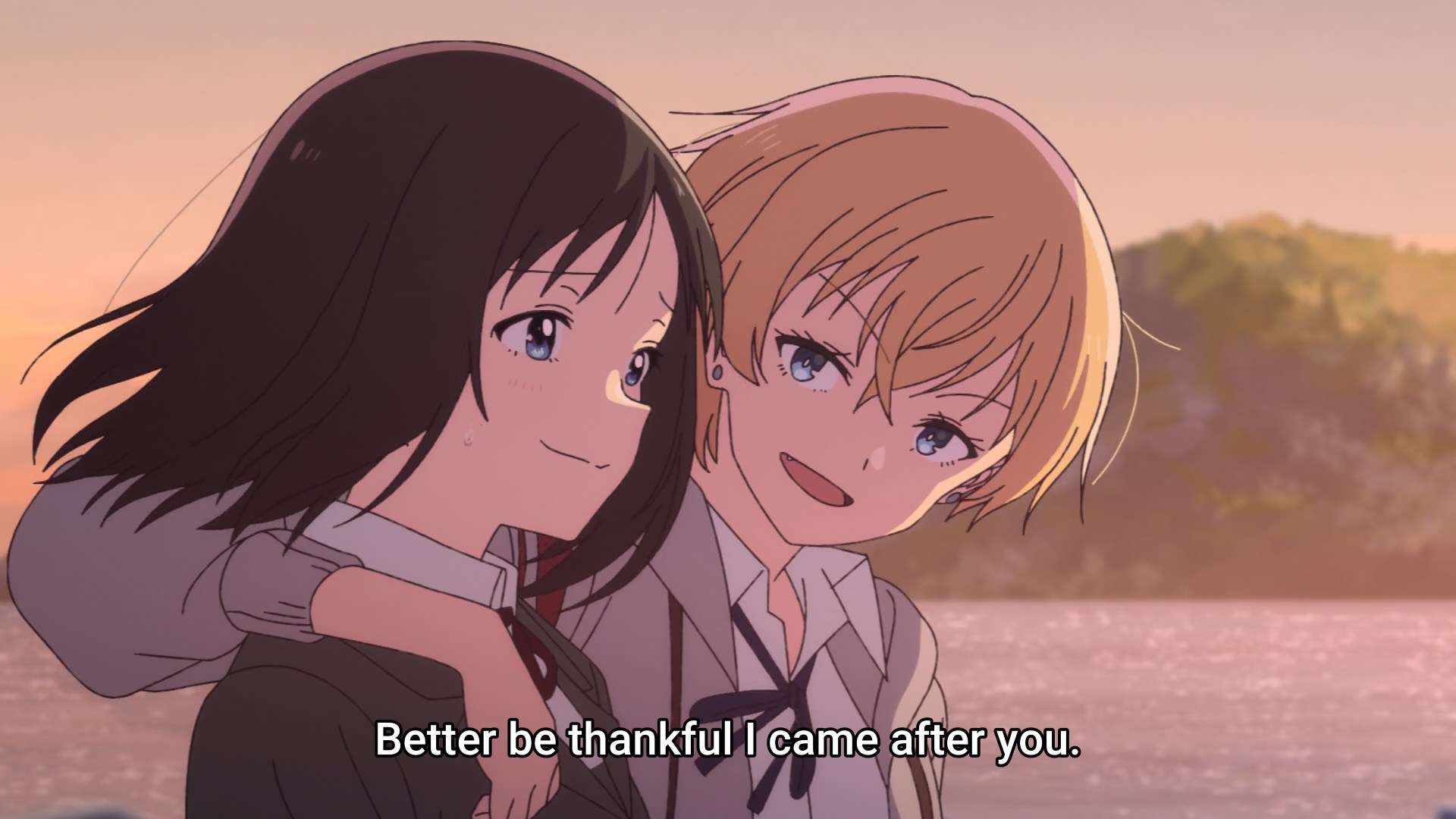
'Better be thankful I came after you.' says the short cropped blonde haired senpai to her insecure, black haired kohai, both smiling.

As a young child Hana watched a recitation contest on television and became fascinated by it to the point that in middle school she held regular reading sessions for the younger children of her small island. By chance the club president of the broadcasting club of her new high school catches one of those readings and decides she has to have her for the club. But Hana isn’t sure whether she can, even if she wants to…

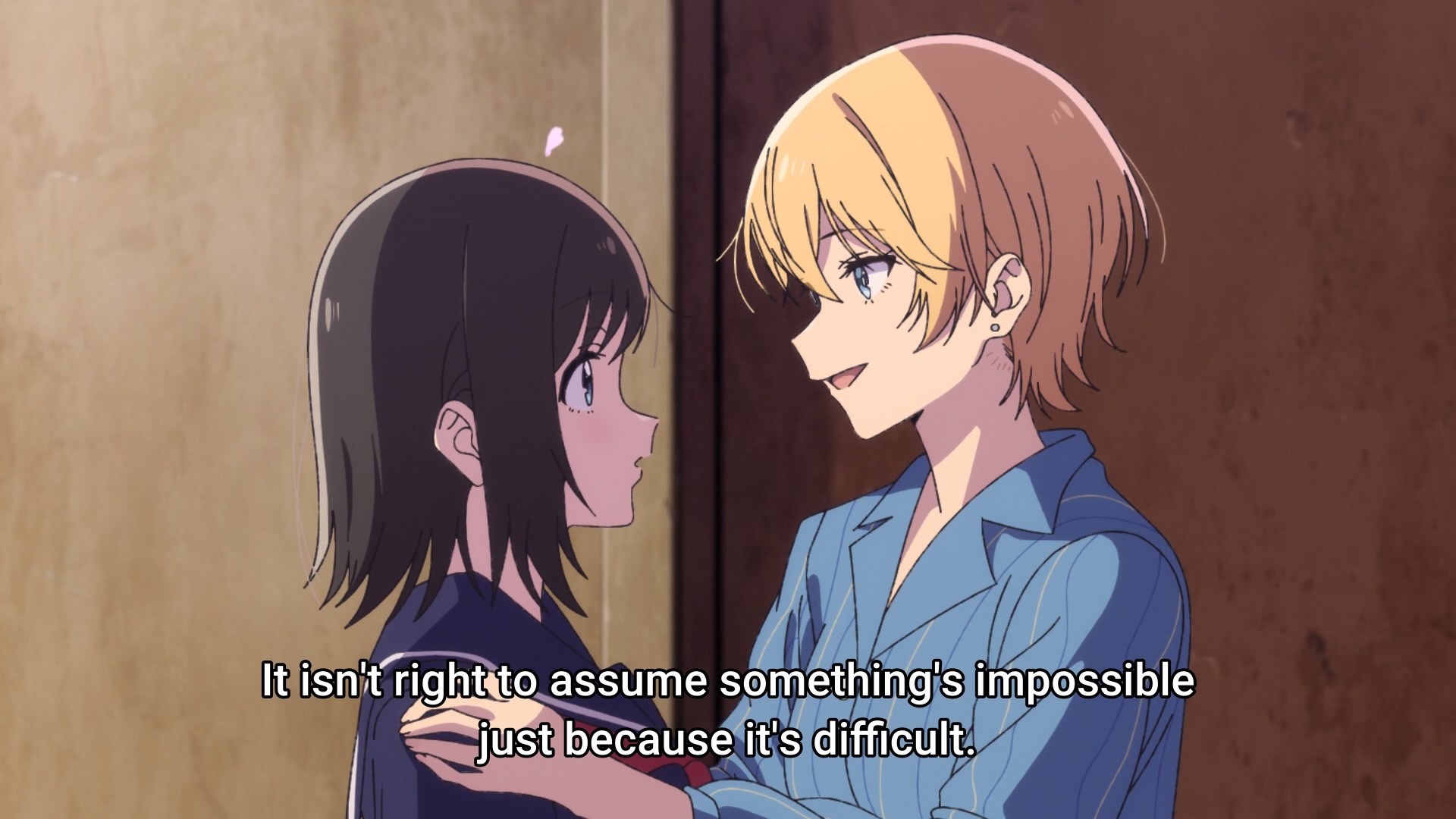
Mizuki grasping Hana by the shoulders as she tells her that just because something is difficult it doesn't mean it's impossible.

This was a nice surprise. I went into this completely blind and got not just a nice, sweet first episode about a girl who’s afraid to let herself attempt the things she wants to do, but also a bit of cute flirting by her senpai. Mizuki is a lot more touchy feely than normal for an anime character and feels extremely lesbian coded? Short haired, strawberry blonde, wears ear piercings and when we first saw her she was in a pants and blouse combination. I’m not getting my hopes up that this will amount to anything, but it would be great if it did. In the meantime this seems like a nice, meaty school club story and I like that it’s not all girls in the club either.

The character design is on point and the animation is strong, especially the character animation. Mostly it quietly shunts along until we get to the climax, where it lets loose, showcasing Hana’s dramatic recital of her favourite poem with equally dramatic animation. This so far is my favourite premiere of the season.

Zot! 01 — #aComicaDay (67)

Welcome, one and all, to the far-flung future of– –1965!

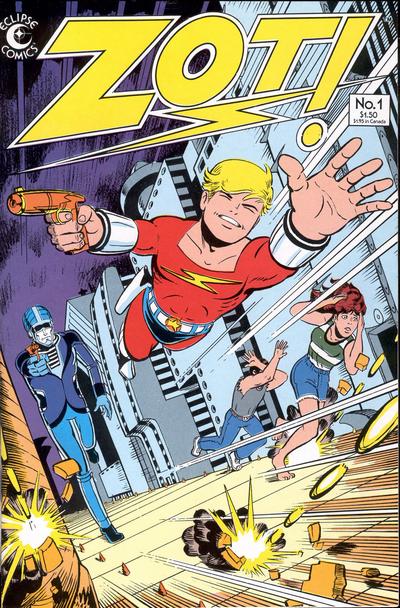
A blond boy in a red jump suit with withe boots and belt, a ray gun in his left hand, his right hand outstretched in front of him is flying towards the reader. To his right his robot butler is walking behind him, pointing a gun at the reader while to his left a girl stumbles due to the backdraft of his flying past

If you don’t like the colour issues of Zot!, comics are not for you. Scott McCloud’s first significant comics project, it all starts with the titular hero from a parallel Jetsons future like Earth full of jet packs and flying cars, crash lands through a dimensional gate into the very ordinary life of bored teenage girl Jennie Weaver. Much later, after Zot! had been rebooted as a black and white title, this very ordinary life would become the focus, a critically acclaimed portrait of adolescence, but for the first ten issues it would be colourful high adventure all the way.

Back in the 1990s I was a regular at two comics shops: Het Perron, a traditional, mostly European orientated shop that had also started carrying American comics and Henk Lee’s Comics & Manga Store in Amsterdam. The first I went too every weekend I was visiting my parents, the second I went to every Thursday, new comics day. Henk Lee had his shop in the middle of Amsterdam’s Chinese district on the Zeedijk, at first as part of the Chinese supermarket his family already owned. I’d found out about him through an ad in one of the first US comics fanzines published in the Netherlands, Comic View, where he promised low prices and rare comics for cheap if you got a subscription. Back then Zeedijk was still somewhat of a junkie hangout, so it was a bit of an adventure for a provincial boy like me to make that first trek there…

Over the next decade I would buy most of my comics from there; I can still remember the smell of spices that hung over the store when it was still part of the supermarket. I’d soon established a routine of going in every Thursday, get the new batch of comics, then go to one of the Thai restaurants in the neighbourhood for dinner, occasionally strolling into the Red Light District by “accident”. What set Henk apart was not just that he carried new comics, as many other shops had started doing, but that he had a well stocked back issue section. Most shops just had random issues of whatever they had ordered new and some crap that had been floating around the Dutch comics circuit for years, but Henk actually imported them directly from America. Which is why I could get the first 18 issues of Zot! in one fell swoop. I already knew Zot! from mentions in the fan press, had already read Understanding Comics, so once these were available at Henk’s I immediately bought them.

The first issue is a masterpiece in how to get your readers excited. We get a few pages of Jennie moping about having had to move to the suburbs because of her parents jobs and her brother Butch teasing her, before Zot crashes into their lives, pursued by killer robots from Sirius who are after the key to the doorway at the edge of the universe. Jennie helps Zot defeat them, he returns through the gateway when she finds the key and ends up falling through it herself, together with her brother. Some exposition and touring of Zot’s future world of 1965 later, back to the action as a de-evolution cult attacks and Butch gets turned into a monkey…

Everything about this bops. The writing and art is great, while the lettering by Todd Klein, who designed the logo, and the colouring by Tom Zuiko is top notch too. McCloud would go on to do a lot of great, interesting comics but none quite as fun as these first ten issues of Zot!.

Anime Resolutions (The New Year’s kind)

I was good yesterday. Instead of watching the first two episodes of yet another boring isekai premiering this season, or the equally boring first episode of a mobile game adaptation, I rewatched the first three episodes of 1999’s To Heart.


You don’t really get this sort of aspect to aspect mood setting scene anymore in anime, do you? Based on a Aquaplus romance simulator, To Heart is a nice little romcom centered on Hiroyuki, the guy at the end of the clip. Hiroyuki has a little bit more to him than the usual potato-Kun, even if his personality consists mostly of being helpful to any girl he meets (except for middle school friend Shiho) and wanting to sleep. But there isn’t that much romance in these first three episodes and they’re mostly told through other characters than him, mainly his childhood friend Akari, who very much has a crush on him, unlike Shiho, who sees him as her rival and a nuisance.

I first watched this years ago, in 2016 and thought it was good, but not that special. The only reason I started rewatching it was because various people I follow on Bluesky were talking about how good it was, independently from each other (for Bless it was his anime of the year, frex). Yes, I am easily influenced.

But I also did it because I wanted to get out of the habit of trying every bucket of slop that’s released in season and then continue to watch it out of habit. There is so much good good anime I still need to watch I’d really should start being more ruthless in culling the crap from my diet. Especially because there are a number of series on my backlog I really want to finish this year as I’m starting to feel guilty about them. In order:

  1. Mazinger Z (1972), 54 out of 92 episodes to go:
    The super robot show that saved anime from being crushed by the Tokusatsu craze of the early seventies. A kids’ show, but one in which in the last couple of episodes I watched we see a bus full of innocent people being murdered by the bad guys, a plane blown up and crashed and similar violence. Started out episodic in a monster of the week format but starting to deviate slightly from the format in the last few episodes. Not really made to be binge watched which is the problem.
  2. Kingyo Chuuihou! (1991), 28 out of 54 to go:
    A comedy series set in a school full of weirdos, done by the same staff who would go on to work on Sailor Moon directly afterwards. I started watching this a couple of years ago as part of a group watch but fell behind and stopped. The problem I have with it is that I like it when I’m watching an episode, but rarely find myself wanting to watch it. It is very funny but also something that I can only watch in small doses.
  3. Mobile Suit Gundam ZZ (1986), 42 out of 47 to go:
    The third series in the OG Gundam chronology, the problem I have is that it’s a) an incredible mood swing from the previous series and b) its protagonist is an even greater jackass than Kamille or Amuro ever were. I first started watching this in 2020 (!) and never got more than five episodes in, even restarting it last year didn’t work. Just never build up the momentum to get over my dislike of Judau.

There are many other series I started and need to finish, but those three are the most important ones. If I managed to finish any of them I’ll be happy.

Area 88 12 — #aComicaDay (66)

One of the very first manga series to be regularly published in the US, from the time when they were still published like any other comic.

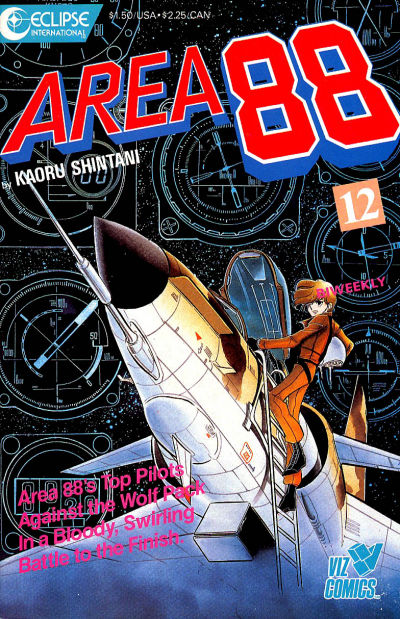
A floppy haired pilot is climbing out of his lovingly rendered jet fighter, some sort of Mirage or Kfir.

Manga had been published in the US before, most noticeably an abridged version of Barefoot Gen, but these had been one-offs. It was only after Viz Comics was founded in 1986 that the first regular series got published. At that time Viz was little more than a middleman, getting startup capital from and licensing titles through Japanese publishing giant Shogakukan. Therefore Eclipse was taken on board as the actual publisher, who at the time had a decade worth of experience with the direct market. Area 88 was one of the four launch titles, together with Legend of Kamui, Mai the Psychic Girl and Xenon. All of these were published as regular US comic books, artwork flipped so it reads left to right.

The strategy here was the same as other companies were doing with licensing anime at roughly the same time. Two of the four titles were science fiction (Mai the Psychic Girl and Xenon), while Legend of Kamui offered samurai action of a kind American audiences were already familiar with through B-movies. Area 88 however was a bit of an outlier, an adventure story about a Japanese airline pilot who, betrayed by his friends, is forced to become a mercenary pilot in the air force of a small, fictional Middle Eastern country in the grip of a civil war.

Here in Europe the jet fighter pilot strip is a well established genre. Typically starring a handsome airforce pilot, with optional comedic sidekicks, the emphasis is on ‘realistic’ adventures against a backdrop of lovingly rendered military hardware. The venerable Buck Danny is the best known example, starring an US Airforce/Navy pilot, but there’s also Tanguy et Laverdure serving in the French airforce and Dan Cooper whose unfortunate hero serves Canada. Area 88 fits in well with these comics, Shintani Kaoru too drawing his aircraft with loving care even as his characters are more cartoony. Not that you can tell from this issue as all action takes place in the sky, with everbody wearing helmets and oxygen masks.

In American comics I don’t think there was ever a similar series published; there were stories about fighter pilots in DC’s war comics, yes, but no series about a jef fighter pilot I can remember. So it’s a bit odd that Viz would choose Area 88 as one of its launch titles. Nevertheless it was successful enough, the first two issues getting a second printing and lasting for 36 issues in total. It was only because Viz was dissatisfied with Eclipse’s handling of their titles that these were cancelled. From what I can tell all of them did well enough and Mai the Psychic Girl especially became famous enough that for years there were plans to make a Hollywood movie out of it.

Of all these early manga, this issue is the only one I ever saw and bought myself. Either I wasn’t really looking for them at the time or they never made their way down to the Netherlands. The story here is simple, just one big aerial battle between the good guy mercenaries flying Mirages or Kfirs (as their planes have the little canard) and the bad guys flying Mig-23s. There’s nothing in here that makes you root for one set of mercs over the other, but the battle is well drawn and the planes look like their real life counterparts. What I liked is that this had a three page article on shoujo manga (or ‘women’s comics’ as it’s called here) by Heidi MacDonald which namechecks Urusai Yatsura and Rose of Versailles, among others.