Rather than give wingnuts the benefit of the doubt, try these

John Scalzi gets it wrong with the Hugos:

Please also keep in mind that even if you believe that the list is a cynical exercise, there are people and work on that list who may be well worth consideration, who may or may not have even known they were part of (or would have consented to) being part of a cynical exercise. Consider that you would be doing them (and the Hugos) a disservice to dismiss them out of hand. I’ve seen rumblings of people suggesting they’ll put everyone on the Correia/Day slate below “no award” no matter what, but if you’re doing that, you’re making these fellows’ alleged point for them. Again: Why do that? It’s nearly as easy to read a work (or at least, read as far as can) and decide it’s just not for you. And if it is for you, well. Surprise!

No, you can’t and shouldn’t attempt to judge books or stories on merit that are on the shortlist as a political gesture. You can’t take the politics away and any gesture at judging on “merit” is naive or disingenious. If you don’t want the Hugo to become yet another front in the rightwing war on culture, the only sane thing to do is reject any and all of these nominations. Pretending that doing anything else is value neutral or objective harms those this stunt was aimed at, the women, people of colour and others whom the initiators want to drive out of science fiction. As Rose Lemberg argues, doing so also marginalises yet again exactly those voices:

Also, conciliatory statements often have the effect of diverting the attention yet again (along with the accompanying social praise and support) from the marginalized voices to the power brokers, thus increasing the social capital of those who already have it, while marginalized voices go unpromoted and unsupported – unsupported often in context of vicious attacks from those who deny Diversity Age fans their personhood.

People like Vox Day and Larry Correia and, yes, John Scalzi already get too much attention and consideration just for being straight white males, with all the privileges that entails (something which Scalzi to his merit of course has long realised). Even being outraged at the Correia/Day stunt is once again talking about the same sort of people we always talk about, rather than the people we should be talking about more.

So who and what should we be talking about? Here are some suggestions for further reading:

Anything else that should be on this list?
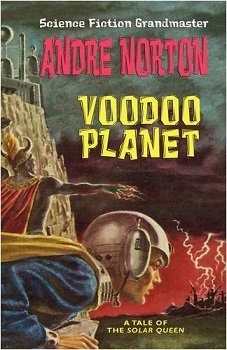
Voodoo Planet — Andre Norton

Cover of Voodoo Planet


Voodoo Planet
Andre Norton
192 pages
published in 1956

Genre science fiction got its start in the pulp magazines of the twenties and thirties and many of its early writers were just pulp authors writing the same old stories they’d always written, just with some sf flavourings. So instead of the brave sheriff depending on his horse and trusty six gun to fight off the bandits out in the Oklahoma badlands, you got the brave space marshall depending on his trusty rocket and raygun to take out the bandits hiding out in the Martian badlands. It’s this what fans meant when they talked about space opera, before that got co-opted for something more respectable, crappy fake science fiction stories that might just as well have been westerns. As the field matured and new writers moved in actually interested in science fiction as a genre, these stories quickly disappeared.

Or did they?

Tintin versus the big noses

Rudi de Vries’ dissertation Comics and co-evolutions : a study of the dynamics in the niche of comics publishers in the Low Countries, attempting to explain why the Dutch comics industry lags behind that of France and Belgium, sounds interesting:

Hergé’s exciting but wholesome adventures of Tintin were originally published in a refined Catholic magazine, and soon found their way to France and the Netherlands. The ‘big nose’ style favoured by Dupuis, publisher of the Robbedoes comic strips, became very popular, inspiring Goscinny and Uderzo, the creators of Asterix. De Vries: ‘The fierce rivalry that developed between the Belgian publishers only served to stimulate production.’ Cartoonists like Hergé (Tintin), Morris (Lucky Luke), Peyo (Smurfs) and Franquin (Guust Flater or Gaston) grasped this opportunity to exercise their influence on the development of comic culture.

[…]

The Dutch comic culture is lagging behind the rest of the world. The swift rise of comics in Belgium and France can be traced back to historical developments. Back then, Dutch publishers were happy with translations of foreign comic strips. De Vries: ‘There are other reasons for Dutch comics failing to thrive, but they are more difficult to pinpoint. I think it has something to do with our Calvinistic outlook on life.’

The complete dissertation can be downloaded from the University of Groningen website. Found via Dutch comics journalist/blogger Michael Minneboo through the interview (Dutch only) he did with de Vries last year.

Kick out the jams motherfucker!


So in 1989-1990 when the KLF broke through with their Illuminantus! influenced house I was in the perfect position to be susceptible to them, having just myself gotten Robert Anton Wilson and Robert Shea’s classic hippie drugs, sex and conspiracy out of the secondhand bookstore myself. For a while when I was fifteen-sixteen it was my bible (could’ve been worse, at least it wasn’t Ayn Rand), so hearing the Justified and Ancients of Mummu refered in dance music just knocked me off my feet. It felt dangerous and modern and nerdy but in a cool way.

The politicalisation of the Hugos

Ian Sales is worried and upset about the Hugo Awards:

First, a bunch of right-wing scumbags campaigned to get some of their right-wing scumbag friends onto various of the shortlists. And they mostly succeeded – of the twelve people on their “ideal ballot”, seven made it onto the shortlists. What they did was perfectly well within the rules, and similar campaigns have taken place in the past – although none have been as successful as this one. Let’s be clear about this, however – this wasn’t because they wanted to see their friends on the shortlists, this was a direct attack on a part of genre fandom. And yes, it’s an attack on the part that exhibits the qualities genre fandom should exhibit – inclusivity instead of misogyny and homophobia, diversity instead of racism and marginalisation, progressiveness instead of regressiveness… you know, the qualities associated with civilised human beings.

Worse, this was a revenge attack for what happened with the Science Fiction and Fantasy Writers of America, which cleaned up its act this year and gotten shot of some of the rightwing loonies cluttering up its publications. Vox Day and friends had problems with the SFWA, so they took revenge by pushing a political slate of nominations on their readers designed to annoy the liberals in their head. So in order to “punish” the SFWA they’re wrecking the Hugo Awards, which have nothing to do with that organisation. What they’ve done is legal even if it goes against the spirit of Hugo nominations. It’s a typical rightwing tactic, trickled down from how the Republican/Tea Party abuse of congressional procedures in real life American politics.

As such, it’s therefore much more of an attack on the Hugo Awards than the nomination of the Wheel of Time series, which misguided as you think it may be, is done out of a genuine love for these books, without any political undercurrent. This has happened before and will again, the only novelty being that an entire series has been nominated under the idea that it is a complete work, just like the Lord of the Rings books would’ve been had the Hugo existed then. Whether this argument holds merit for this particular series is debatable, but it’s not a problem for the Hugos as a proper, non-political award, unlike Vox Day’s stunt nominations.

Apart from the fact that Day is trying to punish SFWA by meddling with the Worldcon/Hugo Awards, the real problem is the politicalisation of the Awards, which hasn’t been done to the Hugos before, or at least not on this scale and this successfully. Of course, they imagine that they’re in a war with a leftist-liberal conspiracy to make science fiction politically correct, but we sane people do not need to encourage that delusion. It does make it harder though to solve this problem, when one faction thinks it’s in a war for the very soul of fandom while the rest of fandom just thinks it’s nominating the books and writers they like.

Even if there were an organised faction to oppose these chuckleheads, it couldn’t engage in the same tactics without destroying the awards. You can’t remove their slate form consideration because how it was nominated was all done according to the rules, even if the intent clearly goes against the spirit of the Hugos. At the same time, this slate should not be treated as normal nominations either, to be judged on merit, as S. L. Huang explains. The only thing left therefore is either to boycott the awards entirely and leave the wingnuts their victory, or to consistently vote No Award above the wingnut candidates. That latter would at least neutralise this attempt to game the Hugos. Unlike Ian, I have no real worries about the credibility of the awards outside this particular context; the Wheel of Time nomination or the idea that a couple of lesser books by popular writers are on the list doesn’t break the Hugo because that has always happened.Sometimes they even win.

Update: according to Feòrag, it’s better to list what you want, then No Award and not list the rightwingers, so their votes can’t be transferred.