Farnborough airshow 1968.
Vulcan world record 1961
Black Knight: Britain’s First Space Rocket 1958.
What killed it (1965).
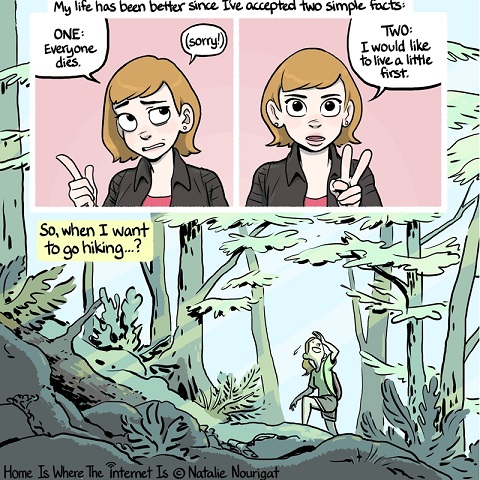
There’s nothing I don’t like about Natalie Nourigat’s Don’t let fear stop you from traveling. The story, the message, done without preaching, the cute characters, the artwork. What I especially found impressive is how well it looks even on the small screen of my mobile phone, still easily readable (and loaded relatively quickly as well).
It’s interesting how text heavy this strip is. Nourigat makes full uses of captions, thought balloons and all the other comics paraphernalia the modern superhero strip has rejected as not serious enough. Yet here Nourigat tells the story mainly through captions, only occasionally talking directly through the reader, transitioning seamlessly between the two, as above. It’s a technique you see a lot in diary and non-fiction comics (Joe Sacco’s work e.g.). Done wrong, it can be stilted, unnatural and dull, but Nourigat makes it work, knowing when to use normal dialogue instead. You don’t normally notice lettering in comics, but there are a lot of regular comics that could use Nourigat’s lettering here as an example of how to do it well.
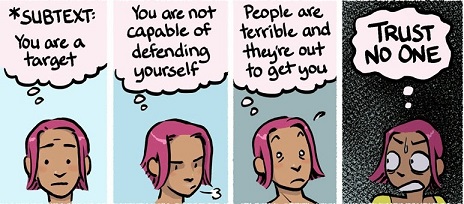
Nourigat’s artwork is clean with crisp, clear lines and an excellent use of colour, especially background colour. Whenever she’s able, Nourigat drops any background details from her panels, using single slabs of colour instead. this of course helps to make them more easily readable in a smaller format, making the foreground characters “pop” out even on a mobile phone. It also helps to distinguish “story” panels from “commentary” panels; everytime she herselfs appears to talk directly to the reader, it’s against a solid single colour background. She also uses these colours to indicate moods, as above, where the colour slowly changes from light to dark.
What I only really noticed once I started going over this story again for this post is the way she simplifies her drawings where needed. Her characters have, big, expressive eyes in the larger, closeup panels and just dots in smaller and action orientated scenes. Mouths become simple lines or ovals,figures are reduced to a few lines. Sometimes she does it even in the same panel, with the viewpoint character having normal eyes etc and background figures sketched in. Again, it makes it easier to read on smaller screens and makes the story less busy in general, helping to guide the reader to what’s important, rather than overwhelming them with unnecessary detail.
In short, this is an incredible showcase for how to draw comics for the modern internet and it’s impressive enough I bought a couple of her books online.
I’m more than slightly in awe of Olivia Waite. For the blogging from A to Z in April challenge she decided to do a series of posts on intersectional feminism in Romance, leading to such gems as this review of Sandra Hill’s Frankly My Dear:
This is the petty tyranny of inconvenience — just as the heroine believes that her individual comfort somehow justifies the enslavement of roughly a hundred other human beings, romance readers feel it’s inconvenient and uncomfortable to reflect on the ways the genre not only has marginalized but continues to marginalize not only characters, but also readers and authors of color. This book was not written by an obscure self-published writer with a small niche audience. Sandra Hill is a New York Times bestselling author, a genre mainstay for the past two decades; she is still writing books set in the contemporary South, though I am certainly not going to read them.
In her introduction post she sets out how she will do this:
Every day in April, Sundays excepted, I will post about an author or a book that features something other than the straight white wealthy cis able-bodied mold romance is so wedded to (see what I did there?). These will not be reviews in the usual sense, though I will usually mention whether or not I find a book compelling as a romance. Instead, these posts will be literary or structural analyses with a feminist lens, using as much privilege-checking as I know how to bring. Many of the books are no longer new, so if you can think of more recent releases that grapple with the same issues, please mention them.
Every day in April, Sundays excepted, I will post about an author or a book that features something other than the straight white wealthy cis able-bodied mold romance is so wedded to (see what I did there?). These will not be reviews in the usual sense, though I will usually mention whether or not I find a book compelling as a romance. Instead, these posts will be literary or structural analyses with a feminist lens, using as much privilege-checking as I know how to bring. Many of the books are no longer new, so if you can think of more recent releases that grapple with the same issues, please mention them.
Sometimes, as with Sandra Hill’s novel, this means looking at a problematic work to see what it’s doing wrong and what this means for romance as a genre, sometimes, as with Jacqueline Koyanagi’s Ascension, it means looking at a book that gets it right and show how it does it:
It’s easy to say that Jacqueline Koyanagi’s luscious debut Ascension ticks just about every box on the anti-kyriarchy bingo card: our heroine is a queer disabled woman of color (in space!). She falls in love with a disabled starship captain who’s in a polyamorous relationship with another queer woman: a medic who plans on having children with a man-slash-engineer-slash-sometime-wolf. But like we saw with Her Love, Her Land, this book was written from deeply within the perspective of the identities it represents. The characters’ disability is a plot point, but it’s not The Plot Point — the same goes for queerness and race: they’re baked in, functions of character rather than Moving Moments. Polyamory gets a bit more of the Very Special Episode treatment, but this aspect is presented as bridging a gap between two different planetary cultures, one more sexually conservative than the other.
And all the characters are compelling, and several scenes made me gasp out loud (Adul!), but what I can’t wait to talk about is how this book treats the problem of humans having bodies.
And I’m so glad that finally not only has somebody else heard of Ascenscion, but she seems to like it as much as I liked it. It’s a novel I found only by accident, in the for sale section of a local bookstore and which nobody else online seems to have read, unlike say Ann Leckie’s Ancillary Justice, which is somewhat similar.
I’m not much of a romance reader myself, but it is interesting to read these reviews and certainly some of them make me curious about the books reviewed, like e.g. Jeannie Lin’s Jade Temptress or Zora Neale Hurston’s Their Eyes Were Watching God. It’s impressive not so much to write a post each day — I’ve managed to do that for long periods of time myself — but rather to write such substantial and insightful posts on such a difficult subject day after day.
(Found via Natalie Luhrs, who has a knack of finding interesting, chewy sort of links.)