I was reminded of this the other day, one of those late nineties hits you see on MTV every day for a month or so and then never again, making you wonder whether you dreamed the whole thing up. That’s Tony “the way to Amarillo” Christie doing the vocals, Jarvis Cocker who wrote it and All Seeing I what did the music.
DC called this a “fun Easter egg”
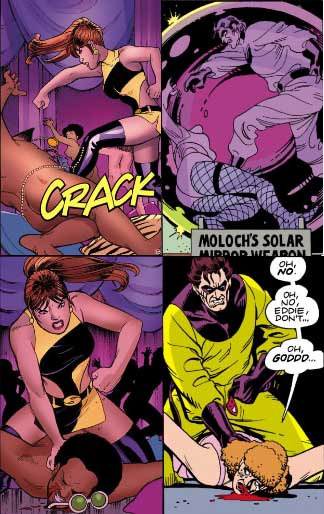
Before Watchmen was of course a moral and artistic travesty, amply documented in William Leung’s Who whitewashes the Watchmen review at Hooded Utilitarian, but what really struck me were the “homages” or “fun Easter eggs” as DC comics called them in their promotional material.
Even on their own merits these easter eggs are tone deaf, considering how much Alan Moore loathes and despises DC and Before Watchmen, so you must be pretty clueless as artist or writer working on it to think, “hey, I know, I’ll show my respect by putting in a little wink to the original series”. Worse though, when, as Darwyn Cooke and/or Amanda Connor did, the “homage” is to the rape scene where the original Silk Spectre was attacked by the Comedian in the first issue of Watchmen, here reimagined as her daughter beating up a pimp. That he’s a huge, fat black man (with all that implies, considering all those racial fears about what black men want to do to white women and how that worked out in real life) is just the racist icing on this particular sexist shitcake.
I do hope it was Darwyn Cooke who thought of this, because it’s exactly the sort of half-clever idea he tends to come up with and I think more highly of Amanda Connor, though you do wonder what she thought when drawing it. Cooke on the other hand is the epitome of the conservative fanboy turned professional, with no ideas of his own, spreading his bland nostalgia over everything he works on, in that sickening cutesy style of his.
Wearing smiley earrings and a cute pout on her face, Laurie is a badass chick delivering rough justice to a mean black dude. Like father, like daughter. It is blatantly obvious what effect Cooke and Conner are aiming for here. But the question they apparently didn’t have the wits to ask themselves is what on earth led them to think it’s okay to use Moore’s serious critique of misogynistic violence as a vehicle for their shallow indulgence in kick-ass theatrics. Cooke may do all the talking he wants about respecting female characters and Conner may present herself as a champion of her gender in a male-dominated industry (e.g. Zalben, “FanExpo” pars. 4-7); but to take the most well-known rape scene in mainstream comics and turn it into a celebration of the rapist’s progeny bespeaks gross insensitivity and moral blindness, not to mention being deeply offensive to the spirit and intelligence of the original Watchmen.
Then again, the whole idea of the Comedian as unseen father figure watching over Laurie goes so against the spirit of the original series that it’s not that surprising DC, Cooke and Connor see nothing wrong with paying homage to a rape.
That’s my reading sorted for this year
This is an awesome list of science fiction/fantasy novels coming out this year and I like Mahvesh Murad’s reasoning here:
There is a great deal of potentially excellent writing and brilliant storytelling to look forward to this year, especially from women writers of speculative fiction. A number of titles that I am looking forward to are from writers of colour, many with stories set outside of the usual Eurocentric/American diaspora.
Sure, you can make up any culture you like as a writer – as long as your worldbuilding is authentic and strong, we’ll buy it. But when you’re not from the mainstream, when you’re not a white, heteronormative writer from the UK or US, you’ll probably be bringing your own cultural background, your own myths, beliefs and baggage to your work and it will probably be a whole lot richer and more interesting for it.
By way of contrast, James Nicoll linked to what NASA thinks makes for good science fiction, fighting the cutting edge battles of the seventies.
Growing Up Gender Nonconforming
What Molly Knefel talks about in wasn’t my childhood, but is a great piece of writing:
Girls who wanted to be my friend wanted to help me get better at being a girl. Like a Bridget Jones-esque makeover montage, I let them burn my forehead with curling irons, poke me in the eyes with eyeliner pencils, and look me up and down in dressing rooms. I was so thrilled for the friendships I was convinced I enjoyed the forehead burning (my same friend, always burning me in the same place, before every quarterly Junior High dance, as reliable as the changing of the seasons). What began in early adolescence– genuine friendships forged through drag-like gender performance– continued well into adulthood. I’ve made wonderful friends through playing dressing up with them. The friendships are real, and even the girlness was real, at the time.
N. K. Jemisin on the SFWA petition
N. K. Jemisin on that SFWA petition:
Oh, and — people who signed that petition: you want to know the real reason why you’re getting so much disrespect from the rest of the genre right now? It’s because you and your friends keep pulling shit like this while the rest of us are just trying to keep the lights on and put food on the table. It’s like Republicans passing bill after bill to fuck up reproductive health rights while the economy’s in the toilet; what the hell does this have to do with anything that matters? You got yours. You’re still getting it. You had every advantage in your favor, and you used the hell out of it. Good on you. But stop pitching shitfits just because the rest of us want a piece of the pie — the pie all of us helped to create — too.