Women writers Wednesday — blogging edition

Part something in an irregular series.

So yeah, today I would like to spotlight some of the female bloggers I started reading in the past of couple of weeks, partially thanks to the whole ongoing SFWA kerfuffle. Everytime we’ve had an outbreak of sexism in science fiction fandom it also has brought new female voices to the foreground and this time hasn’t been any different.

Natalie Luhrs has been one of the most sensible voices during the SFWA controversy, as well as with the more recent Loncon Jonathan Ross fiasco. Beyond that, she also has a great ability to find interesting and thoughtful links.

S. L. Huang like Luhrs has been a voice of reason during the recent sexism scandals, is a new writer whose first book will be published this year and who keeps writing great posts on the same subjects I would’ve written about, but she does it better.

Susan Abernethy writes about history and her blog is a treasure trove of posts about well known and not so well known parts of history, especially British history.

Loretta Chase & Isabella Bradford also write about history, both in their dayjobs as bestselling writers of historical romances and on their blog. They seem to have a real affinity for the Georgian era, but roam wide and far and have a knack of finding links to other interesting blogs — like Susan Abernethy’s above.
And they thought I was weird not to go in the water

So on Saturday my eldest nephew celebrated his fifth anniversary and he wanted to go to the swimming pool, the same “subtropical paradise” we used to visit as kids in the eighties and which hadn’t changed since. I used to swim a lot as a kid, but have become grossed once I started to think too much about what was in that chlorine filled water and especially what people put in it. So I spent the afternoon in a beach chair catching up on my reading, which the family found hilarious and teased me about. Well, who’s laughing now:

While some people are disgusted by the thought of human pee in their pool water, others figure there’s no harm in letting loose a little urine while swimming. It turns out, however, that when urine reacts with chlorinated water, it may be creating chemical byproducts hazardous to everyone in the pool.

Cyanogen chloride (CNCl) and trichloramine (NCl3) are nitrogen-containing disinfection byproducts (N-DBPs) that are commonly found in swimming pools. In low levels, N-DBPs have been linked to eye and throat irritation, and in high levels, they have been linked to nervous and cardiovascular problems. It turns out that this toxic swimming pool environment may be caused, at least in part, by swimmers peeing in chlorinated pools.

So next time your eyes are stinging when you’re swimming in a public pool, it’s not the chlorine that’s causing it, it’s the byproducts of piss reacting to the chlorine…. (As my brother in law also pointed out on saturday)

Kenau


To call a woman a kenau in Dutch is to call her a harridan, a bitch, harsh, strident, aggressive, taking on masculine qualities. It’s a slur that’s rooted in an actually existing, historical woman, Kenau Simonsdochter Hasselaer, a Haarlem born widow, woodsmerchant and shipbuilder who became famous due to her role in the siege of her hometown by the Spanish in 1573.

As you of course know, the Netherlands fought the Eighty Years War to liberate themselves from Spanish and Catholic oppression, a large part of which consisted of the siege and countersiege of rebel or loyal cities. Haarlem in the 1570s was one of the richest, most important cities in the north of Holland and when it rebelled the Spanish were quick to put it down. The siege ended in a defeat for the rebels, but not before Kenau’s role in it had become legend.

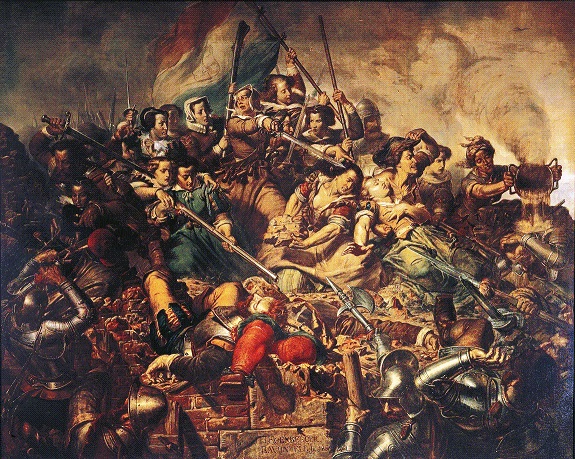
19th century painting of Kenau Hasselaer on the walls of Haarlem by Barent Wijnveld and J.H. Egenberger

As legend has it, Kenau Hasselaer was the leader of an army of women who fought together with the men on the walls of Haarlem, pouring boiling pitch and water over the Spanish troops attempting to climb the walls. How historical this is, has been disputed, but what’s undisputed was that she was involved in supporting the soldiers on the walls, organising repair works and the like.


But of course the idea of Kenau Hasselaer as the firebreathing leader of a monstrous regiment of women is much more interesting, something that was played up in Dutch propaganda after the siege and which ultimately led to her name becoming the synonym for an aggressive woman, with the connection to the historical figure forgotten. A new Dutch movie, which premiered only this week, seeks to restore that connection, to rehabilitate Kenau as a name of pride, not a slur.

Course, being a Dutch film it’s not likely to be much good, but the idea is interesting.

Books read February

February was dominated by one book and one book only: Samuel R. Delany’s Dhalgren, which I started at the beginning of the month and only finished in the last week of February. Very unlike me, I couldn’t read anything else beside it, because this was a book that demanded and got my full attention. I needed to concentrate to read it and when not reading it, I had no desire left for other books.

Fortunately Dhalgren is a masterpiece, one of the greatest novels ever produced as science fiction, so I didn’t begrudge its monopoly claim on my reading.

However, I did manage to squeeze one other book into my reading at the end of the month, K. W. Jeter’s Morlock Night which, as both Jeter and afterword writer Adam Roberts take great pains to tell you, is one of the books that created the steampunk genre back in the late eighties. I’m not actually sure I agree with that: there were steampunk books published before it that actually have more in common with the genre as it exists now than this book does. It’s also not as good a book as it thinks it is, glorified pulp ultimately.