Imagine wanting new experiences as a sf reader!

So Alex Dally MacFarlane started a series on gender diversity in science fiction which some obnoxious little wankstain “author” called Larry Correia took exception to, whose nonsense was aptly but slightly more charitably than I would’ve done dissected by everbody’s science fiction pinup, Jim C. Hines. The gist of Correia’s ranting was that nobody was interested in all that gender nonsense and it was all political correctness and message writing and people want story, not strange queer or agender people in their fiction, anyway, you know the type.

Basically what he seems to say is that only white straight men read science fiction and they don’t want to read about anybody else but themselves, because the familiar is truely what you read sf for. Well, Ria off off Bibliotropic is here to set him straight (heh) on the first part:

I love opening a book and sinking into the story and discovering that a character is like me. Whether that means they’re asexual or agendered or just have a weakness for knitting with cashmere yarn, it’s a little bright light that goes on, a link between me and the person whose story I am following, and it makes me want to read about them even more. It’s a very selfish impulse to want to read about people in whom I can see myself reflected.

But that doesn’t make it a bad thing. It makes the character real, because I am real. It makes them a person, because I am a person. It means they have no point, because I have no point, but why should that mean that I and everything about me should disappear for the comfort of people who already have far more options to see themselves reflected in the pages of the novels they read? My existence doesn’t depend on someone learning a lesson from me. I am not an after-school special.

And I’ll set him straight on the second. You know, these days I not only reading science fiction that doesn’t feature the kind of protagonist I can see in the mirror, but actively seek it out. I bought Ascension because its cover featured a black woman; heck, this is my FemShep. Why? Not out of some poofaced desire to know what it would be like to be a black woman in the future, that would be slightly offensive, but because it’s fun, it’s interesting to read the adventures of somebody who isn’t you.

And that’s something people like Correia just can’t understand, that people can be genuinely interested in post-binary gender, even if they’re not personally involved in it. Which is just sad for a science fiction writer.

Ancillary Justice — Ann Leckie

Cover of Ancillary Justice


Ancillary Justice
Ann Leckie
385 pages
published in 2013

It’s funny how you don’t notice how ingrained gender is until you get your nose rubbed in it. In Ancillary Justice, Ann Leckie makes it clear by the third page that when her protagonist Breq uses “she” and “her” she uses it as a neutral pronoun, yet unless I paid close attention or Leckie explicitly outed a character as male, I kept thinking of every character she meets as female. That’s I think a response more readers will have, as we’re just not used to thinking of the female form as universal; traditonally it has always been “he” or “him”, or something like singular “they” for those of us aware that the male isn’t actually universal. It may seem like a too clever writing trick, a clumpsy attempt at showing the reader the gender assumptions build into the very language we use, but I don’t think this is actually what Leckie had in mind. What it does instead is establishing the fundamental strangeness of Breq herself even before we learn she’s the last remaining component of a thousands years old warship’s AI.

That consistent use of “she” and “her” foregrounds the difference of the Radchaai culture Breq comes from. It’s a bit of unexplained strangeness that tells a lot about their society, culture and history, most importantly that the Radchaai are inherently matriarchal in the same way most if not all actually existing human societies are patriarchal. But there’s more going on with Breq’s gender blindness, as other Radchaai seem to have far less trouble differiating between men and women, even if they use the same pronouns for both. Meanwhile Breq not only has pronoun troubles, she also has trouble remembering which secondary sexual characteristics are male and which are female. It’s this that singles her out as not quite human.

Read more…

A fair point, well made

Over at Mighty Mighty Godking, John Seavey raves about the new Ms Marvel and how it’s a really great comic. As you know Bob, the new Ms Marvel is a Pakistani-American Muslim teenage girl, first time a Muslim hero has had her own Marvel comics and as such has been a Big Deal before the first issue came out. Seavey is at pains to point out that despite its “worthiness”, Ms Marvel is a great comic in its own right. This annoys one commenter to go on a bit of a rant how it’s never allowed to just enjoy seeing somebody like you in comics

I bring this up because I have actually had straight people bitch me out for telling them that I like a book or a movie JUST BECAUSE it has queer characters. They get so incredibly offended by this, the idea that I might derive enjoyment from nothing more than seeing myself existing in the world of fiction, this blessing that they’ve taken for granted all their lives.

So I wouldn’t actually be bothered if Ms Marvel sucked. It’s THERE, in the midst of a sea of white, white, white superhero books. Its mere existence is heroic. If nasty little white fanboys have an issue with that, maybe they shouldn’t have created the problem in the first place.

Comics have always had a problem with showing heroes other than straight, white males, something that has been slowly changing. Because so many of the attempts to change this, to showcase somebody else for a change were godawful, done by well intentioned but clueless white men and because that meant any “minority” book is judged extra harshly by fans, I can understand why Seavey felt the need to emphasis that Ms Marvel first and foremost was a good comic. But I understand tickstander’s irritation even better. There are so few heroes of colour or queer heroes or even heroines that even get their own titles and when they do they largely get ignored or written off as “politically correct”; certain “fans” do seem to hate these titles just for existing.

Truth is, a greater diversity can only help comics and attempts like Ms. Marvel should be applauded for just existing. What helps is that the writer, G. Willow Wilson is herself Muslim, though through conversion, so has some sympathy and experience with what she writes about.

Two years, three months

For some reason it’s doing the shopping that gets me a lot, walking through the supermarket getting stuff for the weekend, nobody to take into consideration but the cats and myself. It’s been two years and three months since I last had to shop for anybody but me, and actually the two years before that saw me not needing to more often than not too. Sometimes that gets to me and I feel myself getting maudlin over by the sausage rolls.

Sandra’s toothbrushes are still in the cup on top of the sink in our bathroom. “Our” bathroom; I still find myself talking that way, or mentioning Sandra and then having to decide about to explain or keep sthum about the whole dead wife thing to coworkers when you’re just talking about Devon or whatever.

Keepsakes and reminders of her are everywhere of course, but you slowly see the character of our house change now she’s no longer here to put her stamp on it. It’s half in stasis, half turning into a slightly bigger version of my old student flat. I keep oscillating between wanting to keep everything as it was and wanting to change everything, in the end doing neither but letting entropy do its work for me.

To be honest, I’ve been running in stationary myself as well. The days go by and things change, but I’m just going along with the flow, no clear goals in mind. Living with somebody for so long, having been so focused on getting Sand better for the last five years, then having all that effort be for nothing, these past two years just have left me goalless. Living alone again after so long isn’t getting any easier. Not even after two years.

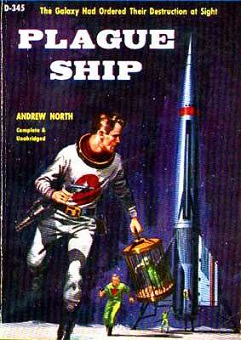
Plague Ship — Andre Norton

Cover of Plague Ship


Plague Ship
Andre Norton
192 pages
published in 1956

Hold on to your tail fins, space fans. This retro rocket boosted tale is sure to knock you out of your orbit. Oy, did this very fifties future slang get old fast in Plague Ship. This is another of Norton’s books at Project Gutenberg and mildly irritating as its language occasionally was, it was also the perfect kind of light adventure science fiction to be read in small snatches on my phone, while getting coffee at work.

Plague Ship is the second in Norton’s Solar Queen series, about the adventures of the crew of the ship the series is named after, free traders trying to eke out a living making the kind of trading deals the big companies can’t. The Solar Queen is literally a huge rocket ship, complete with humongous fifties tail fins to land on. Amongst its crew is Dane Thorson, Cargo-master-apprentice and our hero, prone to saying things like “rest easy on your fins” and “right up the rockets” and all other sorts of horrid expressions you have to read around.

Read more…