Cartoonists urge Angoulême to drop Sodastream

Dozens of well known cartoonists, including Joe Sacco, Tardi and Baru have signed an open lettre urging the Angoulême Comics Festival to drop Sodastream as a sponsor:

We, cartoonists, illustrators and authors from all countries, are surprised, disappointed and angry to find out that SodaStream is an official sponsor of the Angoulême International Comics Festival.

As you must know, SodaStream is the target of an international boycott call for its contribution to the colonization of Palestinian land, due to its factory in the illegal settlement of Ma’ale Adumim, its exploitation of Palestinian workers, and its theft of Palestinian resources, in violation of international law and contravening international principles of human rights.

Angoulême has had an important role in the appreciation of comics as an art form for over 40 years. It would be sad if SodaStream were able to use this event to whitewash their crimes.

We ask you to cut all ties between the Festival and this shameful company.

Sincerely,

This fight against Sodastream, for having established a plant in a Israeli settlement on stolen Palestian land in the West Bank, a plant Sodastream itself has admitted was a mistake, is just one small battle in the BDS (Boycott, Divest, Sanctions) struggle against the Israeli Apartheid State. It’s similar in fact to that long struggle against South African Apartheid in the seventies and eighties and hopefully it can lead to similar results. Certainly the Israeli government fears the movement:

The movement’s economic impact is also becoming evident. The recent decision by the $200 billion Dutch pension fund PGGM to divest from the five largest Israeli banks because of their involvement in occupied Palestinian territory has sent shock waves through the Israeli establishment.

To underscore the “existential” danger that B.D.S. poses, Israel and its lobby groups often invoke the smear of anti-Semitism, despite the unequivocal, consistent position of the movement against all forms of racism, including anti-Semitism. This unfounded allegation is intended to intimidate into silence those who criticize Israel and to conflate such criticism with anti-Jewish racism.

Getting Angoulême to drop Sodastream sponsorship, though welcome, is of course not going to change Israeli policies but seeing conservative pension funds start to drop Israeli investments, as much out of conviction as for legal concerns, that’s a game changer.
Books read January

With the first month of 2014 done, I’m reasonably satisfied in what and how much I’ve read. Eight books, five science fiction, one fantasy, two non-fiction. Could be better, could be worse. Five female writers, three male; I’m still trying to keep a rough gender equality in what I read.

Key out of Time –Andre Norton
Another novel in the series that started with Time Traders finds Ross and friends stranded in the prehistory of an alien planet. More decent young adult adventure science fiction.

Rocannon’s World — Ursula K. LeGuin
An early LeGuin science fiction novel, not nearly as good or interesting as the novels she made her reputation with, but still of interest for fans.

Women in Medieval Europe 1200-1500 — Jennifer Ward
A thorough introduction to the roles women could and did play in the late middle ages.

Soviet Operational and Tactical Combat in Manchuria, 1945 — David Glantz
An examination of the Soviet campaign against the Japanese late in World War II, in which they basically crushed the Japanese forces in Manchuria in barely a week.

Pushing Ice — Alastair Reynolds
When Janus, one of Saturn’s moons, turns out not to be and leaves it orbit, only the Rockhopper is in place to follow it. Just another gritty Reynolds hard science fiction bravoura.

The Killing Moon — N. K. Jemisin
First in a duology (so far) of fantasy novels inspired by certain aspects of Egyptian history and mythology.

Zoe’s Tale — John Scalzi
The fourth in Scalzi’s Old Man’s War series, a retelling of the third one, now told through the eyes of the seventeen year old daughter of that novel’s protagonists.

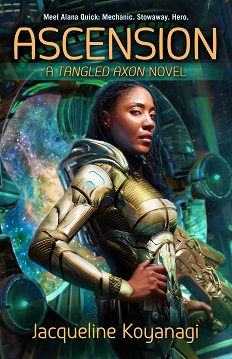
Ascension — Jacqueline Koyanagi
Alana Quick is a starship engineer in a galactic wide depression when nobody needs starship engineers anymore. She stows away on the Tangled Axon and falls in love with its captain, Tev, — “blond hair, boots and confidence”.

Ascension — Jacqueline Koyanagi

Cover of Ascension


Ascension: A Tangled Axon Novel
Jacqueline Koyanagi
331 pages
published in 2013

It was the woman on the cover which drew me to this novel and the subtitle which almost scared me off again. The woman attracted me because it’s not often you actually do see a woman of colour on the cover of a science fiction novel, sometimes not even when the heroine is indeed a black woman. Seeing that got me to pull Ascension off the shelves, but reading the subtitle A Tangled Axon Novel almost made me put it back because it made it sound as if this was a novel in an established series, rather than a first novel. Luckily the inside cover blurb mentioned that this was Jacqueline Koyanagi’s first novel, so I took a punt. Not having heard of her or her novel before, in the end the cover as well as reading the first few pages were enough to make me want to read this.

And I’m so glad I did, because this was a glorious, wonderful mess of a book. Reading it, especially in the first couple of chapters, you get the idea that the author is only showing you glimpses of a much larger universe she’s been carrying around in her head for a long time, therefore occasionally making oblique references to things she knows and which are completely clear to her, but doesn’t quite explain to the reader. That’s the messy part of the book. The glorious and wonderful parts are its characters, its protagonist especially. Alana Quick is a sky surgeon, a starship engineer in the midst of a depression when nobody needs starship engineers because starships are obsolete. Her ex-wife left her for a career with Transliminal Solutions, the company that made them obsolete, her sister Nova has a flourishing career as a spirit guide, relieving rich clients from their anxieties, while her own obsession with space, with the Big Quiet, makes her unsuitable for anything but repairing spaceships even if the hard physical labour does her chronic nerve disease no favours. Having to deal with a debilitating disease while barely making ends meet, is it any wonder she stows away when the Tangled Axon comes looking for her sister? Or that she falls in love with the ship’s glamorous captain Tev — “all blond hair, boots and confidence”?

Read more…

No one will fail to support my right to exist unmolested

Science fiction fandom doesn’t have the best of reputations when it comes to providing safe spaces, so it’s heartening to hear about when a convention gets it right. When twistpeach got harassed, the Arisia concon took her complaints seriously and made sure her harasser was banned (which, it turned out, he was already) and once it became clear that this wasn’t a one-off incident, other cons were warned about him and several followed Arisia’s lead and banned him too. Twistpeach credits Arisia for having created a place in which she felt secure enough to come forward:

I was confident that I was in a safe place, surrounded by people who I could rely upon to back me up. No one will fail to support my right to exist unmolested in space and time, displacing the room for entitled jerks to have free reign. So I don’t have to be afraid. I am not alone. And yes. I have a right to be here.

I have these things because of activists against rape culture, movements against harassment at conventions in general, Arisia’s policy and personnel particularly, feminism, supportive friends, and a culture that has been significantly altered by them. I am so grateful that somebody told me that I have a right to be here. My community supports that right and it is because of them that I have the conviction to stand up for myself. Thank you to all of you who have made me strong enough to be a warrior.

All of this is excellent news, to see that sf conventions can get it right, that anti harassment policies can and do work and that problem individuals can be identified and do have to take the responsibility for their actions. In an ideal world this shouldn’t have been remarkable or newsworthy, but publicising such positive outcomes help both to restore confidence in sf fandom to clean up its own house as well as make clear fandom doesn’t tolerate harassment. Kudos to Twistpeach as well for being confident enough to write about her experiences so honestly.