Sun City


Little Steve van Zandt talks to Dave Marsh about Sun City, Paul Simon and the fight against Apartheid, on the eve of Bruce Springsteen’s first tour of South Africa:

And I met with AZAPO, who had a very frank conversation — I was talking to the translator — about whether they should kill me for even being there. That’s how serious they were about violating the boycott. I eventually talked them out of that and then talked them into maybe going kinda with my thing.

They showed me that they have an assassination list, and Paul Simon was at the top of it. [NOTE: In 1986, Paul Simon recorded tracks for his Graceland album in South Africa, in direct violation of the cultural boycott.] And in spite of my feelings about Paul Simon, who we can talk about in a minute if you want to, I said to them, “Listen, I understand your feelings about this; I might even share them, but…”

What strikes me almost thirty years later is how modern the Artist United Against Apartheid project was, especially compared to the other Big Cause projects (We Are the World, Live Aid). Much of that is of course because Little Steve was smart enough to bring hip-hop artists into project, not just pop and rock musicians. Also how much more and much more explicitly political. The famines in Ethiopia were presented as natural disasters, but Little Steve and co from the start made clear not only that the South African government was to blame for Apartheid and its evils, but also how much western support it received over the years. “Why are we always on the wrong side” indeed.
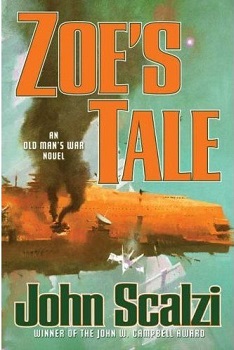
Zoe’s Tale — John Scalzi

Cover of Zoe's Tale


Zoe’s Tale
John Scalzi
406 pages
published in 2008

John Scalzi’s Old Man’s War was popular enough to spawn four sequels so far, of which Zoe’s Tale is the third. Military science fiction set in a Heinleinian dog eat dog universe, with hundred of alien races competing for new colonies and humanity only a middling power, the first three novels in the series followed new recruit John Perry and Special Forces specialist Jane Sagan through increasingly high stakes adventures, in the process learning that the Colonial Defence Forces they’re fighting for might not be entirely trustworthy. Things came to a head in the third novel, The Last Colony in which John and Jane, as leaders of the latest colony founded by the CDF had to fight off the Conclave, a four hundred members strong alien alliance as well as the CDF’s own plans to turn the colonists into martyrs. Amongst those colonists? Their own, adopted, daughter Zoë.

As you may have guessed from the title, Zoe’s Tale retells and extends the story of The Last Colony from Zoë’s point of view. On its own it’s therefore slightly less than a whole novel and can only be properly understood if you’ve read the previous novel. Things happen for reasons that are only partially explained, with major plot developments happening off screen, “as you know bobbed” later; at the same time Zoe’s Tale was partially written to explain some of the plot holes from The Last Colony. For me, it had been more than two years since I’d read it, so some of its plot was a bit hazy while reading this; not entirely dissimilar to Zoë’s experiences.

Read more…

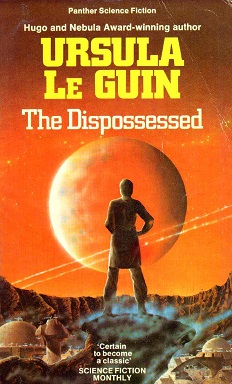
The Dispossessed — Ursula K. LeGuin

Cover of The Dispossessed


The Dispossessed
Ursula K. LeGuin
319 pages
published in 1974

After the Earthsea trilogy and of course The Left Hand of Darkness, The Dispossessed is arguably Ursula LeGuin’s most famous novel. It was one of a small group of novels in the early seventies –including e.g. Joanna Russ’ The Female Man that took the American New Wave and science fiction as a whole into a much more explicit political direction. It’s a novel that’s still controversial today, or at the very least can still lead to heated debates. The Dispossessed has been hugely influential in radicalising whole generations of fans, while there are plenty of conservative science fiction fans for whom its is a symbol of everything that went wrong with science fiction in the seventies.

The Dispossessed, firmly in the utopian tradition of Herland and looking Backward is a travelogue, set on the double planets of Urras, stand-in for seventies America and Anarres, the “ambiguous utopia” of the subtitle. The protagonist Shevek is a brilliant young physicist whose passion for science leads him to travel from his anarcho-syndicalist home planet to Urras because there he hopes to find the support he needs to finish his thesis. In alternating chapters we get to see his journeys to and on Urras as well as his upbringing and life on Anarres.

Read more…

Comics by mail

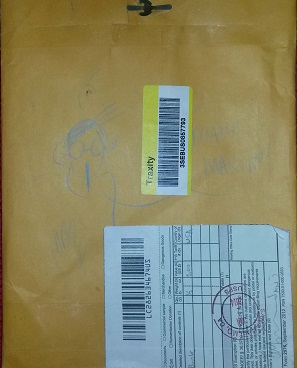
mystery envelope

It’s always a nice surprise to come home and find an international mail envelope on the doormat, especially when it comes with a drawing on the outside (barely visible above). Who was Sophie Yanow and why was she sending me mail?
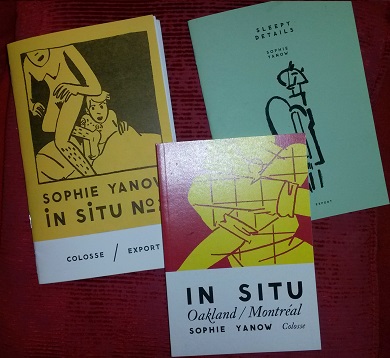
three comics by Sophie Yanow

Well, it turned out this mystery envelope contained three comics and then I remembered. Back in december Tom Spurgeon had linked to her because she had her laptop stolen and was holding a sale to replace it. I’d looked at her site, liked the comics I saw so the choice to get some comics from her wasn’t too hard.

What made it even easier, and which is something I would like to see more professional publishers do, is the way Yanow has set up her online shop. No bother with setting up accounts, just let paypal handle everything. Shipping charges, often horrendous when dealing with importing comics from the US (their annual sale is the only time I can actually afford buying directly from Topshelf), were reasonable as well, only six dollars.

Self promotion: threat or menace?

Adam Roberts doesn’t like the modern science fiction writer’s habit of self promotion. John Scalzi gets a bit defensive about it and explains why a little bit of self promotion is cool, but it shouldn’t be too much. Enter Amal El-Mohtar, who gets annoyed by both of them and explains why these attitudes about self promotion hinder writers coming from marginalised groups:

No hand-wringing or tut-tutting about reading widely or behaving with dignity or integrity or what have you is going to end the practice of brash, confident people telling other people, often and obnoxiously, to vote for them. But, crucially, the hand-wringing and tut-tutting does have an effect: it discourages the people who already feel silenced and uncomfortable from ever talking about or taking pride in their achievements.

You cannot with one breath say that you wish more women were recognized for their work, and then say in the next that you think less of people who make others aware of their work. You cannot trust that somehow, magically, the systems that suppress the voices of women, people of colour, disabled people, queer people, trans people, will of their own accord stop doing that when award season rolls around in order to suddenly make you aware of their work. You MUST recognize the fact that the only way to counter silence is to encourage speech and make room for it to be heard.

To be honest the self promotion of writers like John Scalzi has always annoyed me, all that relentless hyping and huckstering doesn’t fit the fandom I grew up with. Yet Amal El-Mohtar has a point here. Not everybody’s voice is equal in fandom and some people need to shout twice as loud to get their voice heard. And if nobody else does it, you have to do it yourself. Mohtar’s post is where it clicked for me how complaining about self promotion and crass commercialism can be privilege talking, especially in the context of the Hugo Awards.

The truth is that science fiction fandom, certainly that part of it that is defined by e.g. the Hugo Awards, still isn’t as welcoming and diverse as it should be, while the world of science fiction as a whole is much much larger than encompassed by the Worldcon/Hugo Award tradition. I’ve long held that the Hugos have lost much of their relevancy because they’re stuck with a voting audience no longer representative of science fiction as a whole. If left alone, these will keep voting for the same sort of writers they always vote for. Efforts to promote new and underrepresented writers therefore should be lauded, not scoffed at.