It’s been a bit of a Monday; I need a cup of the brown stuff.
Vast — Linda Nagata
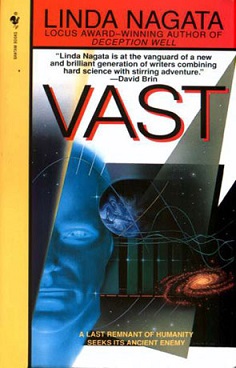
Vast
Linda Nagata
403 pages
published in 1998
Space opera used to be terrible, reactionary stories of brawny male heroes with safe anglosaxon names making the galaxy safe for terran manifest destiny by cheerfully genociding any alien races looking at them funny. Long derided as the lowest of the low, though with the occasional saving grace in the form of that elusive “sense of wonder” all science fiction strives to achieve, it was sort of rehabilitated in the seventies by a generation of fans and writers who’d grown up reading the stuff. In the eighties and nineties this led to the socalled New Space Opera, which took that sense of wonder and removed the xenophobia and human supremacy from it. Though in this New Space Opera the universe was far more indifferent to human pretensions than the old stuff, it could still be upbeat, as in e.g. Iain M. Banks’ Culture novels, where hundreds of various human races live happily ever after in an AI controlled utopia.
But not always. In Linda Nagata’s Vast the universe is not just indifferent, but actively hostile to human life. A millions years old alien war has left still active, automated warships behind, warships capable of blowing up suns. As humanity moved out of the Solar System and established colonies around other stars, these Chenzeme ships started to attack. One such attack has left only four survivors, fleeing the attack aboard the Null Boundary, a slower than light spaceship, who have decided to go look for the source of the Chenzeme coursers, somewhere in the swan direction of the Orion arm of the galaxy, all the while being chased by a Chenzeme courser themselves.
Books Read November
Twelve books read this month, finally starting to make a dent in my backlog, though I’m still buying books faster than I can read them #firstworldproblems.
The Dispossessed — Ursula K. LeGuin
Le Guin’s classic utopian novel is interesting but dated in its gender treatment, especially in the segments outside of its anarchist utopia.
The Normans — Marjorie Chibnall
A short introduction to the history of the Normans.
Silk — Caitlín R. Kiernan
Horror fantasy by a writer who has said some very smart things in various online sexism controversies. Good enough for me to read more of her work.
Italian Aces of World War 2 — Giovanni Massimello & Giorgio Apostolo
One of those slim Osprey books, mostly tedious summings up of various Aces’ kills and such. But the pictures are good.
Ancillary Justice — Ann Leckie
It was Ian Sales review that got me to read this and I wasn’t disappointed. A very solid space opera debut.
Command and Control — Eric Schlosser
Schlosser, who you might know from Fastfood Nation dives into the history of nuclear weapons in the USA; specifically how they were controlled and by whom. Turns out that control was often illusionary and accidents with nuclear weapons happened more often than you’d like…
Vanished Kingdoms — Norman Davies
Norman Davies looks at the more obscure corners of European history, showcasing some of the countries and states that didn’t quite make it. Interesting but a bit wearing in the end.
Plague Ship — Andre Norton
Read on my mobile phone, a download from Project Gutenberg, this is the second novel in her Star Queen series in which wily independent traders outwit the stodgy cooperations that rule the stars.
Conflict of Honors & Carpe Diem — Sharon Lee & Steve Miller
The second and third novel in the Liaden series. Very readable science fiction adventure stories, the sort you plow through in a couple of hours.
Dust — Elizabeth Bear
The first in a trilogy, a science fiction story set aboard a crippled generation ship parked in orbit in a binary star system which could go supernova any moment…
Chill — Elizabeth Bear
The sequel to Chill, opening up the world and dealing with the fallout of the previous book.
Booyah!
Can’t have those nurses smoking; bad PR you see
The National Institute for Health and Care Excellence (not so NICE) wants hsopitals to ban smoking completely:
“We need to end the terrible spectacle of people on drips in hospital gowns smoking outside hospital entrances,” said Professor Mike Kelly, director of Nice’s centre for public health, which drew up the new guidance. It is a “contradiction” for the NHS, which spends £2.7bn a year treating smoking-related ilnesses, to let patients smoke and not do everything it can to wean them off their habit, he added.
It’s the smug classicism that puts the particularly rancid icing on this shit cake. There’s a place and time to get people to stop smoking and it’s not when they’re stressed out, tired and hurting in hospital. Removing smoking shelters from your hospital won’t stop people smoking, it just means that they smoke outside in the wind and rain. Sometimes there are worse problems than having people smoke, for example being a smug condscending prick who wants to take away what little pleasure people can get in hospital.
Reading this made me so angry because I’ve been there with Sandra when the VU hospital decided — over Christmas — to shut down their indoor smoking rooms because some cow took offence to them, so she had to trundle outside into the cold, in her wheelchair (or bed even) to get about the only bit of comfort she had during the two years she had to spent in hospital.
Mind you, it would get worse for the staff:
Under the proposals hospitals’ entire grounds would become non-smoking areas, smoking shelters would be banned and staff contracts would forbid them from “smoking during work hours or when recognisable as an employee, for example when in uniform or wearing identification or handling hospital business”.
This really is the enforcement of a priggish morality under the guise of health concerns, because why else would you be bothered by people smoking in uniform? NHS staff isn’t paid nearly enough to be this kind of role model.