Animal Man 09 (Spanish) — #aComicaDay (62)

It was reading this comic while walking along the sidewalk that made me walk into a lamp post face first, on a school trip to Barcelona, to the amusement of my class mates.
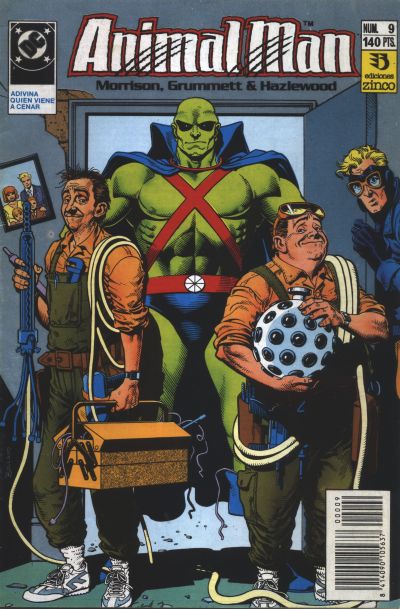
Animal Man is on the right having opened the door for the Martian Manhunter who stands in door opening. In front of him are two not too bright looking technicans holding pieces of high tech security kit

Yes, I was the kind of teenager that would buy a superhero comic in a language he doesn’t speak as a souvenir rather than something more appropriate. I didn’t even have the decency to buy an actual Spanish comic! That was the kind of nerd I was unfortunately. The rest of school trip was eventful. We saw the usual things you see in Barcelona: Sagrada Familia, the parks, some musea I don’t remember. Got food poisoning with half the class from the dodgy paella served on the first night in the bording house we stayed at, drank sangria with a couple of class mates in a McDonalds, nothing as interesting honestly as that issue of Animal Man was.

That was in 1990 and the first issue of Animal Man I ever “read”. I knew about the series already, from an interview Grant Morrison did with comics Scene, but my local comic shop didn’t carry it. Which meant the moment I saw that Brian Bolland cover on some newsstand I had to buy it (together with a copy of Invasion 3).

Fortunately, this is not one of the more complex issues Morrison ever wrote. It’s just the Martian Manhunter visiting Buddy Baker’s family home to install a new security system and teleport system now that Animal Man is a member of Justice League Europe, following on from the Invasion crossover series. As his son is being bullied and has his bike stolen, Buddy himself is struggling with his powers, which have been affected by what happened during Invasion, consluting with the Martian Manhunter about it. The Manhunter also helps his son get even with the bullies.

There are several subplots going on in the background that will tie in with the series overall story, but on the whole this is a very normal sort of superhero story, one that could’ve been published in any other superhero series. A typical sort of breather issue, where we look into the hero’s personal circumstances while they rest between adventures and the stage is set for the next big event.

The reason I was reminded of this comic was because I’ve spent today reading the Animal Man Omnibus, which collects Grant Morrison entire run on Animal Man. Because it was one of the founding series of the Vertigo imprint a few years later, I always tend to think of Animal Man as being much weirder and isolated from the bigger DC Universe than it ever actually was under Morrison. This issue is a good example of how it was still a part of that wider, much more traditional universe even when Morrison was doing their best to kick the legs from under it later on.

It also shows that Morrison’s Animal Man was never a series that would appeal to a non superhero comics reading audience, like e.g. Sandman was. You can read the series while never having read any other superhero series, but its appeal is still firmly to the sort of nerd who’d actually care for an obscure character like Animal Man in the first place.
My !mpact Comics Wishlist

As I said when talking about The Jaguar 01, DC’s !mpact imprint was the first time I was in on the ground floor of a new superhero universe and therefore it has a special place in my heart. DC’s attempt at using the old Archie/MLJ superheroes to create a new reader friendly superhero imprint, !mpact lasted for little over a year. At the time I bought everything published under it, but there are still some gaps in my collection. This post therefore is a list for me to find when going comics shopping again. In total, !mpact published the following titles:

  • Black Hood, 12 issues, 1 annual: complete
  • The Comet, 18 issues, 1 annual: complete
  • The Crucible, 6 issues: missing #03-#06
  • The Crusaders, 8 issues: missing #08
  • The Fly, 17 issues, 1 annual: missing #17
  • Impact Christmas Special, one issue: complete
  • The Jaguar, 14 issues, 1 annual, complete
  • Legend of the Shield, 16 issues, 1 annual: missing #14, #16
  • The Web, 14 issues, 1 annual: missibg #12
  • Who’s Who in the !mpact! Universe , 3 issues missing #01-#03

Basically then I’m missing 11 issues out of 115. The Who’s Who in the !mpact! Universe will probably be the most annoying to find, as these were ring binder inserts (and I also need the ringband itself).

Grendel: Warchild 01 — #aComicaDay (61)

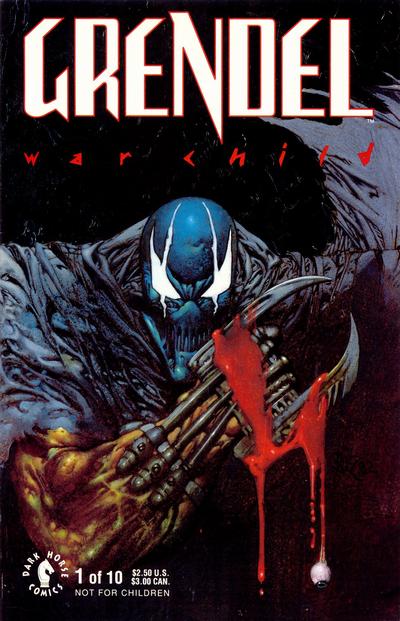
This is a 1992 science fiction series so the Simon Bisley cover is de rigeur even if the inside art is as different as it gets.

A monstrous Grendel with a hook for a hand with the blood dripping off

The first in a ten issue miniseries and the first ever Grendel story I’ve read. Bisley’s cover is what drew my eye but the interior artwork by Patrick McEown, of which more later, is what got me to buy this series.

The story is simple. We open with a hover motor and sidecar fleeing through the desert. Riding it are a man dressed in black, wearing a black mask with white eyes and a boy in a hoodie. We don’t know who or what they’re fleeing until we go to what looks like a simple chalet but which hides a much larger complex below to see various murdered soldiers and we learn that somebody has kidnapped the heir to the Grendel-Khan. An elite group of soldiers dressed in red body armour is sent off in pursuit on their own hover bikes. They ambush the black clad man and the boy but are killed by him. After they reach Chicago they run into a gang that hates Grendels and think the man is one. He kills them in hand to hand combat and they continue their journey, to New York.

We don’t know why this man has kidnapped the heir or what his goal is or even where they’re going to. Any context we get is from the people responding to the kidnapping, a nameless woman who clearly seems to be some of leader and her assistant Heath. We also meet the woman’s daughter, Crystal, who is kept in the dark as to what happened. But the real context is given in the text box of the front inside cover, that starts with “Chapter 41: Devil in the Desert”, giving us the title of the story and which explains the setting. It’s the 27th century: the late Grendel Khan Orion Assante unified the world. His heir, the boy is Jupiter, who has been cloistered away in that complex we saw, in the Dakota Black Hills, held captive by his stepmother, the reigning regent Laurel Kennedy Assante, the woman trying to get Jupiter back.

But wait a minute. Chapter 41? But isn’t this the first issue of this miniseries?

Well, yes, but this was supposed to come out as the 41st issue of Comico’s Grendel series. Matt Wagner had startedGrendel at Comico as a three issue black and white series: the adventures of gentleman villain Hunter Rose. Wagner reworked this story after the series cancellation in backups to his other big Comico series: Mage but then was done with Grendel, or rather, Hunter Rose’s Grendel. Grendel became a persona that other people could take over and use, or be used by and the second Grendel series explored this, with various new characters picking up the role. Unlike the earlier stories, Wagner would only write, not draw the series, getting new artists for each story arc. By issue forty Grendel has basically taken over the world and Wagner had reached the end of what he wanted to with it. ut then he thought off the story that would become Grendel: Warchild… The idea had been to hand over Grendel entirely to other creators, creating a second series called Grendel Tales, then continue Grendel with issue 41 some months later, but then Comico went bankrupt..

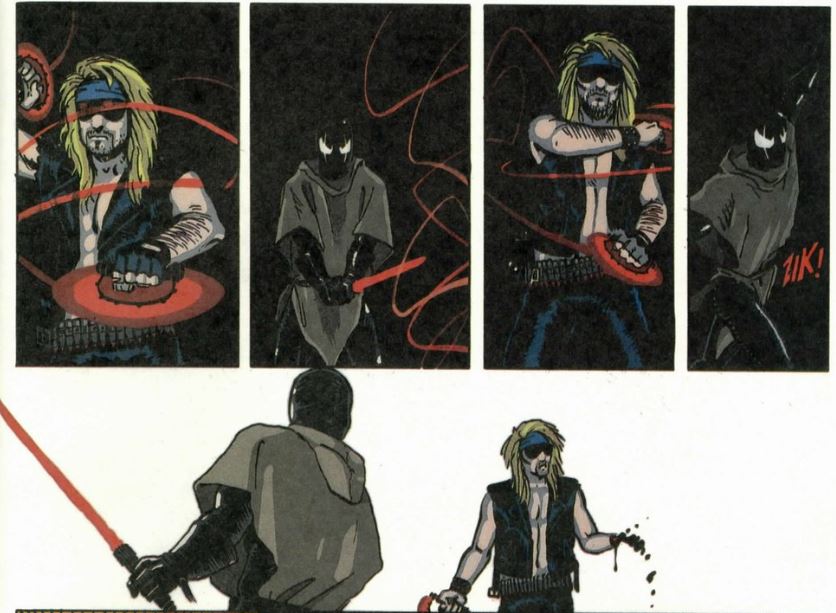
An example of McEown's art

It took two years for everything to clear up and Grendel: Warchild would end up at Dark Horse instead. I’m not sure exactly how much of this issue had been drawn already, but Amazing Heroes Preview Special 11 from Fall 1990 had one McEown page featured in its Batman vs Grendel article. Patrick McEown is an interesting artist. At the time his artwork reminded me of European science fiction artists like Enki Bilal or even Moebius, but now it feels more mangaesque to me? Especially the fight scenes, which are both brutal and funny at times. McEown hasn’t done much else either before or after Grendel: Warchild, having mainly worked on various Aircel series in different roles. A pity, because I like his art.

St Swithin’s Day — #aComicaDay (60)

Of all of Grant Morrison’s stories, not even The New Adventures of Hitler got them in as much problems as this. Parliamentary questions were asked. All because it’s a comic about killing Margaret Thatcher…

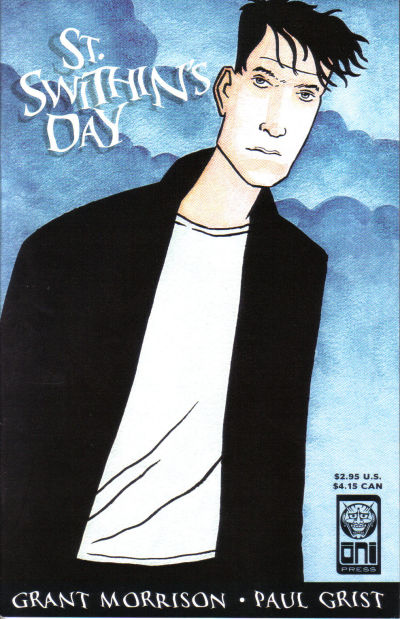
A black haired teenager wearing a black coat and white t-shirt underneath it, the protagonist.

In 1989 Grant Morrison had just begun their conquest of American comics, having started writing Animal Man the year before and having just taken over Doom Patrol from Paul Kupperberg, both on the strength of their work in the UK, notably Zenith. At the time they were also still writing for UK publishers, with the aforementioned The New Adventures of Hitler in pop culture magazine Cut and with St Swithin’s Day serialised in the anthology comic Trident, from Trident Comics. A story in four parts with art by Paul Grist, it would be released by Trident in a collected edition in 1990 and seven years later by Oni Press for the American market. The last one is the edition I have. St Swithin’s Day is the story of a nameless nineteen year old teenager plotting to assassinate Margaret Thatcher with a gun he found after a bank robbery. The story follows him a few days before she’s due to visit a school on July 15 (Saint Swithin’s Day). He steals Catcher in the Rye from Foyles bookshop to because “he wants them to find it” in his pocket afterwards. He also gets the collected works of Rimbaud for the same reason. It’s the sort of pretentious facade an intellectual nineteen year old would come up with. A little later he talks about how he doesn’t want to go back to his old room at his mother’s, with the Tolkien posters on the wall from when he was fifteen. Morrison has said that St Swithin’s Day partially autobiographical and based on these things I can see it.

Our protagonist then spends the day in Winchester, holed up in a cafe ogling a lone girl before having a conversation with an imaginary friend (also a girl). Depressed when the real girl’s date shows up, he leaves and spent the night sleeping in a work cabin, then the next day drops all his stolen book and stolen Walkman in a canal, deciding not to give “them” the pleasure of analysing him. The night before his assassination attempt, he breaks into Highgate Cemetary and dances in front of Karl Marx’s grave, to the tune of The La’s “there She Goes”, which is very, very of its time for when this was originally published.

As Thatcher visits the school, he manages to get close to her, gets her attention and shoots, but with an imaginary finger gun. Struck down and beaten up by the cops protecting her, the last page is of him on an old fashioned train with windows that can open, in the summer.

Now obviously this isn’t really a story about wanting to murder Thatcher, even if quite a few people would’ve wanted to kill her at the time. (In one of his imaginations of what would happen if he did kill her, the protagonist imagines street parties, which is indeed what did happen in certain places when she did pop her clogs much too late…) It’s rather a psychological portray of a sensitive teenager wanker, whose father had died sometime before the story opens, running away from becoming an adult, his mother pressing him to take a job. Nevertheless, The Sun got hold of it, whipped up a small moral panic, some Tory asked questions in parliament and Trident used all this as free advertising… So it goes.

Star*Reach 07 — #aComicaDay (59)

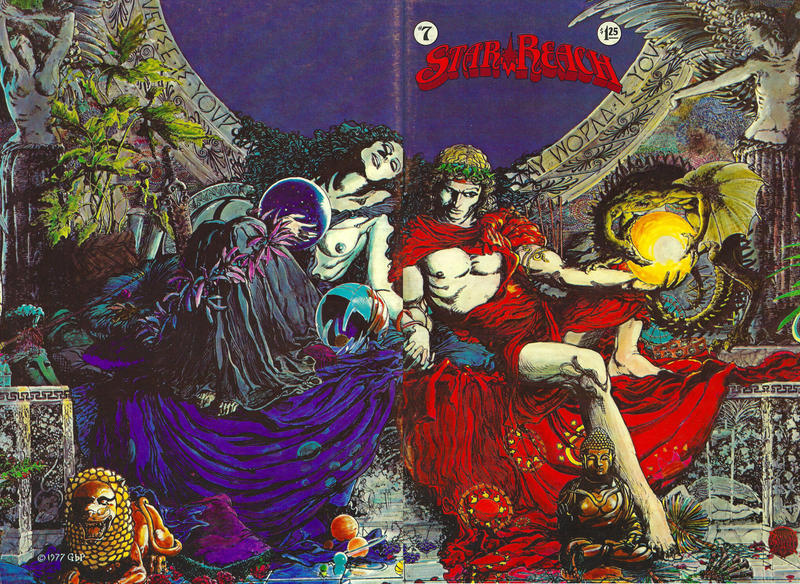
Star*Reach 07 is not important because of its gorgeous Barry Smith wraparound cover. Nor even because it has an early Dave Sim story. But because it contains the very first manga published in English.

A wraparound Barry Windsor Smith cover. On the front cover a man in a white toga and cloak, chest bare, wears a laurel wreath and holds a glowing orb in his left hand. His right hand is holding the left hand of the woman on the back cover, clad in a purple toga, chest also bare

In the mid-seventies the American comics industry was going through one of its periodical doldrums. The silver Age of superhero comics was over and they had become slightly stale and formulaic again. While there was some room for more experimental stories in the weirder parts of the Big Two, that room was limited. Sales were down too as the newsstands were slowly dying, as they had been for decades. Meanwhile, the underground comix revolution had petered out too, partially due to the crackdown on head shops and other alternative distribution points for them. Partially also because too many imitators just went for quick drugs jokes and t&A instead of anything interesting.

Enter Mike Friedrich. One of the first fans to become a comics professional, Friedrich had written for both Marvel and DC, but by 1974 was fed up of working for them. Instead, he set up his own magazine, Star*Reach, positioning it as inbetween the underground and the “over ground” of mainstream comics: ground level comics. Where artists would have creative freedom and own their stories. The first issue came out in my year of birth, 1974, the last in 1979 for a total of eighteen issues. In many ways it pointed the way for the direct market revolution of the early eighties and the work of publisher like Eclipse, first and Pacific Comics.

Most of the people published in Star*Reach were sort of Friedrich’s contemporaries from the mainstream. Young artists like Walt Simonson, Howard Chaykin, Frank Brunner, Mike Vosburg, Jim Starlin and even Dick Giordano. Lee Marrs meanwhile represented the underground tradition. What you got as reader was not that different from what was on offer from the mainstream. It was all genre work, science fiction, horror and fantasy, just with more violence and nudity than you could get away with at Marvel or DC.

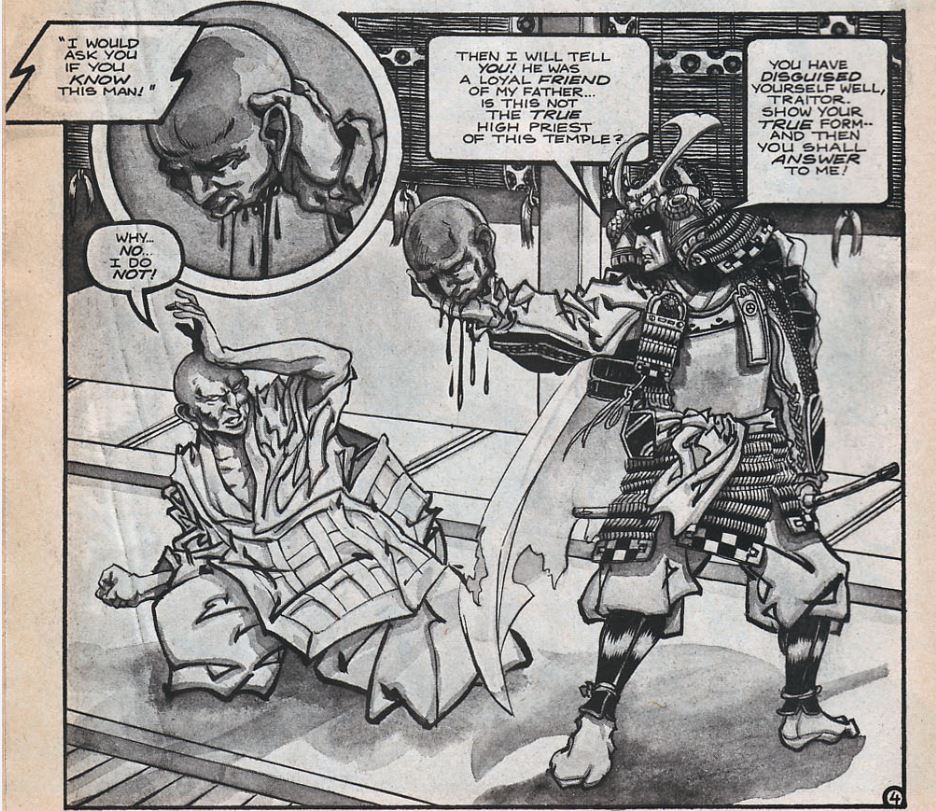
Art by Masaichi Mukaide for the Bushi story showing a samurai confronting a priest with a chopped off head

Issue 7 was published in 1977 and is typical. It starts off with the Dave Sim story about an astronaut meeting god, which is actually penciled by Fabio Gasbarri instead of Sim himself. There’s a Johnny Achziger scripted story about the Gods of Olympus with Joe Staton art, a Lee Marrs story like there was (almost) every issue, something by Jeff Bonivert and a Steve Englehart and Mike Vosburg thriller to round out the issue. And without fanfare, a short samurai story by Satoshi Hirota and Masaichi Mukaide, which may be the very first manga ever published in the US or even in English. Not that you would know that except for the names in the credits; the art and story are not dissimilar to the sort of thing Star*Reach published anyway.

There was a reason for this. Masaichi Mukaide was that rarest of breeds, a Japanese artist who was a fan of and inspired by American comics. Because republication of these in Japan was rare, he read them in English. Along the way he came across Star*Reach and decided to submit to it, striking up a mail correspondence with Mike Friedrich. Several other stories of his would be published in other issues as well. This also led to the first ever attempt to create an English language Manga magazine a few years later, called, erm, Manga, in which Friedrich and several other Star*Reach affiliated creators were involved as well. Mukaide was the editor of this, one of the first attempts to bring manga to an English speaking audience:

The stunning roster of authors makes the unique publication more impressive: Hiroshi Hirata, Yosuke Tamori, Yukinobu Hoshino, Katsuhiro Otomo, Keizo Miyanishi, Noboru Miyama, Yoji Fukuyama and Noriyoshi Orai (illustration). In addition, Hajime Sorayama was featured on its cover. The back cover was illustrated by Hiroshi Hirata. Chiki Oya was in charge of coloring the illustration indicated.
[…]
During the editing process, people who were introduced to Mukaide by Friedrich were highly involved. They included Lee Marrs, who debuted with an underground comic, Steven Grant, who later worked for Marvel and DC, and Larry Hama, who worked as an actor, musician, writer and artist.

As adapters, their duties were correcting parts unacceptable to American readers because they were too Japanese. For instance, take Keizo Miyanishi’s “MidSummer Night’s Dream,” which depicted the night Hikaru Genji met a mysterious woman. The original didn’t have much dialogue and narration, so Marrs added lots of it.

Manga is actually available at Mangadex if your morals are loose enough. Both Mukaide’s Star*Reach stories and it are ultimately just curiosities, early attempts at creating manga for an American audience, but no less interesting for this. An indicator of how much of a ‘prehistory’ there is to the official history of manga publishing in America.