The New Adventures of Superboy 46 — #aComicaDay (58)

Even if the comic inside is utter crap, you always get something worthwhile with a Gil Kan cover-up.
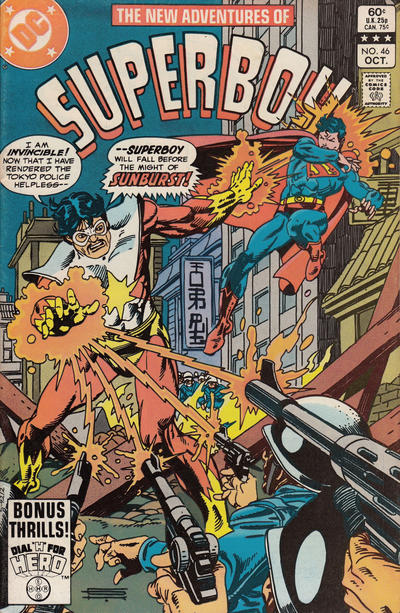
Sunburst stands in the middle of a ruined building, having smacked away Superboy as guns are blazing at him. He says he's invincible now he has rendered the Tokyo Police helpless, Superboy will fall before his might. He wears a white mask covering just his eyes, a red costume with a white cover his chest and yellow gloves and boots

In one of his “Mark’s Remarks” columns in Marvel Age, Mark Gruenwald had a list of not quite serious professional comics jargon. The two I remember were “weeding the grass”, cancelling old series to make way for new projects and “cover-up”, when you have a good artist do the cover for an issue to cover for the much weaker artist doing the insides. Boy was Gil Kane used a lot in that role at Marvel in the 1970s. Not always even for bad artists. He also did a lot of covers for various reprint titles of pre-Marvel, Atlas monster stories that usually had Jack Kirby or Steve Ditko art. DC must’ve used them in this role as well when he worked there in the 1980s, considering this issue of The New Adventures of Superboy.

The art inside is by Alex Saviuk who isn’t a bad artist by any means but I can understand why if you can have a Kane cover, you take it. Saviuk himself was only a guest penciler for the three issues this Sunburst story ran (#45-47); Kane’s cover run went from #41 to #49. This is the only issue of the series I have and I only have it because of the Kane cover, proving that a cover-up works. I also like the idea of Sunburst, who I’d first seen getting killed in Crisis on Infinite Earths, but the cover was the main reason I picked this up.

If you’re familiar with Gil Kane’s art, you recognise it’s his work immediately even without his signature. The way Sunburst stands, with his right hand out stretched in front of him, his left slung out to the side, legs slightly bend, one slightly lower than the other, is a clear giveaway. The same goes for Superboy, repelled by Sunburst’s energy blast in mid flight. The outstretched, elongated right leg with the left leg raised up, lower leg tucked in under the knee is typical Kane. Hell, even the guns are: modern fire arms but they look like sci-fi blasters in a way only Kane (and maybe Carmine Infantino) drew them.

With any cover-up you run the risk of disappointment with the art inside but if you bought it DC had gotten its sixty cents, right. In this case, Alex Saviuk’s art here is disappointing, nowhere near the level he displayed on his later run on Web of Spider-Man, which is where I first encountered it. Look at Saviuk’s cover work there and these are great, much better than what he drew inside here.

Covers are there to sell comics, especially when most comics were still sold on the newsstands. Kane, with his dynamism and eye for composition is the ideal artist to do so. It would be great if somebody published an artbook of his Marvel and DC covers.
Tales from the Aniverse 02 — #aComicaDay (57)

From the days before all furries had migrated to Deviantart and you still had to buy this sort of comic in your local comic shop.

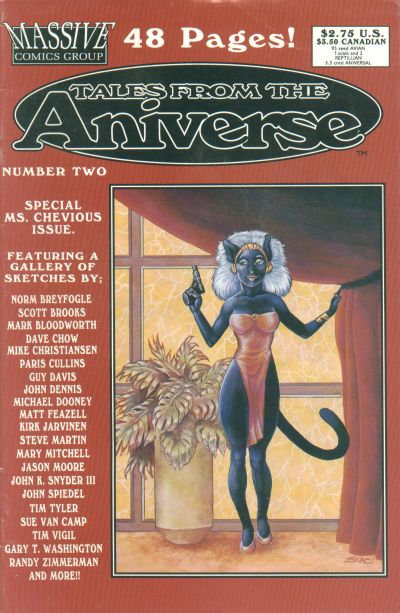
An anthropomorphic black cat in a pink dress that ends at her boobs and leaves her thighs bare holds a gun. Her hair is white

I have no idea why my local comic shop got this particular issue of this particular series back then. As far as I know there wasn’t a cluster of furry comics fans frequenting it, nor do I remember seeing any other furry comic there ever. My guess is that because they had only been selling US comics recently, the owner tried out some things to see if they sold. And since I picked this out of the bargain bin a few years later, it clearly didn’t.

I know why I bought it and so should you if you look at the people listed on the cover. A sketches gallery featuring art by Norm Breyfogle, Guy Davis, Paris Cullins. Matt Feazell, John K. Snyder III and Tim Vigil among others? That’s worth picking up, if perhaps not at full price. That it’s all art of a sexy black cat lady helps of course.

Ms Chevious, the star of this issue was created by Randy Zimmerman and Sue van Camp, who also did the cover here. According to the short history provided in the introduction, she was intended to be the foil to the star of Zimmerman and van Camp’s attempted space trucker series starting J. B. Space that he had thought off in the mid-eighties. Her creation led to them retooling their ideas and instead they settled on a broader series, Tales from the Aniverse, with J. B. Space no longer being the sole protagonist.

Tales from the Aniverse was originally published in 1985-1987 by Arrow Comics. Arrow was one of those mid-eighties publishers which died in the great Black and White Bust of 1987, when the success of Teenage Mutant Ninja Turtles had “inspired” a host of wannabes into setting up their own publishers, flooding the market and killing off a great many comic shops and publishers in the aftermath. Or so I thought, but a quick look at the Grand Comics Database showed that something calling itself Arrow Comics had a book out as recently as 2023.

In any case, Tales from the Aniverse lasted six issues there, then moved to WeeBee Comics for another two as The Aniverse before that publisher died. The third and so far last series, of which this was the second issue of two was published by Massive Comics Group, which despite its name only has one other issue to its name. it looks like this was something Zimmerman himself had set up to publish Tales from the Aniverse. He had plans for more: there was an ad for a terribly generic looking superhero title called The Superials in the back this.

The stories in this issue all feature Ms. Chevious as you’d expect and are decent if you like furry science fiction I guess. This is no Dalgoda but they are perfectly cromulent stories. The main attraction for me were the sketches and there’s a nice mix of proper furry artists (van Camp and Zimmerman, Steve Martin John Spiedel) with more well known ones like Breyfogle.

Furry comics were once a fairly big, if specialised bit of the direct market: even Fantagraphics published them. These days most of it seems to have moved online I think, with a few exceptions like Usagi Yojimbo. Zimmerman, according to the Wikipedia entry was still doing Ms Chevious stories as late as 2009; sue van Camp seem to have moved into being a role playing/computer games artist in the nineties.

All I wanna play is Talk Talk

It’s been a grey, cold day today and I’ve been listening to Talk Talk, all five their albums in chronological order. Talk Talk always feels autumnal to me so this was the perfect day to put them on.

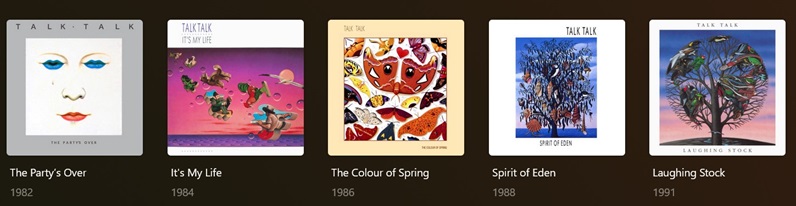
The five studio albums from left to right: The Party's Over (1982), It's My Life (1984), The Colour of Spring (1986), Spirit of Eden (1988) and Laughing Stock (1991)

Now critics always go on about how different each Talk Talk album is from the next, especially the last two from the first three. And indeed, when you listen to Laughing Stock (1982)after The Party’s Over (1991), they don’t sound as if they’re made by the same band. But when you listen to them in order, you can see an evolutionary line in there, one album following logically from the previous.

The Party’s Over is very of its time, big flat drums and lots and lots of synths, but it already contains the seeds for the next two albums, It’s My Life (1984) and The Colour of Spring (1986). These two keep the big, open sound of that debut but dial back on those drums and synths. Spirit of Eden (1988) meanwhile is much more withdrawn and quiet, but its A-side follows logically from The Colour of Spring‘s B-side which already started quieting down.

If you only know the big radio hits and then stumble across those last two albums I can understand why they sound so out of left field, but in context they build up logically from those very first beginnings. Listening to them I really couldn’t tell where The Colour of Spring ended and Spirit of Eden began.

In conclusion: Mark Hollis was a genius and Talk Talk one of the best bands from the eighties.

Captain America 371 — #aComicaDay (56)

All Diamondback wants is a nice evening on the town with Captain America. Standing in her way is an army of the worst villains the Marvel Universe has to offer. Can she prevent Cap from going after them for one night?

Captain America and Diamondback, in their civilian identities are strolling down the street as three members of the Serpent Society watch from a rooftop nearby while two other villains lay in wait around the corner

An easy issue to write about this time as I’m still poorly. This is one of my favourite Captain America issues, a done in one story that’s quintessentially Gruenwald even though it’s nothing like anything else he ever wrote for Cap. Ever since issue 358 Cap and Diamondback had been going through one adventure after another and this issue starts as they’re finally home. Cap wants to leave but Diamondback isn’t having it. After a brief discussion about what they are too each other, settling on friends and having established that Cap has no social life whatsoever, she sweets talks him into a friendly date that night.

Now you have to remember that at this stage of Gruenwald’s run on Captain America, he’s Cap nearly 24/7, his civilian Steve Rogers identity nearly abandoned. The man lives in Avengers headquarters, has no other job than being a superhero and no time for a social life. He doesn’t even have clothes fit for a date anymore and has to ask Jarvis for advice on what to wear. Diamondback meanwhile gets her best friend, a certain Black Mamba, to help her get in top shape for the date. The most important thing being a new hair colour as Cap wouldn’t “look right going out with a girl with magenta hair”…

Both spruced up nicely and revealing their civilian identities to each other for the first time, they set out for a night on the town: dinner at a nice Mexican place, followed by a magic show and a nice stroll through the neighbourhood where Cap grew up, not too far from where Diamondback spent her childhood. Sounds idyllic, but this wouldn’t be a superhero story without supervillains…

As they take a taxi to the restaurant, there’s a traffic jam because the Gamecock is holding a woman hostage nearby. The show at the magic club is interrupted by the arrival of Trump (no, not him) trying to rob the place. Their nice stroll afterwards is interrupted by a lovers spat between Poundcakes and Jackhammer. Yes, the very worst villains the Marvel Universe has to offer and there are reasons you never heard from them. That Scourge never got to any of them is a miracle. Luckily for Diamondback, though it comes close, Cap never has to interfere as they have a trio of guardian angels watching over their date: Black Mamba, the Asp and Anaconda. Diamondback’s friends from the Serpent Society took it on their selves to make sure her date was a success, not knowning who she was dating…

The art in this story is by Ron Lim, inked by Danny Bulanadi. Lim had taken over from Kieron Dwyer with issue 336 and would remain until 386, with Bulanadi having been the inker already and staying on after he left. Gruenwald’s Cap would sadly never look as good as it did after Lim left. The artwork was decidedly inferior under Levins and his successors. But this issue not only has Lim on the main story; the backup art is by Mark Bagley. In it we have Diamondback struggling with what her attraction to Cap means. If she wants to get serious, it means giving up her career as a supervillain and going straight. Can she do it and give up her lifestyle and easy money?

This what I mean by a quintessentially Gruenwald Captain America story. You have the dredging up of deservedly obscure villains on one hand and the socio-economical consequences of wanting to date a superhero on the other. If you want a grasp of what his writing is like, this is the issue to try.

Pink — #aComicaDay (55)

A story about the everyday life and adventures, the “love” and “capitalism” of a girl who was born, raised and “normally” wrecked in a boring town called Tokyo

An elegant girl wearing a hat, in a long dress and with pink lipstick holds a suitcase and looks to the left

Kyoko Okazaki was one of the most influential mangaka of the late eighties, but sadly a traffic accident in 1996 left her unable to work. Specialising in slice of life, psychological driven stories, Pink is one of her most famous works. Written and published in 1989, at the height of the Japanese Bubble, Pink is the story of a 22 year old office lady who moonlights as a sex worker at night to be able to afford the meat with which she feeds her pet crocodile.

There’s more to Pink than this of course. As the opening sentence of Okazaki’s afterword reproduced above states, this is a story about love and capitalism, written at a time when Japan’s love for capitalism was at a fever pitch, just a short time before the bubble would burst. Yumi is representative of a generation of girls who came of age during the bubble and started their careers when it was still expected they would drop out in a few years to get married and have children. She actually comes from a rich family who still pay her rent. The only reason she has to have a job and work as a sex worker is to buy things and most of her money is actually spent on that pet crocodile. Which needs to be fed or it will feed on her.

In some ways Pink, especially with Okazaki’s art, reminds me more of 19902s alt-comix cartoonists like Julie Doucet, Seth or Chester Brown than ‘regular’ manga. This could’ve been published by Fantagraphics or Drawn & Quarterly in 1995 and not look out of place. Instead it only came out in English in 2013, from Vertical, a Kodansha subsidary. As a one volume manga it’s a quick but satisfying read. The only quibble I have with the edition is that the translator is nowhere credited.

I actually only got this manga today, having ordered it because LowercaseJai’s video analysis of it made it look interesting. Because I’m actually suffering from a nasty cold and barely able to string two sentences together, I thought I would embed the video to explain why this is such a good, interesting and important manga.