Keep This a Secret From the Laughing Kookaburra

Now this looks interesting! Baxter Burchill has dug up and scanlated a one-shot manga by “forgotten master” Masako Yashiro, Keep This a Secret From the Laughing Kookaburra:

Manga artist Taro Minamoto mentions (in an article recommending various kashi-hon) how much he admired her work around this time when he was a young seventeen year old, imagining her as a seasoned manga veteran, a master who had already spent years in the industry, and the earth-shattering shock he felt when he finally met her and saw that oh god, she’s the same age. He also mentions how clear and strong Yashiro’s influence was on the early works of Moto Hagio, one of the defining figures of the Year 24 Group shoujo movement, a fact which Hagio herself freely admits.
That influence is crystal clear in today’s manga, “Keep This a Secret From the Laughing Kookaburra”, Yashiro’s second entry in her series of shorts for COM, the experimental manga magazine founded by godfather of the medium Osamu Tezuka that would become her home for several years, published in the July 1968 issue, when she was only twenty-one. It’s an astoundingly interior, reflective title, mining a deep well of thought and feeling in its short 20 page run; a powerful exploration of art, creation, gender, identity and anxiety that hasn’t aged a single day since its initial release.

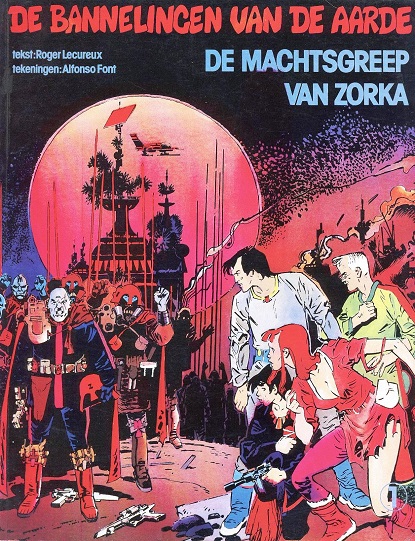
De Bannelingen van de Aarde — #aComicaDay (54)

An attempted coup by barbarian invaders crash lands an artificial mini planet on Earth, 250 million years BC in this mixture of Von Daniken and Star Wars.

Zorka and his henchmen are on the left while our heroes hide from them on the right

Yesterday’s entry reminded me of another 1979 science fiction series with an artificial world traveling the galaxy and a Spanish artist. this time though the journey is involuntary and takes place “250 000 centuries ago”. On Axi, war and violence have been eradicated centuries ago. But then the barbarian Zorks under their evil leader Zorka attacked, were promptly defeated by the Axi defence shields and captured. Turned over for rehabilitation by professor Orloz, they are transported to Thulia, a giant artificial planet in orbit around Axi. But what Orloz and his assistants Rodion (the hero) and Lilya (the girl sidekick) do not realise is the enormity of Zorka’s thirst for power. He quickly gets hold of some antique laser weapons from a museum and forces Orloz to hand over control of Thulia by threatening to murder its inhabitants. Unfortunately during the ensuing fight the control systems get damaged, Thulia leaves orbit and drifts helplessly into the Galaxy only to end up on Earth at the end of the first story.

All of which sets the stage for the adventurs of Rodion, Lilya and prof Orloz on what’s clearly a Jurassic Era Earth considering the presence of brontosauruses, despite the fact that is supposedly 250 million years ago and that era only started 200 million years ago, but who cares eh?

Certainly Roger Lecureux didn’t when he wrote this, considering one of the later stories featured the threat of a Phorushacos, a flightless bird from the Mycene, long after the dinosaurs went extinct. We’re on “prehistoric Earth”, not an entirely new setting for Lecureux, whose much better known Rahan was also set there, but in a more scientific rigorous one. Here all the setting is there for is to provide monstrous menaces for our heroes to overcome in their flight to freedom from the tyranny of Zorka.

With Alfonso Font on art duty, these monster fights at the very least look good. Font is equally adept at drawing realistic, lived in looking high tech space ships and cities as he is at drawing prehistoric animals while not neglecting his characters either. I’ve always liked his art style and De Bannelingen van de Aarde was the first time I saw his art. The title of the series roughly translates as “the Exiles on Earth”; in Dutch three albums were published in 1980-1981. As far as I know, to little success.

The series was originally published in France as Les Robinsons de la Terre, in the weekly comics magazine Pif Gadget for a total of twenty two episodes of usually ten pages. The Dutch version was incomplete, stopping halfway through and at a cliffhanger. (Interesting to note is that Pif Gadget started off as Vaillant, a magazine for the communist youth movement in 1945). In France the series wasn’t successful either, with only one album collection published in 1980.

I can understand why. The stories are competent, but formulaic and while the art is great it’s not sufficient to make this a series you got to read. It’s entertaining but nothing more than that, a minor work in the oeuvre of both Lecureux and Font.

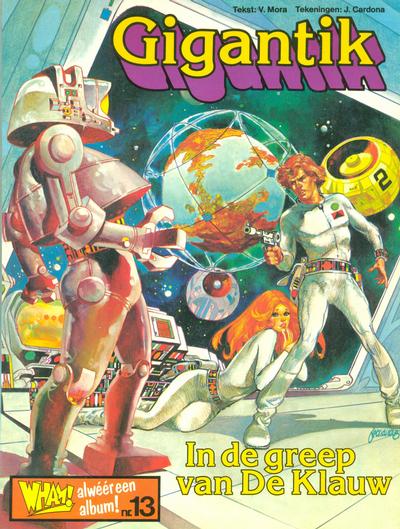
Gigantik 01 — #aComciaDay (53)

If you want to boldly go where no one has gone before, seeking out new worlds and new civilisations, why use a poxy space ship when you can take an entire planet, asks Gigantik?

A robot is menacing our hero, who has his blaster in his hand. A red haired girl is lying next to him, clinging to his leg. On the monitor in the background a planet surrounded by an air shield and two artificial moons is visible

This is something that you can really only do in comics, just use an entire planet to explore the Galaxy with. Blew my mind reading these as a child, the idea of exploring the universe while still enjoying all the comforts of home. José Maria Cardona’s art, whose style is not dissimilar to Alfonso Font’s here, helped a lot with this. He made Gigantik look very attractive indeed, portraying it as a combination of research center, holiday resort and nature park.

The series was set a century from its first publication, 2078, when the Solar System had been completely explored and several planets had been settled as well. Space travel is common and easy enough that a trip from Mars to Earth only takes a few days and space piracy is actually possible. Which is what drives the plot for this first Gigantik story, as astrobiologist Bruno Castor — who had been stufying the native Martian wildlife — prepares to join the Gigantik expedition in place of his brother, who died in a space accident. The Claw, one of the most infamous space pirates, wants to use Bruno to infiltrate the project and take it over to become the ruler of the Solar System. To that end he kidnaps Bruno and Mireilla Anderson, the grand daughter of the leader of Gigantik’s scientific council, to blacvkmail the latter into handing over the planet. Bruno and Mireilla, with the help of their trusty robot sidekicks Bulldozer and Peanut, however manage to foil his plans.

Yes, there is a fair bit of Star Wars inspiration in here, not the least with the bickering robot sidekicks, but the Claw too is a sort of K-Mart special Darth Vader. Probably inevitable as this series was conceived in 1978/79. Gigantik was created by Victor Mora, Spanish like the artist José Maria Cardona, for the West-German comics magazine Zack which at that time had ambitions to become a pan-European magazine. For a short while in 1979-1980 it would be also published in Dutch as Wham! and in French as Super-As. Printing the same magazine in multiple languages can be cheaper than in just one; to swap language you apparently just have to swap the black printing plates; the other colours can remain the same and higher print runs means cheaper printing costs. With Zack having gotten its hands on both new series by established authors as well as several older fan favourites taken over from other magazines you’d think it could’ve done well, but sadly the whole venture lasted only a year.

Gigantik outlived the magazine: seven albums were published in Dutch, from 1979 to 1984. In retrospect Gigantik is a minor classic of what you might call the “Spanish School” of science fiction comics. Victor Mora of course was also the writer of Dani Futuro.

Lost In 1999 — #aComicaDay Special! (52)

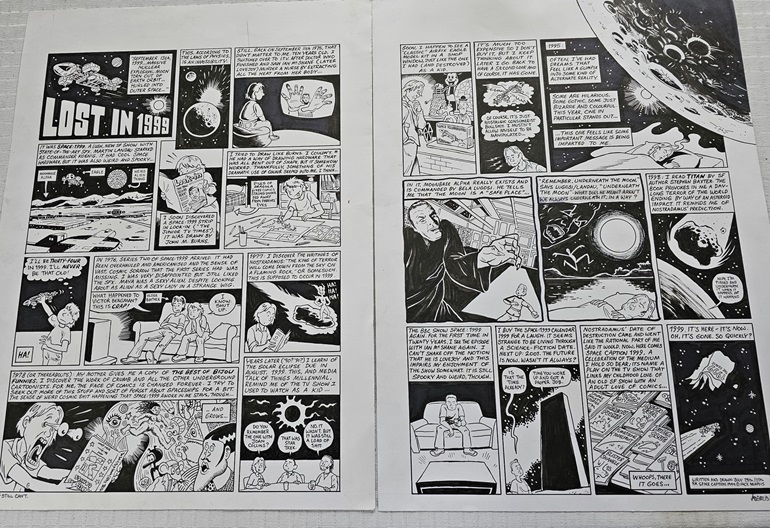
Here’s a comic for which I have the original art but I don’t think I have the issue in which it appeared. Also, it took me twentyfive years to actually hang this on my walls.

The original artwork for the two page story Lost in 1999 by Nick Abadzis

And I had to move house three times before I could!

Back in the previous millennium, in 1999 to be precise, I had the magical combination of income and free time needed to dive deep into comics fandom. I had been going to Dutch cons for some years, but these were mostly an opportunity to score some cheap comics. By the mid-nineties, thanks to Usenet and the Comix-L email list my tastes had broadened and I had gotten into small press and self published comics. Somehow I heard or read about the annual Caption comics convention held in the Oxford Uni halls and decided I would go to the 1999 edition: SpaceCAPTION99.

Caption was an explicitly small press orientated convention, started in 1992 by Adrian Cox, Damian Cugley, Jeremy Dennis, and Jenni Scott, who were still organising it in 1999. Held over the weekend in the hallowed halls of the Oxford Union Society, it was a small affair, a hundred or so people? As I remember it there were maybe a few stands with people selling their own stuff, as well as maybe one dealer with some esoteric stuff — I remember buying some Jack Chic Crusaders comics about the comic apocalypse. There were a fair few comics creators like Dave McKinnon, Terry Wiley, Andy Konky Kru, Lee Brimmicombe-Wood and Bryan Talbot. The latter gave a talk about how his then recently finished Tale of One Bad Rat was created and which techniques he used to make it as accessible as possible for non-comics readers.

The con also held an auction of various things, including original artwork, which is were I bought this. No idea what I paid for it at the time, but it can’t have been that expensive. The pages looked nice, it earned the convention a few quid for next year and I vaguely thought it would be nice to hang up on my wall. Similarly I bought a great looking Lee Brimmicombe-Wood page showing a space ship in transit across the moon and a page from some superhero story by Adrian Dungworth and Mary Green.

Once home none of these made it to my walls, living at the time in a small, cramped student flat already filled up with bookcases. Instead they disappeared in my parents’ attic, where they stayed for a decade and a half until my father got fed up and shifted all my comics crap to me. At that time, having moved twice and in the first house I’d actually bought I still didn’t have room to hang them, for the same reasons. But the beauty of the overinflated housing market in the Netherlands meant I could trade in my far too small flat in Amsterdam for a obscenely big house in the provincial town my parents live in and now I do have room. So yesterday I finally hung these pages up in my living room.

In the process I discovered that this art was created by Nick Abadzis, best known these days for Laika and Hugo Tate. It’s a simple story about discovering Space: 1999 as a child and how he’s occasionally reminded of it as 1999 approaches. According to the sticky note still attached to the back of one of the pages, this story was done for the Caption booklet this year and Nick had donated the artwork to the con’s auction, hoping to raise some dosh that way. Well, according to the surviving photo album, the auction raised over a thousand ponds, so it must’ve served its purpose. As for the booklet, I may still have it but it will be somewhere among all the other convention bumf moved from closet to closet as I moved houses…

Captain America: War & Remembrance — #aComicaDay (51)

You may not like it, but this is what peak Bronze Age storytelling looks like, courtesy of Roger Stern and John Byrne.
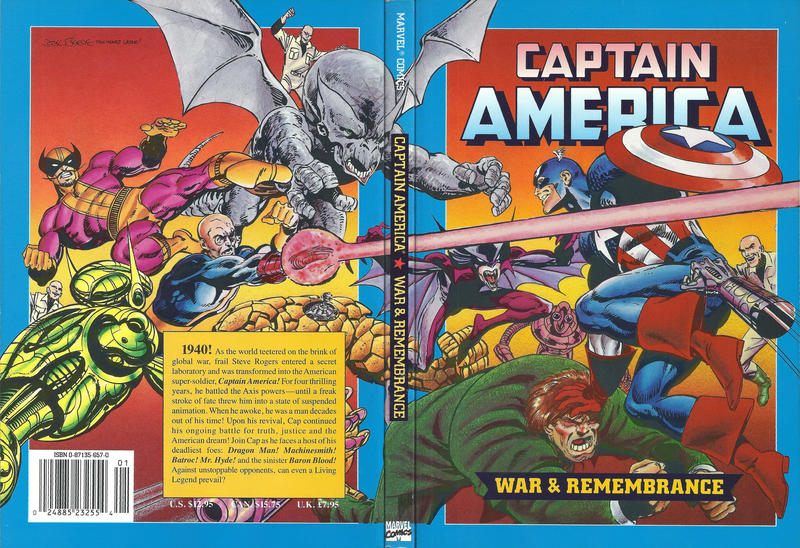
The various foes in this volume attack Captain America from the left

Captain America: War & Remembrance is a 1990 trade paperback collecting the short, nine issue 1980-81 run of John Byrne and Roger Stern on Captain America (#247 – #255). As such it’s a showcase of what a typical Late Bronze Age, Shooter-era Marvel comic read like. This period, roughly 1976 to 1984 and the first Secret Wars, might just be my favourite Marvel period, at least in terms of the Marvel Universe as a coherent metafiction. It’s still small enough to be comprehensible even if you didn’t follow every title, had endured long enough to have a proper sense of history while it was not yet spoiled by endless crossover events and reboots. Not quite the Marvel I grew up with (I started reading superhero comics in earnest only in 1987), but the Marvel I got to know and love through back issues and collections like this.

John Byrne at this time is still just an artist, not quite the writer-artist he would become on Fantastic Four; he and Roger Stern broke into comics together doing fan work for Charlton before both went to Marvel. Stern started work as an editor and went on to write several series, most noticably Avengers and Dr Strange. Byrne of course worked mostly with Chris Claremont on e.g. Iron Fist and Uncanny X-Men. Their short run on Captain America is the only series Stern and Byrne worked on together.

But what do I mean by calling this a showcase of Bronze Age storytelling? How is that reflected in these issues? For me it’s a combination of several things. The first is continuity, having that sense of a wider universe in which Captain America takes place. Sometimes this is done casually, as for example in issue 250, which floats the idea of Cap standing for president in the 1980 elections. Not only do we get Cap visiting the Avengers mansion and getting the responses of his team mates to the news (Wasp & the Beast are all for it, Vision and Iron Man less so), but there’s also cameos of other like superheroes like Daredevil, Spidey and Doctor Strange. Funniest is J,. Johan Jameson’s reaction: conflicted until Joe Robinson teases him with “Spider-Man for mayor”. Ultimately of course Cap decides not to run, which is pity considering who would win that year.

The concern for continuity is also shown in the first story in this volume, from issue 247, in which Cap’s wartime footlocker is found and Stern takes the time to fix the mess a previous writer (Steve Gerber) had made of Cap’s origin. Gerber had him the son of a Maryland diplomat with an elder brother who died at Pearl Harbour, rather than an arty Brooklyn kid that Simon & Kirby had made him. Stern resolves it by making Gerber’s version an implanted memory as protection against Nazi torture revealing his true identity. At the same time Stern also re-introduces old Nick Fury foe Baron von Strucker, who was supposed to have died in Strange tales 168 but then showed up in Captain America 130/131 without explanation. At the end of the issue it turns out Strucker is an android.

Which brings me to the next characteristic of Bronze Age storytelling. The story in issue 247 ends with the destruction of the von Strucker android and the revelation of a new villain, Machinesmith. In the next issue he sends an old Fantastic Four foe, the Dragon Man, another android, to attack Captain America, ending on a cliffhanger with Cap in danger of being squeezed to death by the giant android. Then in issue 248 Cap escapes and follows Dragon Man back to Machinesmith’s lair, where he’s attacked by all sorts of half finished replicas of various heroes and villains. In the end it’s all an elaborate ruse to get Cap to kill him, being unable to commit suicide himself. A story that flows naturally through those three issues, but each part of which stands on its own, is a satisfying read in its own right. And while this story is being told, we also get a few look-ins at what Cap’s supporting cast is doing, especially a potential new love interest called Bernie Rosenthal who will stick around for a fair few years.

The other two stories, from issue 251-252 and 253-254 are similar in the way they operate as part of a wider universe. The first had Mister Hyde escaping from prison with the help of Batroc ze Leaper, hijack an LNG tanker to hold for ransom, then wanting to steer it into Manhattan anyway just to kill his old partner, the Cobra. That leads to Batroc teaming up with Cap to stop Hyde, exactly what you would expect of a ‘noble villain” like him. The first part of this story has Cap meeting with D. A. Tower, who would pop up in a lot of New York set Marvel titles. It’s that sort of detail that makes the Bronze Age MU feel so real and lived in. The last story Stern and Byrne did for Captain America has him go to England to meet an old friend and fight an old foe. Spitfire was a young girl during World War II fighting alongside Cap in The Invaders; she’s now a middle aged woman. the Marvel Universe at that time hadn’t quite settled for a floating timeline yet, so this sort of thing could still happen.
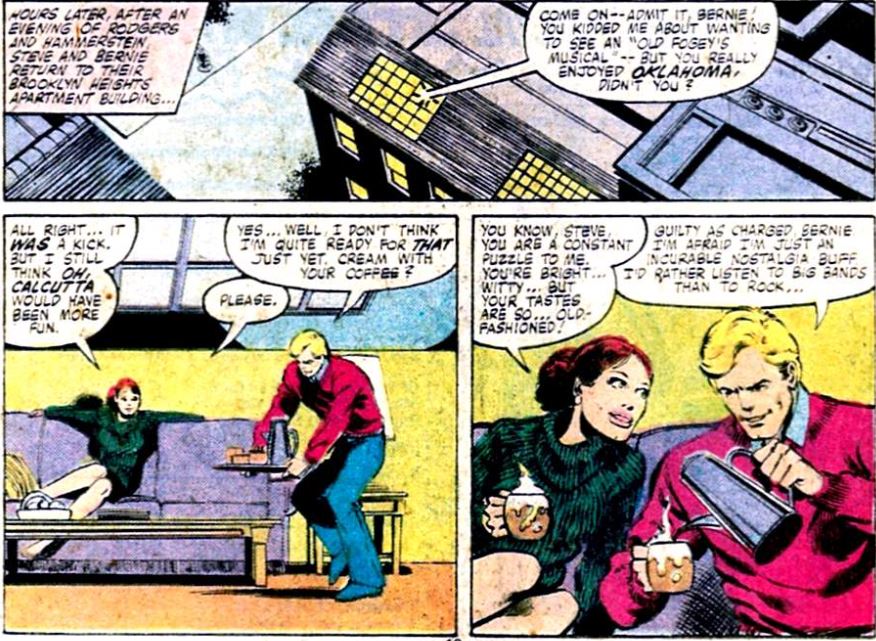
Steve and Bernie relaxing at home discussing the musical they saw

The last bit of Bronze Age storytelling I wanted to highlight comes from this final story, issue 253, which has Cap go on a date with Bernie to see Oklahoma and this half page neatly shows off how superheroes once upon a time had a private life away from the costume, not being stuck in Avengers Towers with the rest of the freaks. It also shows just how much sheer dialogue and captions were used back then. These are seventeen and twenty two page stories but they take longer to read than some modern paperbacks collecting six issues…