The Bride Was a Boy — #aComicaDay (50)

The happy, lovey dovey autobiographic story of how Chii, the mangaka, found out she was trans, transitioned and got married.

Chii in her wedding dress being carried by her glasses wearing husband both in adorable chibi form

This started as a series of blog posts, short four panel comics in which Chii talked about her life as an “ex-boy” and how she got married. With the encouragement of her husband, she then turned it into a book that was published in 2016 in Japan, then translated and published by Seven Seas two years later. I first read it in scanlation some time before its official translation. The scanlation group had thoughtfully included a link to the book’s Amazon.jp page so I bought it there, then bought the English ebook version when it came out.

Chii’s story, as she presents it here, is probably about as straight forward as a transition story could possibly get. She never quite felt comfortable as a boy growing up, but it took some time before she learned about trans people and that she might be one. Even afterwards, she was still resistant to the possibility of transitioning because of the stereotypes about trans women Japan has. It was only after she became a working adult, having finished college that she took the step to start transition. Which at first did not include medical or legal transition as she didn’t think it necessary, but as she got more uncomfortable with her body and partially because she needed to be legally transitioned to be married in the first place, she pursued both.

Intertwined with that transition story and as important, is the story of her love life and how she met and became the girlfriend of her husband to be. In high school and college she passed as (mostly closeted) gay man and had had several boyfriends. This of course brought its own challenges as people of course expected her to have a girlfriend rather than a boyfriend, while she could never be quite honest with her boyfriends either. Once she transitioned, she met her husband at friends and he immediately fell in love with her, while she took some time to do the same. Once they got in a relationship, she came out as trans to her, which he was completely unfased by.

A friend of Chii saying she was right to transition

One of the sweeter parts of The Bride Was a Boy is how accepting her family, husband and friends are. When she came out to her mother the first thing she did was arranged the traditional girls’ coming of age photo shoot, something usually done at twenty. Her father and siblings too were accepting and if anything, a bit too muted in the responses. Chii mentions that her relationship with her father actually improved after her transition and that he even forgot she had been a boy…

A smiling Chii as her friend says she looks so happy now

Each of the nine chapters in the story also includes more general information on trans and queer issues, some of which is more particular to Japan, explaining the challenges faced by people wanting to transition. The biggest hurdle is that you have to legally transition to get married, which in part requires a medical testimony that you are trans. Because Japan still does not have marriage equality, you need that legal gender change to be able to marry as a trans woman if you want to marry a man and worse, if you’re already married to a woman, you need to divorce to get that legal gender change. Even the laws allowing that gender change are quite new, only dating back to 2007. Even if in Chii’s case all this went relatively smoothly, it still shows how many obstacles there still are for trans people to easily transition.

The Bride Was a Boy is a book you can give to your parents or friends if they’re mostly ignorant about trans people and want to know what being a trans woman is “really” like. Of course it’s not the end and be all of trans experiences, not even of Japanese trans experiences, but it’s a good introduction.
Asterix en de Britten — #aComicaDay (49)

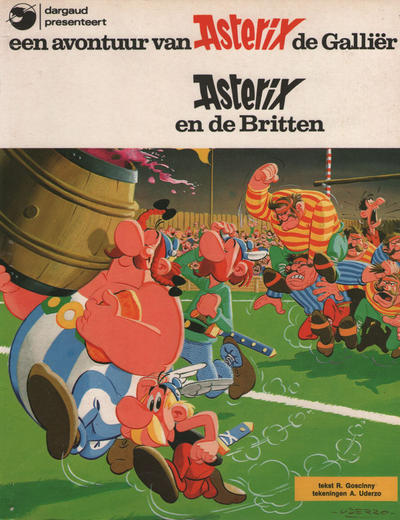
Asterix and Obelix cross the Channel into Brittannia to help out their cousins in a rather jolly adventure. Good show old chum!

Asterix, Obelix and their British cousins are fleeing from a group of rugby players, with Obelix carrying a cask of the magical potion

It turned out that yesterday was the 65th anniversary of the first publication of Asterix in Pilote, which I only realised after I had already published yesterday’s post. A day late then, a happy anniversary to Asterix. It’s hard to overstate how important this was. Not only has Asterix become a national hero of France and the most popular European comics character of all time, even beating out Tintin, but thanks to him Pilote could break the Belgian Spirou/Tintin duopoly. These two magazines had captured most of the European (or at least the French part of it) comics market post-war, creating the Golden Age of Belgian comics during the fifties. By 1959 and Asterix‘s publication however they both had grown a bit stale. The challenge that Pilote would reinvigorate Tintin and Spirou as well.

Asterix en de Britten is a good example of why Asterix became so popular so quickly. First you have the story itself, set just after Julius Caesar’s invasion of Britain. As with Gaul he quickly conquers most of the country except for one tiny village courageously resisting. Sadly, without a druid capable of creating a magical potion that gives them super strength, their outlook is bleak. Luuckily, Notax, one of the village’s inhabitants is a distant cousin of Asterix and rows to Gallia to get his help. Panoramix the druid creates a cask full of the potion and Asterix and Obelix volunteer to bring it and Notax back to his village. Back in Brittania they promptly lose the cask and go through all sorts of adventures to get it back.

That on its own is fine, but it doesn’t set Asterix apart from similar series. What makes Asterix such fun is its sense of humour, which is a cut above the usual slapstick antics of other humouristic adventure series. Not that it doesn’t like a bit of physical comedy, but it’s not the only thing it does. There are the character names for example, usually a pun of some sort. There’s the referential humour, one panel here showing “a quartet of popular bards”, clearly the Beatles. In this story, there’s the gentle ribbing of English stereotypes: Obelix complaining about boar being served drenched in mint sauce, the poor creature, the lukewarm beer, the Brits breaking off their fight with the Romans for a tea (well, warm water) break…

But the best part is that Goscinny gives his British characters recognisable English speech patterns and sayings. And the unnamed Dutch translator has managed the same, e.g. translating “I beg your pardon” as literally “ik vraag uw pardon” or “rather” as “nogal”. They also speak much more formal then either the Gauls or the Romans, further distinguishing them. It takes some time to notice, but once you do it’s rather amusing.

Asterix is one of those series almost every Dutch child has read at some point and I wasn’t an exception, always happy to read a new one. The great thing about them is that I can reread any of the classic Goscinny/Underzo stories and still enjoy them as much as an adult. Sadly Goscinny passed away far too early in 1977, aged just 51, after a botched operation. Uderzo, the drawer, continued the series on his own but it was never quite the same to me. He retired in 2011 at age 84 from the series and would live until age 92, dying in 2020.

Deathwish 01 — #aComicaDay (48)

The first comic both starring a trans woman and written by a trans woman. But you may know Maddie Blaustein better for voicing Meowth in Pokemon.

Deathwish is bursting through a window, guns blazing away in both hands. He is wearing a skull mask, body armour that leaves his arms bear, black trousers and combat boots

That’s right, Blaustein voiced Meowth for the first eight Pokemon seasons and was even inspired by him to fully transition. But that was her second career: she had started as an assistant to Marvel Editor Jim Owsley/Christopher Priest. At Marvel she also wrote some stories for Web of Spider-Man and Conan the King among others. In the nineties she moved to DC and wrote for several of their !mpact titles before getting involved with Milestone where she worked as production manager, doing some fill in stories for e.g Hardware on the side, often together with Yves Fezzani with whom she also wrote Deathwish.

The character itself had actually debuted in Hardware, a Dwayne McDuffie/Denys Cowan creation. A Punisher type vigilante with no powers but who was tough enough to take on the Iron Manesque Hardware in hand to hand combat, Deathwish specialised in hunting down and murdering sex offenders and rapists. When both he and Hardware were after the same serial killer of sex workers, they came to blows. Ultimately it turned out that Deathwish himself was the murderer, having periodic blackouts as the result of severe trauma. His backstory is tragic and deserves a trigger warning; both McDuffie and Cowan felt uncomfortable writing and drawing it. Deathwish had seen his son and wife be raped and murdered in front of him before the same was done to him. He survived and tracked down the murderer, then became a vigilante. McDuffie even gave him a little spiel to go along with it he tells his victims. “There’s this movie. It’s about this guy who gets pushed too far. So he decides to push back.” Rather purile in light of what happened to him and what he ends up doing, but that is as intended. Deathwish isn’t cool, Deathwish is a murderer who serves as an example for Hardware of how not to be a hero. That’s the point in which Blaustein picks him up to star in his own miniseries.

Marisha's face is in the background as she tells Deathwish her origin, wearing lipstick and round glasses, her long hair in a ponytail. In the foreground she's sitting at Dini's hospital bed handing her flowers, in her male phase, beared, short haired, wearing a suit and tie with square glasses. Captions tell how awful she felt having to pretend to be a man and how meeting Dini cracked her egg.

Except he isn’t. The real star of the series, the one we follow the most, the one narrating the story is lt. Marisha Rahm, “the first pre-operative transsexual police lieutenant the city has ever employed” as her narration puts it. We first meet her four years earlier, when she’s on the trail of Boots, a serial killer specialising in murdering trans and queer sex workers. That’s when she meets Dini, who had survived his attack. It’s also when Marisha first meets Deathwish, who tells her that maybe she hadn’t faced it yet, but she’s one of the girls. As Boots returns in the present day, Marisha visits Deathwish in prison, where he’s been since what happened in Hardware and asks his help. He agrees, but only if she tells her story, as shown above.

Not too hard to tell… This movie ran through my head twenty-four seven. It was with me when I was a small child lying awake at night and cursing the fates. It was with me when I walked down the aisle at my wedding… like a Jew at Treblinka. It was with me when I took the Seaport murders case. It was a story of mind-numbing pain until I met my Dini. My life started after her attack at the warehouse. I’d give her flowers. She gave me her ears.

This, Marisha’s story is at the heart of the issue and the series as a whole. Most of the surface plot is a fairly by the numbers serial killer plot, but Marisa’s transition and the reality of what that is like is what sets Deathwish apart. The story Marisa tells of her coming out, of the pain that living as a man brought with it, the realisation that she could change and the realities of being out in a world that’s not kind to trans women, these are all things I’ve heard from trans friends as well. As Blaustein and Yves make clear in the letter columns, the story of Marisha and Dini is their story; even the murder of Dini’s friend on the first page is based on the murder of one of Yves’s trans woman friends. this gives it an authenticity that’s rare in comics then or now.

But if there was any publisher which could publish a series like Deathwish it was Milestone. It was founded after all by a coalition of African-American comics creators (Dwayne McDuffie, Denys Cowan, Michael Davis, Derek T. Dingle and Christopher Priest), explicitly set up to provide a much more diverse sort of superhero universe than that of the Big Two. That sort of worked against it sadly as readers thought of it as “those Black superheroes” (putting it politely), with white readers thinking that therefore it wasn’t for them. But it also meant that it could publish a series like Deathwish.

(As a side note, Maddie Blaustein was not the only trans comics writer working then: at roughly the same time there was Rachel Pollack writing Doom Patrol after Grant Morrison had left the series, introducing her own trans superhero, Coagula.)

Deathwish, published in late 1994, early 1995 is a bit rough when looked at thirty years later. Terminology has evolved since then and of course it wa swritten for an audience that had much less knowledge of such things. There’s also the issue that Blaustein is credited under her dead name, though she ia called “Addie” in the editorials. I should hope these credits have been fixed in the collected edition. One last thing worthy of mentioning is the art, some of the earliest work done by J. H. Williams III, inked by Jimmy Palmiotti.

Batman Classics 118 — #aComicaDay (47)

This was the way I first got to read the classic Steve Englehart/Marshall Rogers Batman stories from Detective Comics and it was the best way I could’ve, as these Rogers’ artwrok never looked as good as it did in black and white here.

Batman is looking down from a rooftop while behind him Manbat is flying in the distance. An inset on the left shows the Warlord

Honestly. I also have these same stories as collected in the Legends of the Dark Knight: Marshall Rogers, in full colour on great paper and it just doesn’t look as good as it did in black and white on that crumbling newsprint paper Classics Lektuur used. The atmosphere of these stories was just so much better suited to black and white.

Marshall Rogers was already the penciler of the backup feature in Detective Comics in #466-467, with his first full issue in 468. Then in issue 471 he was joined by Steve Englehart as writer, who had started the previous issue but that had been drawn by Walter Simonson. From 471 to 476 they would create some of the best Batman stories ever published. Starting off with Hugo Strange, a villain last seen in the 1940ties discovering Batman’s secret identity, then trying to auctioning it off to, among others, the Penguin and the Joker. Before he can do so however he’s kidnapped and murdered by local crime lord Boss Thorne, who doesn’t get him to divulge the secret.

While this is all playing out, Batman first has to deal with the Penguin’s plan to rob a bird statue from a Gotham museum, in a rare teamup with Robin, still in college at this point. Then Englehart brings back another ancient villain, Deadshot, who started out as a fake Batman wannabe, now equipped with cool new wrist guns and costume. Then Rogers and Englehart round off their tenure with the legendary Laughing Fish story, in which the Joker poisons the fish around Gotham so they look like his own face and then threatens the copyright commission because they wouldn’t copyright the fish for him…

All these were reprinted in Dutch in Batman Classics 118-122 in 1980 and almost a decade later I would find these in a local secondhand bookstore for 75 cents a pop. That was a bit steep at the time for me, but over the next few weeks I would buy as many of these as I could, as well as some of the other issues they had. These would be not just my first introduction to the Englehart/Rogers Batman stories, but because these issues were 52 pages long, it also had various backups, including Warlord and Manbat. The latter series also featuring Rogers art.

At the time I wasn’t really a DC reader, but these were so good that they converted me from being a proper Marvel Zombie. The Batman Classics series had run from 1970 and would be cancelled in 1981, when the publisher, Classics Lektuur, got out of doing comics entirely. They actually started off as a publisher of the old Classic Illustrated edutainment comics in the mid-fifties, then branched out into less reputable fare. Not picky when it came to what they reprinted, they not only published DC superhero series, but also a lot of Marvel ones as well as Dell/Goldkey series, most with “Classics” in the title. Batman was actually a late addition to their portfolio as he had been licensed by another publisher during the sixties…

For years you could find all these comics very cheap in second hand stores or at comic cons, but over the decades they have become somewhat collectable to a few generations of superhero fans who grew up without access to the originals. I too have been slowly starting collecting them again, for nostalgia sake.

A word about the cover art: most of the Batman Classics issues at this time used new covers rather than reprints from the original American issues, with them being used not just on these Dutch reprints, but on similar series all across Europe. The artists responsible are largely unknown.

Flare Adventures 01 — #aComicaDay (46)

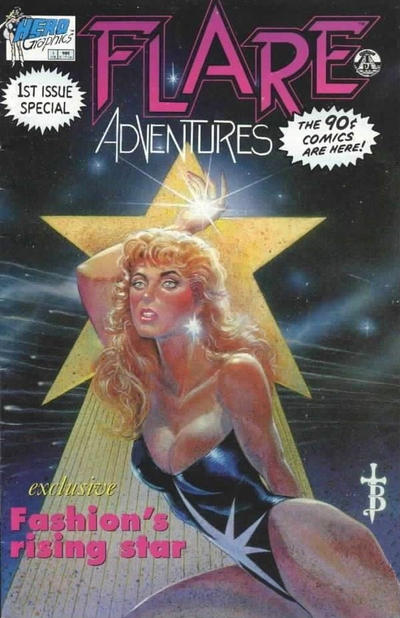
The cover showing off Flare’s best assets promises exactly what you will get inside. If you liked Wonder Woman or Black Canary but hated how conservatively they dressed, Flare is the genetically engineered raised by Nazis in the Brazilian rainforest superheroine for you.

Flare, a blonde woman in a one piece swimsuit with a large star on her stomach area is posing

Flare Adventures was a low price reprint series of the first Flare series, the first issue reprinting the first story from the original. In it, Flare is woken up by a phone call from her friend who wants her to come down, quickly puts on a way too short dressing gown and promptly flashes the photographers her friend had assembled for the press conference Flare had totally forgotten about. After that, she does some work as a photo model, then has to fight a bank robbing villain called Darkon and is promptly beaten by his darkness powers. It’s a pretty good sampler for the rest of Flare’s adventures. If you read them for anything but the cheesecake, they’re mildly underwhelming.

But I didn’t know that when I bought this. It was 1992 and all I saw was another superhero when I bought this together with the similar Champions Classics, reprinting one of Heroic other old titles. They’d gotten George Pérez to do the cover for that one which lured me in, just as the Tim Burchard cover had done for Flare Adventures. Together they were my first introduction to the whole Heroic universe and honestly the covers were the best part of them. As I read more Flare stories when I came across them I realised that in general, the artwork was always a cut above the writing which never rose above ‘serviceable’.

To understand why that is you have to understand that Heroic Publishing and the Flare/Champions universe are largely the rpoduct of one man, Dennis Mallonee. He’s the writer for most of these comics as well as their publisher. Yet ironically, he didn’t create Flare or the Champions: those came from a role playing game also called Champions. That had been first released in 1981 as one of the first superhero RPGs and also one of the first not to use dice rolls but a point distribution system: you could decide for yourself what your character’s strengths and weaknesses were. As people started playing that, they of course created their own heroes and some of these, via ‘official’ RPG sessions were included as examples in new editions of Champions. Then, when during the ’85 Comic Con fans of the game asked if there would ever be a comic version, Mallonee decided he would do it. That led to the first Champions miniseries, published by Eclipse in 1986, which wasn’t quite what he wanted.

Mallonee was already a publisher, having published the Fantasy Book prose magazine and he decided he would go into comics to publish his stories the way he intended. Heroic Publishing started off in 1987 with three series: champions, another Mallonee series called Eternity Smith that had started at Renegade Press and the Roy & Dann Thomas written Captain Thumder & Blue Bolt. Flare would arrive the year after, having been voted the most popular member of the Champions by the readers of that first Eclipse series. She quickly became the poster girl for Heroic as a whole, starring in various titles, always written by Mallonee and drawn by various artists you may have heard of: Mark Beachum, Chriss Marrinan, e. R. Cruz, Howard Simpson.

Originally created by Stacy Thain for that original Champions RPG, Mallonee fleshed out her background, making her the product of Nazi super science as well as offspring of the Olympian gods. She got a younger sister with similar powers who unlike her completely bought into Nazi ideology, who would later also join the Champions team. Because I could find none of these titles with any regularity in the comic shop and also because Heroic had a habit of stop starting series and introducing new ones that mixed reprints of older material with newer stories, getting a handle on who Flare actually was was always difficult to me. Rereading some of this now it’s clear though that there just isn’t that much going on with her. At best these stories are store brand superhero stories, the characters no more compelling than somebody else’s RPG character always is, at worst they’re just excuse for Flare or another heroine to fall out of her top. Because it’s always Mallonee writing them, these stories and characters all blend together; Flare doesn’t feel that different from her sister or from another heroine like Arcane.

Nevertheless, Flare and Heroic Publishing are still around, now doing print on demand and Kickstarter campaigns. Somebody still likes Heroic’s blend of cheesecake and superhero stories….