A familiar problem

David Coggins looks at some famous bookshelves

A good bookshelf should be full. Or nearly full anyway. An empty bookshelf has so much more to offer the world. It sits like an empty closet, an empty museum, an empty stadium, unfulfilled, not reaching its potential. Trust our strength, the bookshelf begs us, let us show off, baby!

Empty bookshelves are unfamiliar to me. My issue is too many books. This leads to a lifetime of stacking, itself a dangerous path. When you admit that your reading ambitions require the air rights above every horizontal surface in your home—even the floor is in play—then you have a problem I can relate to.

A personal library announces many things. Some are general (“I like to read”), some are about taste (“These are the books I enjoy”), and some are about personality (“This is the way I arrange them”). This combination makes a library so revealing.

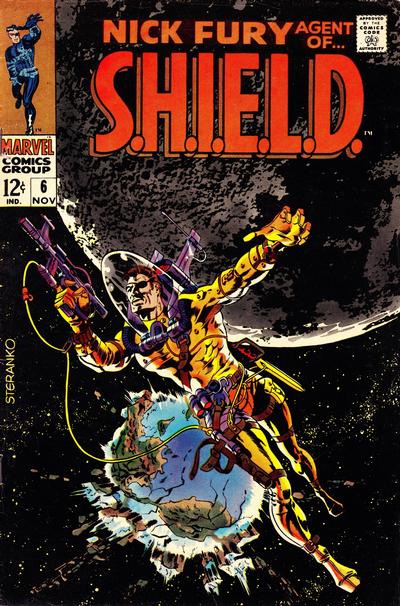
Nick Fury Agent of SHIELD 06 — #aComicaDay (45)

There are a few artists (Gulacy, Chaykin, Pérez e.g) for whom I’d buy a comic even if they only did a cover. Steranko too is such an artist, but that’s not why I wanted this particular issue.

Nick Fury is swimming through space in his skintight golden space suit while the Earth explodes behind him

I certainly didn’t buy it for the story, an Archie Goodwin/Roy Thomas yarn about a group of extradimensional exiles calling themselves the Others who with their psionic powers are drawing a planetoid unto Earth to release the energy needed to return to their home dimension. Nick Fury is no stranger to sci-fi plots but this was something you’d expect to see in Fantastic Four or Avengers. The artwork by Frank Springer is good. He has a decent eye for the sort of futuristic decor that this story needed while he’s no slouch at action scenes either. Springer’s very good at ratcheting up the tension as well, as Nick has only hours to save the Earth. The resolution is a bit obvious, but the way Goodwin and Thomas increasingly corner Fury as the story unfolds, as each of his attempts to stop the disaster is foiled, is great.

No, I couldn’t care less about the contents of this issue nor even for the fact that Steranko had drawn the cover. This was simply something I purchased for nostalgic reasons. I knew that cover, had seen and admired it long before I ever laid my hands on the issue it was used on. It was all thanks to the first, 1979 edition of John Clute and Peter Nicholl’s Encyclopedia of Science Fiction, which unlike the second 1991 edition was illustrated. And one of these illustrations was this particular Nick Fury Agent of SHIELD cover.

I must’ve read every word of the encyclopedia after I had discovered it in my local library. I borrowed it for months at the time, just rereading it and learning about science fiction when I didn’t have the pocket money to regularly buy science fiction books myself. And every time I browsed through it, I would come across this picture and had to stop to admire it for a second. Of course then I bought the actual issue it was from the moment I spotted it at a convention. It turns out I wasn’t the only one enthralled by this cover either: it won an Ally Award in 1968 for Best Cover.

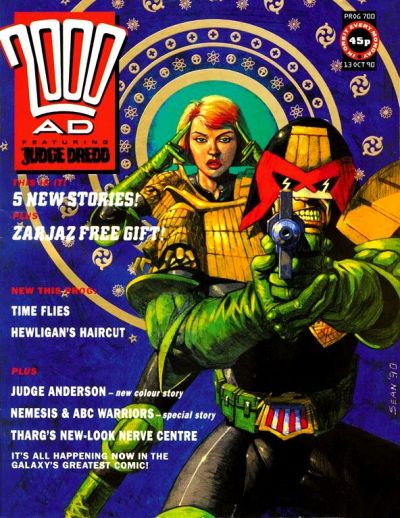
2000 AD prog 700 — #aComicaDay (44)

You’ll never forget your first prog as a 2000 AD reader and this one was mine.

Judge Dredd pointing his gun at the reader with Judge Anderson behind him using her psi powers

I’ve talked about 2000 AD before recently, but I thought I would mention this particular prog as this was my first ever. A good start it was too, because it did periodically the magazine had reinvented itself again with a little bit of a makeover (and a price hike, natch) and all new stories. A perfect jump on point for new readers like me.It certainly hooked me enough to keep buying 2000 AD for over a hundred progs.

The lead Judge Dredd story was the first of a two part John Wagner/Ron Smith follow-up to the Necropolis saga that had ended the previous issue, with Dredd investigating a disused holo theatre for a sign of Judge Death. To be honest it, together with the Pat Mills/C. Critchlow Nemesis and Deadlock story, is the weakest story in here. Both are more palate cleansers, just there to mark time between more substantial stories.

Much more interesting is Time Flies, which will run for 11 progs, a Garth Ennis and Philip Bond time travel comedy in which squadron leader Bertie Sharp is plucked out of time by a group of time travelers from the 35th century (and the Bros brothers) to help rescue Hermann Goering from a band of time pirates so that Adolf Hitler can get them spare parts for their own time machine. It’s a slightly overcooked zany adventure and Ennis’ first 2000 AD story.

Even zanier is Hewligan’s Haircut, by Pete Milligan and Jamie Hewlett, about the unfortunate Hewligan, a patient on a psychiatric ward who managed to cut a perfect hole in his hair that looked the same from all angles and which slightly upset all laws of physics and reality itself. For all of its zaniness it’s a story that worked rather well, more interesting than the Ennis attempt.

Rounding off the issue is the first in Psi Judge Anderson story by Alan Grant and Arthur Ranson, whose art is just gorgeous. None of the artists in this issue are bad, but his is just on another level. Shamballa is a psychic adventure in which Anderson teams up with a Sov Bloc Judge as various psionic breakouts around the world spell out that the end times are near. A far more serious to end on.

As a whole, for somebody who had only read some Judge Dredd and was only vaguely aware of other 2000 AD this was a good start even if two out of the five stories were middling. There was enough there that was completely new to me that I looked forward to the next issue.

Shogun Warriors 17 — #aComicaDay (43)

This cover caption has lived rent free in my heads for decades. You’re a kid… You’re flying a Shogun… And it’s really fun…. RIGHT? WRONG!
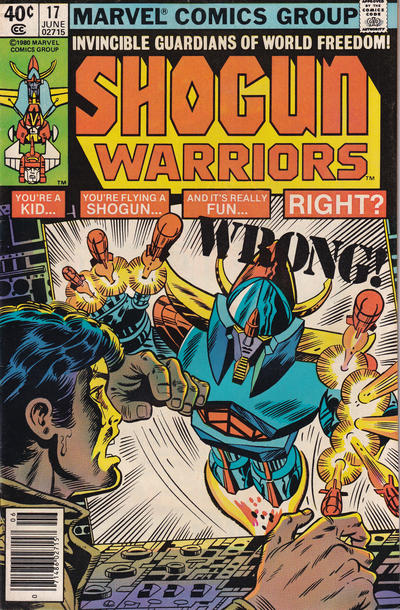
You're a kid... You're flying a Shogun... And it's really fun.... RIGHT? WRONG! is the caption as a terrified boy looks at a giant robot flying at him firing missiles

The local comic shop in my hometown started stocking American back issues sometime in the late eighties and every Wednesday I would go there and browse through to see what caught my eye. Shogun Warriors 17 was one of those. Not just one of the first American comics I ever bought, it may very well have been the very first mecha story I ever read.

Because that’s what Shogun Warriors was, a comic book based on a toy line that took the lead mecha from three different anime (Wakusei Robo Danguard Ace), Brave Raideen and Chōdenji Robo Combattler V) in an attempt to sell them to American children. Marvel was asked to create the comic as an advert for the toys and with only the toys as a reference, writer Doug Moench and artist Herb Trimpe invented a whole new story to go along with them, Trimpe also inventing the monsters the Shogun Warriors would fight. Nothing was carried over from the original stories these mecha appeared in; this isn’t even a Macross/Robotech situation.

What Moench and Trimpe invented was a story of a long ago war between the Followers of Light and the Followers of Dark, which the latter lost and after which they were sealed in a volcano. When its eruption threatened to revive the evil Follower of Dark Maur-Kon, a neat multinational three person squadron was formed to combat them, each given their own giant robot. Stuntman Richard Carson got Raydeen, test pilot Genji Odashu got Combatra and oceanographer Ilongo Savage got Dangard Ace, the coolest of the three. I’m not sure how much Moench and Trimpe knew about mecha anime or super sentai live action series, but the series sure reads like one, with the Warriors having to fight a series of monsters sent their way by Maur-Kon.

Shogun Warriors was created in 1978, at a time when Marvel did a lot of titles based on licensed properties and usually stuck them somewhere in the Marvel Universe. Moench and Trimpe had already done that with Godzilla before, while Micronauts, Rom, The Human Fly and Team America were launched at roughly the same time or slightly later. You could even argue that it all started with Conan the Barbarian: not explicitly set in the Marvel Universe at first, but once he got his first team-up with Spider-Man…

Shogun Warriors greatest contribution to the Marvel Universe was Doctor Demonicus, a super genetic engineer making giant monsters out of mutated animals. He would later pop up in Roy and Dann Thomas’s Avengers West Coast as a major villain. The final two issues of the series had the Fantastic Four as guest stars and the Warriors would return the favour in a later issue of Fantastic Four in which the robots were destroyed to tie off all the loose ends from the series.

Issue 17 though is a simple story of a young boy who discovers Combatra having been hidden in an abandoned building in San Francisco and accidentally triggers the mechanism that transports him into the cockpit. Not knowing how to operate it, the poor kid is along for the ride as Combatra goes on a rampage and Raydeen has to stop him… The cover was probably more exciting than the actual story, but it hardly mattered at the time.
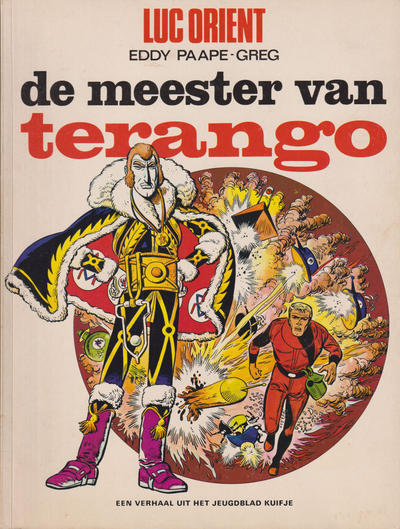
Luc Orient 03 — De Meester van Terango — #aComicaDay (42)

Luc Orient and pals are brought to the planet Terango to dispose of its tyrant before he can invade the Earth!

A literally white man with red hair wearing a opera style military custome complete with cape is standing in the foreground while behind him a blonde man in ajump suits runs towards the camera while things explode around him

From one of my favourite childhood sf series to another: Luc Orient. Another series I first read in my local library and this particular story was one of the first I can remember reading of it. Written by Greg, who seemed to have written almost every series published in Tintin between 1957 and 1993 or so. The art is by Eddy Paape, another Belgian comics veteran but who had mainly worked for Tintin rival Spirou before Luc Orient.

Luc Orient‘s titular protagonist is a blonde, brawny troubleshooter for Eurocristal, a fictional super science organisation. His best friend is professor Hugo Kala, leader of the lab and his girl Friday is Lora, who luckily does more than just playing the damsel in distress. Together they go on various science fictional adventures and managed to do so for some 18 albums, the first published in 1969, the last coming out in 1994.

What set Luc Orient apart from similar series is its remarkable use of continuity. European heroes tend to have their adventures in neat, 48 page album sized chunks, each a standalone story. Unlike American superhero stories continuing subplots are rare nor is there even the illusion of change most of the time. Tintin kept running around in his plus fours from 1929 to 1976 and the only thing that changed were the types of cars and air planes he used after all. But Luc Orient was different, as the first five stories did have a continuous plot.

In the first two albums, Luc Orient and co are on an expedition to Borneo to investigate the mysterious valley of the three suns, were ultimately they discover a crashed spaceship with a cargo of aliens in cryosleep onboard. After saving them in the second album, this story sees them return to Earth to call on Luc Orient to help them save their planet from its oppressor, the tyrant Sectan. The two volumes after that tell the story of how they managed to do so, after having struck the first blow in this one.

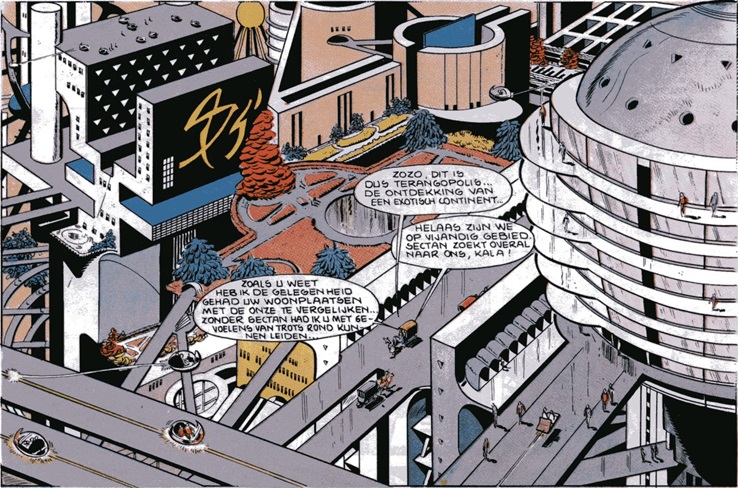
An aerial view of a futuristic city

As a young boy reading this somewhere in the late seventies/early eighties, some of the very first science fiction I ever read this was mind altering. Especially the way Paape depicted Terango, this alien planet. Having discovered Isaac Asimov and his vision of a planet wide super city, the way Paape depicted Terangopolis is how I imagined Asimov’s Trantor would look like.