The sorry Saga #12 saga

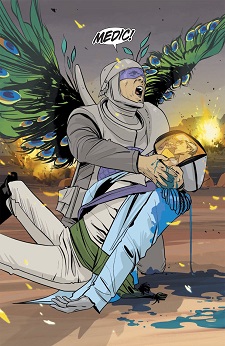
Controversial panel from Saga #12

So, to recap, the latest issue of Brian Vaughan’s and Fiona Staples’ Saga comic felt foul of Apple censorship over the panel to left amongst others, and it couldn’t be sold through the Comixology Apple App. On hearing this, Vaughan and Staples went on a PR campaign to protest this decision, only for Comixology, their distributor, to come back a day later and say it was all a misunderstanding and Apple never had even seen the issue and it had been their own decision not to publish it through the Apple app.

A happy ending? Not really, as apart from that whole being lied to by Comixology about who took the decision to censor what, there’s still the reality of the threat of Apple censorship and the influence it already has on how companies like Comixology behave. It was their ideas about what Apple would and would not allow to be published on iOS that led them to pull Saga 12 and this might not have been the first time they did it. It’s not just a problem with comics either of course; everybody who has to deal with Apple as gatekeeper to publish on the iOS platform will have to self censor to a greater or lesser intent to deal with their guidelines, which can also be a bit vague.

It’s not just Apple either. We’re entering an era in which, as everything migrates online while the devices that we go online with become increasingly less open, there are now several powerful gatekeepers emerging that can strangle freedom of speech. Apple, Google, Amazon, all have the potential to do this, or are already acting as a censor to some extent. This is not necessarily done maliciously, but in any situation where there’s only one party that can give you access to a certain platform, there will be censorship emerging naturally from ordinary business considerations. When we were all using desktop pcs this wasn’t that big a problem, as there never was this central gatekeeper and you as a user could decide for yourself what to and what not to install. With publication on an iOS platform only possible through the Apple store, this is no longer possible and anything Apple deems unsavoury or against their own interests will therefore be rejected.

The only real solution to this problem therefore consists of the opening up of all such walled gardens, to allow rival shops on iOS, Android, Kindle, etc, rather than allow a monosophy of gatekeepers to persist.

She said I’d need a blaster and I’d need a freezer gun


Nicked from James. A folk song written in 1952 by Ewan MacColl and Peggy Seeger, parodying Golden Age science fiction, kept alive in filk, then reworked as a straight forward folk song by what’s basically a folk supergroup.

I hadn’t heard it before, even though James had linked to it two years ago, but it’s a great song, sung by Eliza Carthy with just the right kind of wistful melancholy undertone to it.

If you want to know where all the clips are from, the creator put a list on their Livejournal.

Elite panic

This Bombsite interview with Rebecca Solnit is interesting just for the following extract:

AT One of the most interesting ideas in the book is the concept of “elite panic”—the way that elites, during disasters and their aftermath, imagine that the public is not only in danger but also a source of danger. You show in case after case how elites respond in destructive ways, from withholding essential information, to blocking citizen relief efforts, to protecting property instead of people. As you write in the book, “there are grounds for fear of a coherent insurgent public, not just an overwrought, savage one.”

RS The term “elite panic” was coined by Caron Chess and Lee Clarke of Rutgers. From the beginning of the field in the 1950s to the present, the major sociologists of disaster—Charles Fritz, Enrico Quarantelli, Kathleen Tierney, and Lee Clarke—proceeding in the most cautious, methodical, and clearly attempting-to-be-politically-neutral way of social scientists, arrived via their research at this enormous confidence in human nature and deep critique of institutional authority. It’s quite remarkable.

Elites tend to believe in a venal, selfish, and essentially monstrous version of human nature, which I sometimes think is their own human nature. I mean, people don’t become incredibly wealthy and powerful by being angelic, necessarily. They believe that only their power keeps the rest of us in line and that when it somehow shrinks away, our seething violence will rise to the surface—that was very clear in Katrina. Timothy Garton Ash and Maureen Dowd and all these other people immediately jumped on the bandwagon and started writing commentaries based on the assumption that the rumors of mass violence during Katrina were true. A lot of people have never understood that the rumors were dispelled and that those things didn’t actually happen; it’s tragic.

But there’s also an elite fear—going back to the 19th century—that there will be urban insurrection. It’s a valid fear. I see these moments of crisis as moments of popular power and positive social change. The major example in my book is Mexico City, where the ’85 earthquake prompted public disaffection with the one-party system and, therefore, the rebirth of civil society.