Chris Mautner’s Comics College

Windsor McCay was one of the first superstars of the American comics strip, a pioneer in both cartooning and animation, massively prolific. All of his work is in the public domain, but where to start? Over at Robot 6, Chris Mautner provides the lowdown in the first installment of a new series of Comics College, “a monthly feature where we provide an introductory guide to some of the medium’s most important auteurs and offer our best educated suggestions on how to become familiar with their body of work”. The previous thirtytwo installments profiled the following cartoonists and writers:

  1. Los Bros Hernandez
  2. Jack Kirby
  3. Osamu Tezuka
  4. Robert Crumb
  5. Neil Gaiman
  6. Chris Ware
  7. Lewis Trondheim
  8. Harvey Kurtzman
  9. Art Spiegelman
  10. Eddie Campbell
  11. Harvey Pekar
  12. Kim Deitch
  13. Kevin Huizenga
  14. Herge
  15. Charles M. Schulz
  16. John Stanley
  17. Seth
  18. Frank Miller
  19. Joe Sacco
  20. Jason
  21. George Herriman
  22. Jack Cole
  23. Adrian Tomine
  24. Grant Morrison
  25. Jessica Abel
  26. Gabrielle Bell
  27. Scott McCloud
  28. Charles Burns
  29. Jacques Tardi
  30. Phoebe Gloeckner
  31. Marjane Satrapi
  32. David B.

It’s a decent list, one that’s clearly the work of one particular person’s tastes, but which is also partially driven by which creators are currently relevant for one reason or another. The one thing that’s a bit of a disappointment is the lack of female creators, only four in a list of thirtysomething.
“Let someone else be on the poster”


When Brown Lady Shepard is rude, or curt, or dismissive, the reactions she receives from others are not to her gender or her race, but to her words. Why? Because the character was written with the expectation that most people will play it as a white dude … In Mass Effect, no matter what my Shepard says or does, not only is the dialogue the same as it would be for the cultural “default”, but the reaction from the other non-player characters is the same … Brown Lady Shepard waves her intimidation up in a dude’s face and he backs the fuck down, just like he would if she were a hyper-privileged white guy. My Lady Shepard faces no additional pressure to prove herself because of her background; if she is dismissed, it’s on the basis of her assertions, and not because she’s a queer woman of color from a poor socioeconomic background — even though that’s exactly what she is.

[…]

We don’t need Lady Shepard to verbally eviscerate a racist or punch an ass-grabber in the face to know she’s tough. We know she’s tough by her non-explicitly-gendered actions — the same way we know Dude Shepard is tough.

Yes, I’ve been playing Mass Effect this weekend, about five years behind everybody else. And like everybody sane, I’m playing FemShep, as who’d want to play an overmuscled meathead if they don’t have to? To be honest, I usually play as a female character if I get the opportunity; gaming after all is as much about being somebody else than your normal self as it is about anything else.

Underneath the surface FemShep, the female version of Mass Effect’s hero, is quite literally the same as her male counterpart: they share the same animations, the same dialogue trees, etc. Which means, as Lesley Kinzel explains above, that female Shepard is treated the same as male Shepard and people respond to her personality and actions, rather than to her gender or race. This is interesting, rarer than it should be in pop culture, let alone real life. It’s not completely unproblematic, still a standard sort of sci-fi adventure, but the ability to play a competent, tough female action hero and it’s no big deal, is worth it.

Sixteen months on

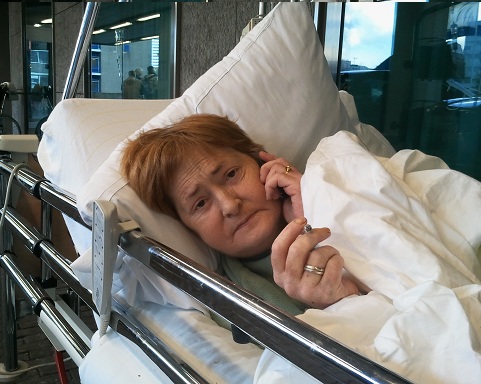
Sandra smoking in bed outside the main entrance of VUMC

That photo right there sums Sandra up to a t. Stubborn enough, determined enough that she would go and get a fag even if it meant getting wheeled outside in her bed to the small smoker’s cubicle next to the main entrance of the VUMC hospital she stayed in. That picture was taking just a month before she would die, roughly around the time that she had decided she was going to die and I was going to have to come to terms with that. It’s how I want to remember her, as somebody who always stayed true to herself, who kept trying to lead her own life as well as could, until she could no more.