The sad faith of the Big Two’s happy little cogs

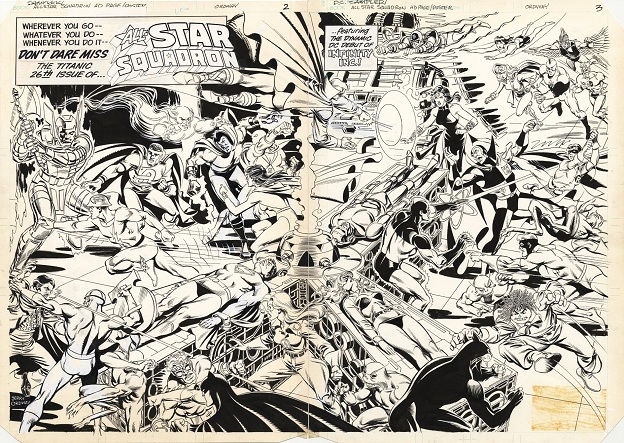
Jerry Ordway original art for an All Star Squadron splash page with the debut of Infinity Inc.

It’s hard to believe, but eighties and nineties DC Comics mainstay Jerry Ordway explains isn’t getting any work from them anymore and can’t live on the royalties for his older stuff:

On a recent Absolute Infinite Crisis hardcover, I had 30-odd pages reprinted in there, a book that retailed for over a hundred dollars– a book that DC never even gave me a copy of, and the royalty amounted to a few dollars, I couldn’t buy a pizza on that windfall. I want to work, I don’t want to be a nostalgia act, remembered only for what I did 20, 30 years ago.

In a way, Ordway is lucky. He at least still gets some royalties. Had he worked on Disney comics like Don Rosa, the most popular Donald Duck cartoonist after Carl Barks, he wouldn’t have received any royalty at all, as Rosa made clear in his explanation as to why he stopped drawing:

Disney comics have never been produced by the Disney company, but have always been created by freelance writers and artists working for licensed independent publishers, like Carl Barks working for Dell Comics, me working for Egmont, and hundreds of others working for numerous other Disney licensees. We are paid a flat rate per page by one publisher for whom we work directly. After that, no matter how many times that story is used by other Disney publishers around the world, no matter how many times the story is reprinted in other comics, album series, hardback books, special editions, etc., etc., no matter how well it sells, we never receive another cent for having created that work. That’s the system Carl Barks worked in and it’s the same system operating today.

For a time back in the eighties and early nineties it looked like (American) comics as a field would evolve beyond it’s low rent, exploitative roots and start treating its talent better. But that needed a growning, not a stagnating field and while comics have always been dying, never more so than in the past two decades. Working for the mainstream, commercial comics publishers in the US was always a good working class sort of career, where you could make decent money if you worked hard and were reliable, but were never going to get rich from. Nor would you get a pension from your work or anything other than a flat rate, but at least you’d still might be able to support yourself even after retirement with freelance work.

But when the slow collapse of the comics industry was accelerated with the mid-nineties crash, when the speculators and collectors left the field and superhero comics became what it was always destined to be, a niche market, it meant there were far too many cartoonists for the field to sustain and all the old pros, some having worked decades for the same company, would gradually disappear, retire, retrain, the lucky ones doing reproductions or sketches at comics cons to get some money, but many of them, like Jerry Ordway, finding it harder to make a living from what once seemed a safe job.

In some ways then what’s has happened to the commercial comics industry is a belated echo of what happened to so many American industries no longer needed or done cheaper elsewhere. These days there is still a comics industry, but outside the rotting corpses of the socalled Big Two it’s a much more boutique approach, one aimed at a smaller audience willing to pay more for a particular cartoonist’s vision or for excellently curated collections of the best of American comics history, with little room for those professionals for which comics was always more of a vocation than a personal calling. There’s no call for assembly line workers when you’re building cars by hand.
Books read February

Seven books read, four Terry Pratchett Discworld novels as part of my ongoing quest to reread them all.

Feet of Clay — Terry Pratchett
The third Discworld city watch novel and the first in which the focus is less on the doings of the Watch itself, and more on the broader politics of Ankh-Morpork.

Holy Disorders — Edmund Crispin
Another dry humouristic detective novel by Crispin

Head Hunters — Steven F. Pond
An excellent look at how the classic Herbie Hancock jazz fusion album was created and the context in which it was recorded.

The Secret State — Peter Hennessy
The evolution of the UK’s nuclear policy over the decades and how this influenced the shape of the secret state.

Hogfather, Jingo, The Last Continent — Terry Pratchett
Three more Discworld novels, including the last Rincewind novl.

Faust Eric — Terry Pratchett

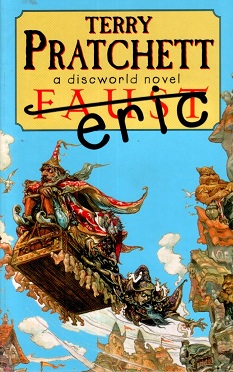
Cover of Eric


Faust Eric
Terry Pratchett
155 pages
published in 1990

Eric is a bit of an odd duck in the Discworld, out of place amongst the increasing sophistication of the last couple of novels coming before it, almost a throwback to the very first few books. It’s a lot shorter, a lot less serious and a lot more written for comedic effect than its immediate predecessors were. All of which can be explained by the simple fact that it was first published as an illustrated book, written around a series of Josh Kirby illustrations, which was later adapted into standard Discworld paperback format, losing most of its charm in the process.

A word about Josh Kirby is needed at this place. Kirby was of course the cover artist for all the Discworld novels up until his death, Thief of Time being his last novel. His work was incredibly caricatural in nature, with very exaggerated figures and bright colours, not really to everybody’s tastes. Some might have found it a bit childish even, but I always liked it. To me his covers were Discworld, especially the early novels when it wasn’t all taken that seriously yet even by Pratchett himself. Therefore it made perfect sense to do an illustrated Discworld story with his drawings, just like his replacement as cover artist, Paul Kidby, would do with The Last Hero.

Read more…

The grey realist seventies

agata pyzik talks about living in the seventies:

One of the reasons the punk generation reads dystopias like A Clockwork Orange as if they were their lives, and looks longingly towards the communist East in their aesthetics, is their depoliticisation. The generation of their grandparents was the one who survived the war, believed in socialism, was changing the world, joined political parties. Earlier, to piss off your parents, you’d join a communist party. By the 70s, those who wanted to change the world, were discredited and all that had left was the aesthetics.

[…]

If you look at any footage of West Berlin in 70s, you see a murky, sinister city, whose punctum, trauma, is the Wall. People gravitate around it. Living next to a prison, even if theoretically you’e not the prisoner, you can develop symptoms of suffocation. Seeing people regularly being killed over an illegal crossing of the Wall, not being able to walk through your city, imagining what there can be on the other side.

One of the things that defined the seventies, especially the second half of the decade, was the freezing of the Cold War into stalemate. The excitement of the fifties and the sixties, when war between the capitalist and communist blocs seemed just around the corner had ebbed away, Vietnam was just a memory and all that was left were petty little squabbles in Third World countries of no great interest to people in Europe or America. You can see that period reflected in Jerry Pournelle’s mil-sf stories of the period, with their background of a codominiom of the US and USSR ruling the stars for the next couple of centuries.

The late seventies and early eighties before the feverdreams of Reaganomics and yuppism took hold were a time without great dreams, a grey, dour, chilly time where economic depression and political stagnation looked to be permanent.The generation that grew up in the seventies was perhaps the first to really grow up with the Cold War as a constant, something that had always been there and that short of nuclear war would not go away.

And then at the tail end of the seventies there was the Soviet invasion of Afghanistan, the first major crisis in the Cold War since Vietnam and there was a president in the White House, a southern Baptist, who was a ruthless son of a bitch despite his public image, who deliberately set out to create the USSR’s own Vietnam from this invasion. A few years later he would outflanked on the right by another born again Christian and actor, who was even more determined to suckerpunch the Russsians, fed as he was by Team B propaganda about the overwhelming might of the Soviet War Machine. In the USSR meanwhile, the leaders there were well aware of how vulnerable they really were and several times during the early eighties would creep close to starting the inevitable war themselves out of fear of being surprised otherwise.

The realists were in charge during this time and they all agreed that the Third World War was inevitable and that sense of realism is visible throughout popular culture in the late seventies and early eighties. Nihilism and cynicism ruled as we all expected to die in nuclear holocaust anyway. The idea that a youth revolt could avoid this, that the counterculture could offer an alternative had been shown to be false.

Is it this shared experience that paved the way for the neoliberal revolution of the eighties, as nuclear war receded as a threat? Perhaps.