“Let someone else be on the poster”


When Brown Lady Shepard is rude, or curt, or dismissive, the reactions she receives from others are not to her gender or her race, but to her words. Why? Because the character was written with the expectation that most people will play it as a white dude … In Mass Effect, no matter what my Shepard says or does, not only is the dialogue the same as it would be for the cultural “default”, but the reaction from the other non-player characters is the same … Brown Lady Shepard waves her intimidation up in a dude’s face and he backs the fuck down, just like he would if she were a hyper-privileged white guy. My Lady Shepard faces no additional pressure to prove herself because of her background; if she is dismissed, it’s on the basis of her assertions, and not because she’s a queer woman of color from a poor socioeconomic background — even though that’s exactly what she is.

[…]

We don’t need Lady Shepard to verbally eviscerate a racist or punch an ass-grabber in the face to know she’s tough. We know she’s tough by her non-explicitly-gendered actions — the same way we know Dude Shepard is tough.

Yes, I’ve been playing Mass Effect this weekend, about five years behind everybody else. And like everybody sane, I’m playing FemShep, as who’d want to play an overmuscled meathead if they don’t have to? To be honest, I usually play as a female character if I get the opportunity; gaming after all is as much about being somebody else than your normal self as it is about anything else.

Underneath the surface FemShep, the female version of Mass Effect’s hero, is quite literally the same as her male counterpart: they share the same animations, the same dialogue trees, etc. Which means, as Lesley Kinzel explains above, that female Shepard is treated the same as male Shepard and people respond to her personality and actions, rather than to her gender or race. This is interesting, rarer than it should be in pop culture, let alone real life. It’s not completely unproblematic, still a standard sort of sci-fi adventure, but the ability to play a competent, tough female action hero and it’s no big deal, is worth it.

Sixteen months on

Sandra smoking in bed outside the main entrance of VUMC

That photo right there sums Sandra up to a t. Stubborn enough, determined enough that she would go and get a fag even if it meant getting wheeled outside in her bed to the small smoker’s cubicle next to the main entrance of the VUMC hospital she stayed in. That picture was taking just a month before she would die, roughly around the time that she had decided she was going to die and I was going to have to come to terms with that. It’s how I want to remember her, as somebody who always stayed true to herself, who kept trying to lead her own life as well as could, until she could no more.

The sad faith of the Big Two’s happy little cogs

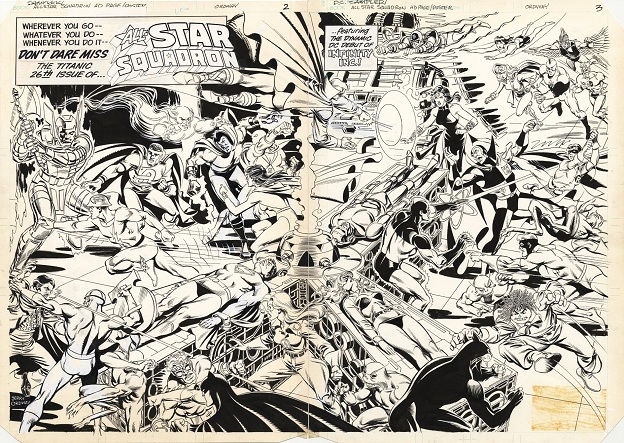
Jerry Ordway original art for an All Star Squadron splash page with the debut of Infinity Inc.

It’s hard to believe, but eighties and nineties DC Comics mainstay Jerry Ordway explains isn’t getting any work from them anymore and can’t live on the royalties for his older stuff:

On a recent Absolute Infinite Crisis hardcover, I had 30-odd pages reprinted in there, a book that retailed for over a hundred dollars– a book that DC never even gave me a copy of, and the royalty amounted to a few dollars, I couldn’t buy a pizza on that windfall. I want to work, I don’t want to be a nostalgia act, remembered only for what I did 20, 30 years ago.

In a way, Ordway is lucky. He at least still gets some royalties. Had he worked on Disney comics like Don Rosa, the most popular Donald Duck cartoonist after Carl Barks, he wouldn’t have received any royalty at all, as Rosa made clear in his explanation as to why he stopped drawing:

Disney comics have never been produced by the Disney company, but have always been created by freelance writers and artists working for licensed independent publishers, like Carl Barks working for Dell Comics, me working for Egmont, and hundreds of others working for numerous other Disney licensees. We are paid a flat rate per page by one publisher for whom we work directly. After that, no matter how many times that story is used by other Disney publishers around the world, no matter how many times the story is reprinted in other comics, album series, hardback books, special editions, etc., etc., no matter how well it sells, we never receive another cent for having created that work. That’s the system Carl Barks worked in and it’s the same system operating today.

For a time back in the eighties and early nineties it looked like (American) comics as a field would evolve beyond it’s low rent, exploitative roots and start treating its talent better. But that needed a growning, not a stagnating field and while comics have always been dying, never more so than in the past two decades. Working for the mainstream, commercial comics publishers in the US was always a good working class sort of career, where you could make decent money if you worked hard and were reliable, but were never going to get rich from. Nor would you get a pension from your work or anything other than a flat rate, but at least you’d still might be able to support yourself even after retirement with freelance work.

But when the slow collapse of the comics industry was accelerated with the mid-nineties crash, when the speculators and collectors left the field and superhero comics became what it was always destined to be, a niche market, it meant there were far too many cartoonists for the field to sustain and all the old pros, some having worked decades for the same company, would gradually disappear, retire, retrain, the lucky ones doing reproductions or sketches at comics cons to get some money, but many of them, like Jerry Ordway, finding it harder to make a living from what once seemed a safe job.

In some ways then what’s has happened to the commercial comics industry is a belated echo of what happened to so many American industries no longer needed or done cheaper elsewhere. These days there is still a comics industry, but outside the rotting corpses of the socalled Big Two it’s a much more boutique approach, one aimed at a smaller audience willing to pay more for a particular cartoonist’s vision or for excellently curated collections of the best of American comics history, with little room for those professionals for which comics was always more of a vocation than a personal calling. There’s no call for assembly line workers when you’re building cars by hand.