Books read February

Seven books read, four Terry Pratchett Discworld novels as part of my ongoing quest to reread them all.

Feet of Clay — Terry Pratchett
The third Discworld city watch novel and the first in which the focus is less on the doings of the Watch itself, and more on the broader politics of Ankh-Morpork.

Holy Disorders — Edmund Crispin
Another dry humouristic detective novel by Crispin

Head Hunters — Steven F. Pond
An excellent look at how the classic Herbie Hancock jazz fusion album was created and the context in which it was recorded.

The Secret State — Peter Hennessy
The evolution of the UK’s nuclear policy over the decades and how this influenced the shape of the secret state.

Hogfather, Jingo, The Last Continent — Terry Pratchett
Three more Discworld novels, including the last Rincewind novl.

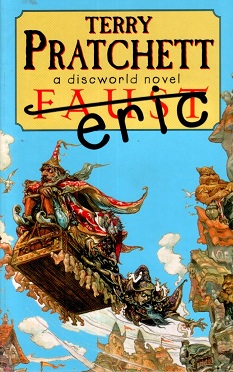
Faust Eric — Terry Pratchett

Cover of Eric


Faust Eric
Terry Pratchett
155 pages
published in 1990

Eric is a bit of an odd duck in the Discworld, out of place amongst the increasing sophistication of the last couple of novels coming before it, almost a throwback to the very first few books. It’s a lot shorter, a lot less serious and a lot more written for comedic effect than its immediate predecessors were. All of which can be explained by the simple fact that it was first published as an illustrated book, written around a series of Josh Kirby illustrations, which was later adapted into standard Discworld paperback format, losing most of its charm in the process.

A word about Josh Kirby is needed at this place. Kirby was of course the cover artist for all the Discworld novels up until his death, Thief of Time being his last novel. His work was incredibly caricatural in nature, with very exaggerated figures and bright colours, not really to everybody’s tastes. Some might have found it a bit childish even, but I always liked it. To me his covers were Discworld, especially the early novels when it wasn’t all taken that seriously yet even by Pratchett himself. Therefore it made perfect sense to do an illustrated Discworld story with his drawings, just like his replacement as cover artist, Paul Kidby, would do with The Last Hero.

Read more…

The grey realist seventies

agata pyzik talks about living in the seventies:

One of the reasons the punk generation reads dystopias like A Clockwork Orange as if they were their lives, and looks longingly towards the communist East in their aesthetics, is their depoliticisation. The generation of their grandparents was the one who survived the war, believed in socialism, was changing the world, joined political parties. Earlier, to piss off your parents, you’d join a communist party. By the 70s, those who wanted to change the world, were discredited and all that had left was the aesthetics.

[…]

If you look at any footage of West Berlin in 70s, you see a murky, sinister city, whose punctum, trauma, is the Wall. People gravitate around it. Living next to a prison, even if theoretically you’e not the prisoner, you can develop symptoms of suffocation. Seeing people regularly being killed over an illegal crossing of the Wall, not being able to walk through your city, imagining what there can be on the other side.

One of the things that defined the seventies, especially the second half of the decade, was the freezing of the Cold War into stalemate. The excitement of the fifties and the sixties, when war between the capitalist and communist blocs seemed just around the corner had ebbed away, Vietnam was just a memory and all that was left were petty little squabbles in Third World countries of no great interest to people in Europe or America. You can see that period reflected in Jerry Pournelle’s mil-sf stories of the period, with their background of a codominiom of the US and USSR ruling the stars for the next couple of centuries.

The late seventies and early eighties before the feverdreams of Reaganomics and yuppism took hold were a time without great dreams, a grey, dour, chilly time where economic depression and political stagnation looked to be permanent.The generation that grew up in the seventies was perhaps the first to really grow up with the Cold War as a constant, something that had always been there and that short of nuclear war would not go away.

And then at the tail end of the seventies there was the Soviet invasion of Afghanistan, the first major crisis in the Cold War since Vietnam and there was a president in the White House, a southern Baptist, who was a ruthless son of a bitch despite his public image, who deliberately set out to create the USSR’s own Vietnam from this invasion. A few years later he would outflanked on the right by another born again Christian and actor, who was even more determined to suckerpunch the Russsians, fed as he was by Team B propaganda about the overwhelming might of the Soviet War Machine. In the USSR meanwhile, the leaders there were well aware of how vulnerable they really were and several times during the early eighties would creep close to starting the inevitable war themselves out of fear of being surprised otherwise.

The realists were in charge during this time and they all agreed that the Third World War was inevitable and that sense of realism is visible throughout popular culture in the late seventies and early eighties. Nihilism and cynicism ruled as we all expected to die in nuclear holocaust anyway. The idea that a youth revolt could avoid this, that the counterculture could offer an alternative had been shown to be false.

Is it this shared experience that paved the way for the neoliberal revolution of the eighties, as nuclear war receded as a threat? Perhaps.
The February strike

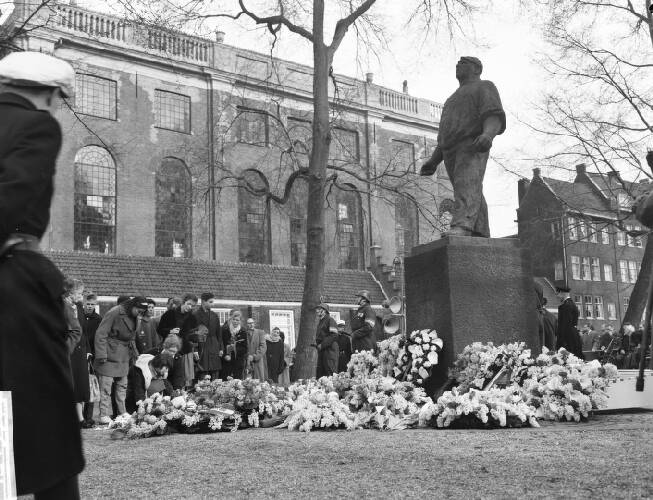
Laying of the wreaths at the Remembrance ceremony at the Dokwerker

On 25 February 1941, less than a year into the nazi occupation of the Netherlands, communist union leaders called for a general strike against the increasing persecution of the Jews. The resulting two day strike in Amsterdam and various other cities in North Holland, the February Strike was the first and only massive public protest against the persecution of the Jews in occupied Europe.

Amsterdam had long been a Jewish city, with a large Jewish neighbourhood in the centre and south of the city. Even before the Germans had conquered Holland, there had been clashes between Jewish people and sympathisers against the indigeneous Dutch fascists of the NSB, the National-Socialist Movement. After the occupation the latter became bolder and started systematically harassing Jewish Amsterdammers, who in turn defended themselves, often with the help of their non-Jewish neighbours and friends. This culminated in a street battle at Waterlooplein on 11 February, when a group of NSB thugs attacking Jewish owned businesses were themselves attacked by a communist strike team of Jewish and non-Jewish residents. As the smoke cleared, one NSB man was left mortally wounded, who died on the 14th.

This incident, as well as similar one when the German SD tried to raid a Jewish-owned icecream parlor and got their asses kicked, was the excuse the nazis needed to institute the first razzias, driving together several hundred Jewish men, beating and torturing them, before sending them off to the concentration camps. This razzia took place on February 23-24, with the communist appeal for a general strike following the next morning.

Though the strike in the end was largely futile, it did serve to rip the mask off the nazi occupier. After its brutal repression it was no longer possible to believe things could continue as usual. In Amsterdam the strike is still remembered each year with a march past the Dokwerker, the statue created in remembrance of the strike in 1951, located on the Jonas Daniel Meijerplein, a centre of the old Jewish neighbourhood.

What makes the Februarystrike special is not just that it was such a public act of resistance, but that it was organised by the Dutch communist party and the communist aligned union, at a time when Nazi Germany and the USSR were still nominally allies. It was also one of the few public acts of resistance in the Netherlands, where the majority of the population not unnaturally just tried to keep their head down, while unfortunately the civil administration and bureaucracy went much to far along in their normal patterns of obedience to authority, even when in service to evil. It’s a proud moment for the Dutch left, one of those times when it took a principled stand, even if an ultimately futile stand, where it led the ordinary people of Amsterdam in, even if for just two days, resisting the deportation of their Jewish neighbours.