How the SWP leadership tried to cover up rape

I’m glad Sandra isn’t here anymore to see how her party, the Socialist Workers Party, deals with accusations of sexual harassement and rape (as reported by Laurie Penney):

This week, it came to light that when allegations of rape and sexual assault were made against a senior party member, the matter was not reported to the police, but dealt with ‘internally’ before being dismissed. According to a transcript from the party’s annual conference earlier this month, not only were friends of the alleged rapist allowed to investigate the complaint, the alleged victims were subject to further harassment. Their drinking habits and former relationships were called into question, and those who stood by them were subject to expulsion and exclusion.

Lenny isn’t impressed either, both by the waqy the central committee handled the original accusations and now has tried to stop criticism of its attempts at covering it up:

This is the thing that all party members need to understand. Even on cynical grounds, the Central Committee has no strategy for how to deal with this. A scandal has been concealed, lied about, then dumped on the members in the most arrogant and stupid manner possible. The leadership is expecting you to cope with this. This isn’t the first time that such unaccountable practices have left you in the lurch. You will recall your pleasure on waking up to find out that Respect was collapsing and that it was over fights that had been going on for ages which no one informed you about. But this is much worse. They expect you to go to your activist circles, your union, your workplaces, and argue something that is indefensible

Richard Seymour is right to put this despicable affair in its proper context, that of a failing, undemocratic, unsocialist party ruled by a nomenklatura of central committee members and hacks, lurching from crisis to crisis, with no real answers to contemporary crisises other than what can be gleamed from the moldering manuscripts of the party’s founder, Tony Cliff. That the CC would cover up sexual assault was only a matter of time, as the leadership has been busy for years if not decades creating the very atmosphere in which these attacks thrive.

The SWP has always been dedicated to the principle of democratic centralism, in which policy and ideological decisions are supposed to be taken by the leadership as a whole, then directed by the central committee, with no room for base politics once these decisions have been made. This is of course rife to abuse and it has long since degenerated into a mockery of socialist democracy: the central leadership is free to think out and dictate policy on its own whim, with no democratic oversight whatsoever, as all room for debate has been removed from the party except for during ritualised conventions.

Sandra, though an active member of the SWP for years, was quite aware of these failings, summing them up as the party being ruled by a generation of professional activists convinced it’s still 1973 and the revolution is right around the corner, but she was equally convinced that flawed as it was, the SWP was one of the few, if not the only political organisation capable and willing to remake the inequalities in our society. But, no matter how cynical she was, I don’t think that she expected the leadership to be as clueless and evil as to coverup sexual assault; nor would she have wanted to stay in such a party.
Up


Up was actually the last movie Sandra and I saw together in the cinema, back in 2009, for her birthday. Even then this sequence was moving; more so now. What with the barely past Christmas season, I saw parts of it several times in the past few weeks, as various channels broadcast the movie again. Which may be why I was dreaming about Sandra last night. One of those dreams where you know she’s dead, but you accept that she got better for some reason and just do mundane stuff. It’s one of those dreams that you wake up from both happy and sad.

Pouring a pint in a quart pot

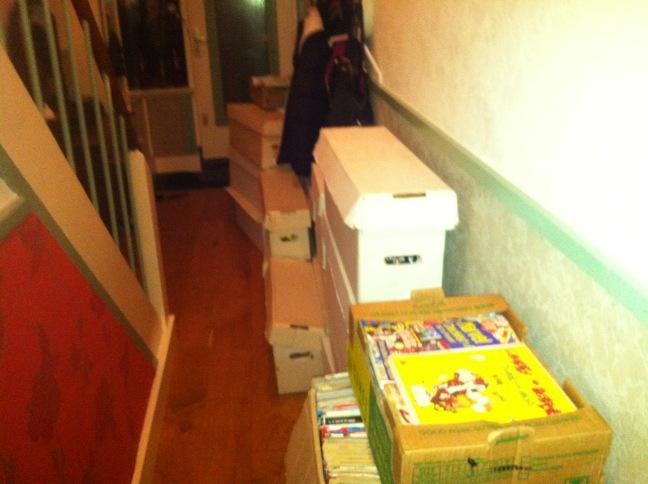
only part of the thirtysomething boxes of books and comics

So in between Christmas and New Year’s Eve, my dad hired a man with a van and schlepped twentyfive years or so of comics and books from the parental home to Amsterdam. Above is only a small part of the thirtysomething boxes: sixteen long boxes of comics, a couple of short magazine size boxes and a lot of banana boxes from the local supermarket. Luckily I had a lot of book shelve space left, not to mention the build-in wardrobe — the clothes can all be scrunged up, can’t they?

There’s a lot of crap in these boxes of course. I started collecting comics properly in about 1987 so was there just in time for the speculation driven Image years; I still have Youngblood #1 fer chrissakes. Most of these aren’t worth anything anymore, so I can’t really sell them, don’t want to keep them, but also don’t want to dump as wastepaper. So who could I do a pleasure with them?

Saga — Brian K. Vaughan and Fiona Staples

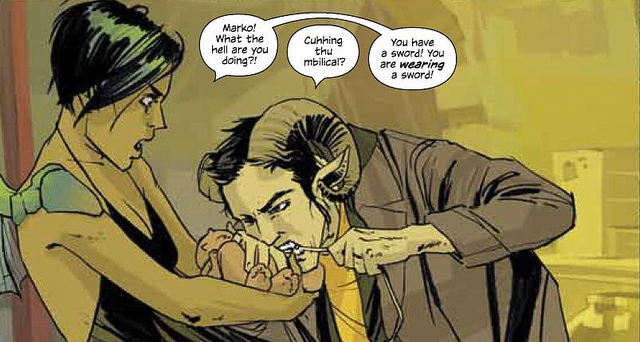
So a couple of months ago I talked about Prophet and how much it seemed influenced by European comics. Well, Saga is another Image series that could’ve just as well been published in Metal Hurlant or A Suivre. It’s written by Brian K. Vaughan, known to me from Y: The Last Man and Ex Machina, but whom I haven’t yet read anything from and drawn by Fiona Staples, who I know nothing about but who is seriously good here. Especially her facial expressions:

Saga - cutting the umbilical cord

Saga is the story of Alana, the woman on the left and Marko, the horned dude, starcrossed lovers in a galaxy at war. Alana is from Landfall while Marko is from Wreath, its moon and these two have been at war for seemingly forever, having outsourced it to the rest of the galaxy. Alana and Marko met on Cleave, the latest planet to become a battlefield when he was a POW and she his guard, fell in love and deserted. Now they have to get off planet while taking care of their newborn baby. Hijinks ensue.

Saga - The Will and the Lying Cat

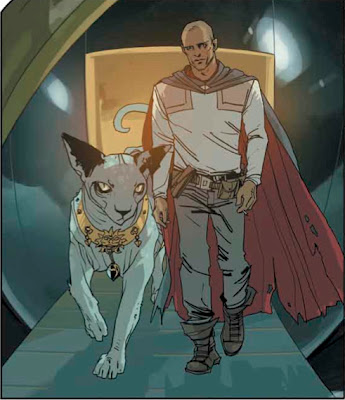
Both sides meanwhile want them dead. From Planetfall Prince Robot IV is sent to Cleave to hunt them down, while Marko’s people have hired freelancers to do the same. That’s one of them above, The Will, with his partner Lying Cat, who can tell if you’re lying to her. The other freelancer is The Stalk, below, whom The Will has history with.

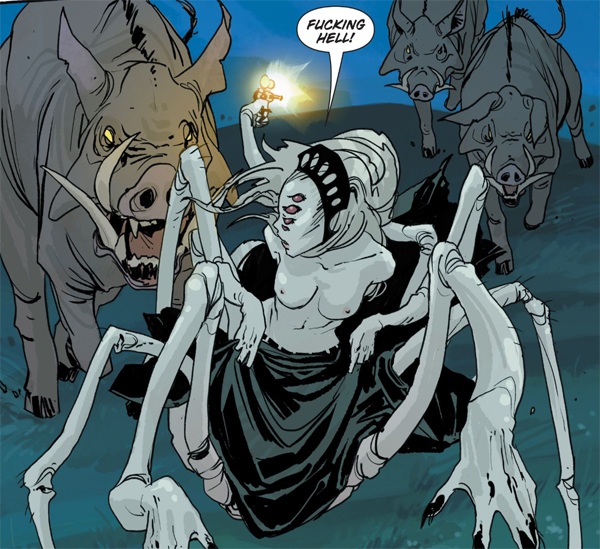
Saga - The Stalk

The story moves slowly over the course of the six issues represented in the first trade paperback, with Marko and Alana trying to get to the Rocketship Woods on the other side of Cleave, while The Will, The Stalk and Prince Robot IV all attempt to catch up to them, one way or another.

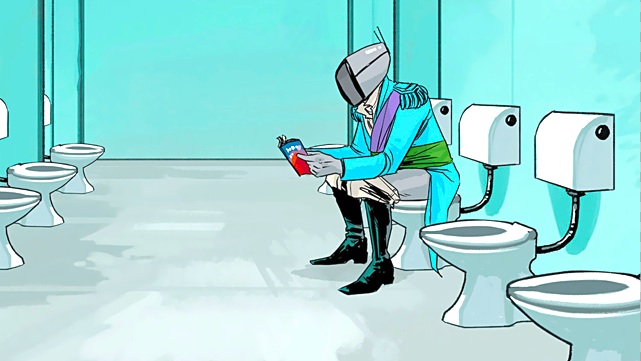
Saga - Prince Robot IV

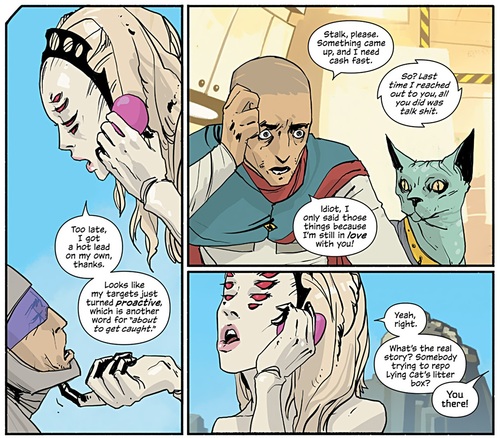
What makes Saga more than just a pretty sci-fi adventure is the simple fact that none of the main characters are true villains or heroes. Alana and Marko just want to live in peace with their daughter, to be left alone, while Prince Robot IV just want to get things over with so he can go home to his pregnant wife. Even the two freelancers are anything but Boba Fett like bounty hunters, with The Will frex having confliced feelings about his former partner, The Stalk.

Saga - The Will and the Stalk

But what really makes the series is the artwork; as said Staples is seriously good at facial expressions, slightly exaggerated at key moments, but also has a good eye for character design and layout in general. In general, like Prophet, this is a series that actually makes me enthusiastic about American comics again, something that shows there are still pleasant surprises to be had.