Growing up in a human made landscape

It takes somebody who’s strange to your part of the world to truly see what makes it special. Here’s Abi Sutherland on what makes Noord Holland’s polder landscape so different from everything else she’s used to:

The more I go out into the polder, the more I see how that narrow, dark line is the focus of the whole landscape. It gives everything else scale and context. The sky is vaster and emptier against its peaks and curves; the clouds are fluffier for its sharpness. It frames and defines the fields around me. And it surrounds my journeys as well, lying at the beginning and the end of every path. Everywhere I go, I’m heading toward it—though, like a mirage, it dissolves into individual trees, houses and villages as I draw near. But then the ever-varied unified silhouette reappears, reformed, when I leave the settlement and reach the next set of fields.

I grew up on the not quite an island anymore of Walcheren, living in Middelburg, on the mid-east side of it. Growing up we did everything — going to school, the beach, visiting family elsewhere on the island — by bike, which nine out of ten times meant heading out from town into the polder landscapes in the heart of it. Largely flat, with Middelburg one of the oldest and therefore highest settlements, with the rest of Walcheren built polder by polder around it, whichever direction you looked, you’d see a human build line on the horizon. To the east, we’d see the same narrow, dark line of towns and villages Abi talks about; every other direction there would be the dunes. Which look natural, but are of course as artificial as the towns themselves.
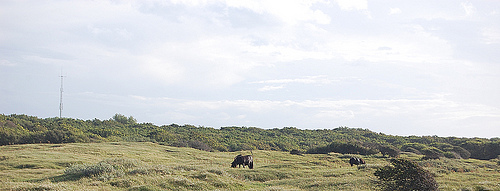

picture of dunes near Oostkappele, by Henk Kosters

As a kid, you don’t really question the landscape you grow up in, or think it anything other than natural, in both senses of the world. Sometimes it’s seeing the old and familiar to new eyes to make you realise how unnatural the land you grew up on is.
Pien


I didn’t think it would’ve been possible to cover Nine Inch Nails’ Hurt in Dutch, but the Heideroosjes manage to pull it off; it’s almost as good as the Johnny Cash version below. The only difference is that Cash brought a history of a life lived with regrets and pain in a way that somebody in his mid-thirties, no matter how good a musician just cannot do. In both cases this is a very masculine song, a very male emotional mix of regret and crippling doubt, self pity and genuine pain, defiantly shouted at the world.


#Transdocfail

Julie Burchill being nasty again about trans people in The Guardian (in an article since replaced by an apology of the editor) is bad enough, as it might provide cover for bullying but much more worrying is the general disrespect and disdain many trans people receive from their own doctors, as documented in stories shared through Twitter and elsewhere.

Two weeks ago, one of the few doctors providing gender re-assignment outside the NHS, doctor Richard Curtis came under investigation by the General Medical Council, for alleged errors made during gender reassignment, including one alleged wrongful referral for surgery.

For many trans people this investigation looked like yet another attack on the already scarce resources for gender reassignment in the UK, once again focusing on the alleged harm that might have been done to people erroneously under going gender realignment therapies, rather than the everyday difficulties many trans people have with getting the right medical support.

This anger led to the establishment of the TransDocFail hashtag on twitter, started by trans activists Zoe O’Connell and Lib Dem councillor Sarah Brown, asking UK trans patients to relate their experiences with gender reassignment and health care in general. It led to a flood of tweets by trans people, often anonymously describing the problems and bigotry they encounter at their GP or hospital.

The heart of the problem still seems to be the idea that trans people need to be protected from making a potential mistake more than they need to be helped become what they really are, as well as a continuing transphobia amongst some health care workers, not often addressed in the news media. As Sarah Brown is quoted:

“The media are typically invested in presenting a rigid narrative about how trans people interact with medicine. The stories trans people would like to tell, stories of outrageous levels of systemic abuse and transphobia, don’t fit this narrative and so go ignored and unreported. Social media is changing this. The stories trans people have to tell are reaching people who seldom hear them, and people are often appalled by what they hear. We can’t even begin to tackle widespread medical abuse of trans people until there is wider awareness of just how bad it is.”

A related problem is the fact that so often, the only trans stories covered in the media are negative ones, which is something the We Happy Trans project attempts to do something about.

(Originally posted on MetaFilter.)

Cat Claw

Cat Claw

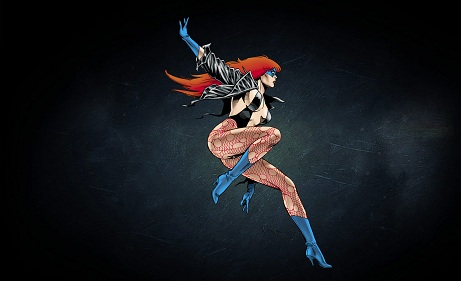
So this might sound familiar. A meek, shy student is bitten by an escaped lab animal and is given strange powers as a result; radiation is involved. Once these strange new powers have revealed themselves to her, she decides to become a superhero. Wait, “she“? Yes, because this is Bane Kerac’s Cat Claw, not Lee/Ditko’s Spider-Man. Not that the similarities in their origins are coincidence; Kerac was inspired by Spider-Man when he created Cat Claw for a Yugoslavian comics zine in the mid-eighties. Where they differ is that Carol Connor was much more likely than Peter Parker to lose her already skimpy costume.

Popular enough in her home country to get a television special dedicated to her and her creator in 1991, Cat Claw was also exported to various other European countries including Holland, as well as reprinted in a nine issue series by Aircel/Malibu comics in the US. To be honest, her adventures, or at least the ones I’ve read, are all pulpy nonsense, but Kerac has a sense of humour and that makes up for a lot. The mini movie from that tv special, excerpted below, meanwhile is very eighties, but does get across the spirit of the comics well.


What being privileged is like

One fine evening, journalist Jamelle Bouie decides to sell his old tv to a friend and sets out to bring it over to them there and then, when considers what this would look like:

As I was getting ready to go, it occurred to me that this would be a terrible idea. Not because I would have been carrying a TV at 10pm down a quiet city street—I actually feel pretty safe doing that. But because I would have been a black dude—in a hoodie, no less!—carrying a nice-looking TV down a quiet city street at 10pm.

Had he been white, would he have thought about this? Jamelle himself thinks not, and I think he’s right. For myself, while I do occassionally wonder when doing something that could look dodgy, I’ve never been in a situation where I’ve been stopped by police because what I was doing looked suspicious. In fact, police officers here and abroad have always been respectful and polite to me, whenever I had to interact with them. The same really goes for any sort of interaction with authority; I’ve always been treated respectfully even when in the wrong, have more often than not been believed on my word when there was no real reason to do so, always gotten the benefit of the doubt when I needed it. In short, I’ve never had to worry about people judging me negatively just of how I look.

That’s something that’s incredibly powerful, in which I’m very lucky as I’ve done nothing to earn this respect, but which from the inside feels like the normal way the world should work; it doesn’t feel like I’m priviledged. This dichotomy, where it’s easier for those without these privileges to see how privileged those with them truly are, is I think responsible for much of the heat around internet debates about privilege.

On the one hand, people like me who enjoy these privileges need to make an effort to see them for what they are, while on the other hand they have never or rarely experienced the sort of harassement people without them encounter regularly. It makes it hard for us to believe them, even when everybody is arguing in good faith and it’s even harder to transform this intellectual understanding in an emotional one, to understand what it is really like to live without this privilege we take for granted.

That’s why simple, to the point and most importantly, unjudgmental post like Jamelle Bouie’s one here are so important, as they provide a way in which we can understand something of how other people live.