Guards! Guards! — Terry Pratchett

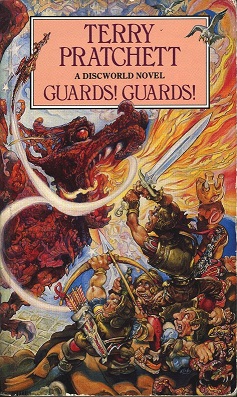
Cover of Guards! Guards!


Guards! Guards!
Terry Pratchett
317 pages
published in 1989

For me Guards! Guards! is the last novel you can describe as an early Discworld novel. From here on all the major subseries have appeared: Rincewind, Death, the Witches and now the Night Watch/Sam Vimes novels. It’s the first novel in which Ankh-Morpork becomes more than generic, somewhat over the top fantasy city, with the first extended cameo for the Patrician and the first insights in how he rules the city. Over time Ankh-Morpork and the Night Watch would come to dominate the Discworld series of course; every novel in the main series since The Fifth Elephant either set in Ankh-Morpolk or featuring the Watch or both, but of course we didn’t know that at the time. Back then it was just Pratchett taking the mickey out of yet another set of fantasy cliches.

In Guards! Guards!‘s case, he did that by importing another set of cliches, that of the hardboiled police procedural. Sam Vimes is a hero straight out of an Ian Rankin novel: the grizzled, older, cynical detective staying in the Night Watch because he has no other place to go. He remained in his post even as the watch has degenerated into a farce and he has become a captain of only three men: Fred Colon, a fat sergeant, Nobby Nobbs, a weassely corporal and a new dwarf recruit called Carrot Ironfoundersson.

Read more…

History is more than just an excuse for your own sexism

Dan Wohl at The Mary Sue examines the idea that actually existing historical sexism can excuse sexism in fantasy fiction, on which Tansy Rayner Roberts elaborates:

History is not a long series of centuries in which men did all the interesting/important things and women stayed home and twiddled their thumbs in between pushing out babies, making soup and dying in childbirth.

History is actually a long series of centuries of men writing down what they thought was important and interesting, and FORGETTING TO WRITE ABOUT WOMEN. It’s also a long series of centuries of women’s work and women’s writing being actively denigrated by men. Writings were destroyed, contributions were downplayed, and women were actively oppressed against, absolutely.

But the forgetting part is vitally important. Most historians and other writers of what we now consider “primary sources” simply didn’t think about women and their contribution to society. They took it for granted, except when that contribution or its lack directly affected men.

A good example of that last point can be found in Kimberly Klimek’s dissertation Forgetting the Weakness of Her Sex and a Woman’s Softness: Historians of the Anglo-Norman World and their Female Subjects, which looks at a particular period in history often used as inspiration for fantasy novels, which was particularly rich both in historians and powerful women both.

To be Grant Morrison when you could’ve been Alan Moore

A couple of weeks ago Pádraig Ó Méalóid looked at the strange relationship Grant Morrison has with Alan Moore. It turns out Morrison was Not Amused and keen to let people know this. So The Beat gave him the space to fisk the article. It’s all a bit needy, spending that much time and space refuting allegations made decades ago in different contexts. You get the feeling he’s too defensive and honestly, mocking it is the only right response.

However, since his extending whinge got on my tits, I thought I’d take umbrage at one part of argument, this:

I’d already submitted art and story samples several times to both DC and Marvel, along with a pitch for a crossover entitled “Second Coming” to DC’s New Talent Programme in 1982. I was on the files and I didn’t stop angling for work. DC would have found all of us, with or without Alan Moore, who seems curiously unable or unwilling to acknowledge that he was part of a spontaneous movement not its driving force or sole font of creativity.

Which is somewhat contradicted a few paragraphs later:

To get work with Marvel UK and “2000AD” I suppressed my esoteric and surrealist tendencies and tried to imitate popular styles – in order to secure paying jobs in the comics mainstream. There is a reason those pieces were written in a vaguely Alan Moore-ish style and it’s because I was trying to sell to companies who thought Moore was the sine qua non of the bees knees and those stories were my take on what I figured they were looking for.

If Morrison would’ve made it without Moore’s pionering work, if Moore’s influence on the development of the “British Invasion”, comicd edition wasn’t that great, why was it important to imitate him?

Because of course without Moore’s Swamp Thing, without Watchmen, without the commercial and critical success he brought to DC, at a time when unlike now it was actively courting an adult audience, trying to establish itself as the thinking person’s mainstream comics publisher, there wouldn’t have been a Hellblazer or Sandman or Animal Man. Without Moore to blaze the trail, to teach DC to handle writers not desparate to write Superman, not beholden to corporate superheroes, would Morrison have had the freedom he had to revamp Doom Patrol?

Of course not.

Yes, there was a larger talent pool in the UK in the early to mid eighties, thanks to 2000AD and the surge in punk inspired, d.i.y. alternative comix, but there was no guarantee that these writers would’ve crossed the ocean without an Alan Moore to do it first. His influence really cannot be overestimated: Marvelman, V for Vendetta, Halo Jones, Watchmen: any writer would give their left arm for just one of them. Through him, DC learned how profitable it could be to have such an independent, literary writer on board; through him, it also learned how easy it was to lose such a writer, through scamming him out of his rights or mucking about with his scripts, something that all the writers who would go on to form Vertigo would profit from.

Both DC and Morrison have forgotten those lessons, both profit from this, but both are the lesser for it.
Footballers against Israeli apartheid


The 2014 under-21 European Championships are supposed to be held in Israel, which is a bit awkward considering it just destroyed a football stadium as a novel new way of expressing its displeasure with the Palestinians. Sport, like art, is of course important to the well being of any peoples and it’s no wonder then that Israel regularly targets both.

To their considerable credit, more than sixty European professional footballers have protested against these acts and urged UEFA to withdrawn the competition from Israel:

We, as European football players, express our solidarity with the people of Gaza who are living under siege and denied basic human dignity and freedom. The latest Israeli bombardment of Gaza, resulting in the death of over a hundred civilians, was yet another stain on the world’s conscience.

We are informed that on 10 November 2012 the Israeli army bombed a sports stadium in Gaza, resulting in the death of four young people playing football, Mohamed Harara and Ahmed Harara, 16 and 17 years old; Matar Rahman and Ahmed Al Dirdissawi, 18 years old.

We are also informed that since February 2012 two footballers with the club Al Amari, Omar Rowis, 23, and Mohammed Nemer, 22, have been detained in Israel without charge or trial.

It is unacceptable that children are killed while they play football. Israel hosting the UEFA Under-21 European Championship, in these circumstances, will be seen as a reward for actions that are contrary to sporting values.

Despite the recent ceasefire, Palestinians are still forced to endure a desperate existence under occupation, they must be protected by the international community. All people have the right to a life of dignity, freedom and security. We hope that a just settlement will finally emerge.

Well done.