Batman Classics 118 — #aComicaDay (47)

This was the way I first got to read the classic Steve Englehart/Marshall Rogers Batman stories from Detective Comics and it was the best way I could’ve, as these Rogers’ artwrok never looked as good as it did in black and white here.

Batman is looking down from a rooftop while behind him Manbat is flying in the distance. An inset on the left shows the Warlord

Honestly. I also have these same stories as collected in the Legends of the Dark Knight: Marshall Rogers, in full colour on great paper and it just doesn’t look as good as it did in black and white on that crumbling newsprint paper Classics Lektuur used. The atmosphere of these stories was just so much better suited to black and white.

Marshall Rogers was already the penciler of the backup feature in Detective Comics in #466-467, with his first full issue in 468. Then in issue 471 he was joined by Steve Englehart as writer, who had started the previous issue but that had been drawn by Walter Simonson. From 471 to 476 they would create some of the best Batman stories ever published. Starting off with Hugo Strange, a villain last seen in the 1940ties discovering Batman’s secret identity, then trying to auctioning it off to, among others, the Penguin and the Joker. Before he can do so however he’s kidnapped and murdered by local crime lord Boss Thorne, who doesn’t get him to divulge the secret.

While this is all playing out, Batman first has to deal with the Penguin’s plan to rob a bird statue from a Gotham museum, in a rare teamup with Robin, still in college at this point. Then Englehart brings back another ancient villain, Deadshot, who started out as a fake Batman wannabe, now equipped with cool new wrist guns and costume. Then Rogers and Englehart round off their tenure with the legendary Laughing Fish story, in which the Joker poisons the fish around Gotham so they look like his own face and then threatens the copyright commission because they wouldn’t copyright the fish for him…

All these were reprinted in Dutch in Batman Classics 118-122 in 1980 and almost a decade later I would find these in a local secondhand bookstore for 75 cents a pop. That was a bit steep at the time for me, but over the next few weeks I would buy as many of these as I could, as well as some of the other issues they had. These would be not just my first introduction to the Englehart/Rogers Batman stories, but because these issues were 52 pages long, it also had various backups, including Warlord and Manbat. The latter series also featuring Rogers art.

At the time I wasn’t really a DC reader, but these were so good that they converted me from being a proper Marvel Zombie. The Batman Classics series had run from 1970 and would be cancelled in 1981, when the publisher, Classics Lektuur, got out of doing comics entirely. They actually started off as a publisher of the old Classic Illustrated edutainment comics in the mid-fifties, then branched out into less reputable fare. Not picky when it came to what they reprinted, they not only published DC superhero series, but also a lot of Marvel ones as well as Dell/Goldkey series, most with “Classics” in the title. Batman was actually a late addition to their portfolio as he had been licensed by another publisher during the sixties…

For years you could find all these comics very cheap in second hand stores or at comic cons, but over the decades they have become somewhat collectable to a few generations of superhero fans who grew up without access to the originals. I too have been slowly starting collecting them again, for nostalgia sake.

A word about the cover art: most of the Batman Classics issues at this time used new covers rather than reprints from the original American issues, with them being used not just on these Dutch reprints, but on similar series all across Europe. The artists responsible are largely unknown.
Flare Adventures 01 — #aComicaDay (46)

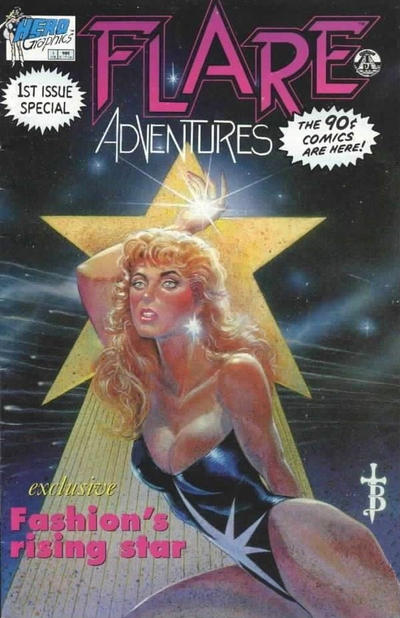
The cover showing off Flare’s best assets promises exactly what you will get inside. If you liked Wonder Woman or Black Canary but hated how conservatively they dressed, Flare is the genetically engineered raised by Nazis in the Brazilian rainforest superheroine for you.

Flare, a blonde woman in a one piece swimsuit with a large star on her stomach area is posing

Flare Adventures was a low price reprint series of the first Flare series, the first issue reprinting the first story from the original. In it, Flare is woken up by a phone call from her friend who wants her to come down, quickly puts on a way too short dressing gown and promptly flashes the photographers her friend had assembled for the press conference Flare had totally forgotten about. After that, she does some work as a photo model, then has to fight a bank robbing villain called Darkon and is promptly beaten by his darkness powers. It’s a pretty good sampler for the rest of Flare’s adventures. If you read them for anything but the cheesecake, they’re mildly underwhelming.

But I didn’t know that when I bought this. It was 1992 and all I saw was another superhero when I bought this together with the similar Champions Classics, reprinting one of Heroic other old titles. They’d gotten George Pérez to do the cover for that one which lured me in, just as the Tim Burchard cover had done for Flare Adventures. Together they were my first introduction to the whole Heroic universe and honestly the covers were the best part of them. As I read more Flare stories when I came across them I realised that in general, the artwork was always a cut above the writing which never rose above ‘serviceable’.

To understand why that is you have to understand that Heroic Publishing and the Flare/Champions universe are largely the rpoduct of one man, Dennis Mallonee. He’s the writer for most of these comics as well as their publisher. Yet ironically, he didn’t create Flare or the Champions: those came from a role playing game also called Champions. That had been first released in 1981 as one of the first superhero RPGs and also one of the first not to use dice rolls but a point distribution system: you could decide for yourself what your character’s strengths and weaknesses were. As people started playing that, they of course created their own heroes and some of these, via ‘official’ RPG sessions were included as examples in new editions of Champions. Then, when during the ’85 Comic Con fans of the game asked if there would ever be a comic version, Mallonee decided he would do it. That led to the first Champions miniseries, published by Eclipse in 1986, which wasn’t quite what he wanted.

Mallonee was already a publisher, having published the Fantasy Book prose magazine and he decided he would go into comics to publish his stories the way he intended. Heroic Publishing started off in 1987 with three series: champions, another Mallonee series called Eternity Smith that had started at Renegade Press and the Roy & Dann Thomas written Captain Thumder & Blue Bolt. Flare would arrive the year after, having been voted the most popular member of the Champions by the readers of that first Eclipse series. She quickly became the poster girl for Heroic as a whole, starring in various titles, always written by Mallonee and drawn by various artists you may have heard of: Mark Beachum, Chriss Marrinan, e. R. Cruz, Howard Simpson.

Originally created by Stacy Thain for that original Champions RPG, Mallonee fleshed out her background, making her the product of Nazi super science as well as offspring of the Olympian gods. She got a younger sister with similar powers who unlike her completely bought into Nazi ideology, who would later also join the Champions team. Because I could find none of these titles with any regularity in the comic shop and also because Heroic had a habit of stop starting series and introducing new ones that mixed reprints of older material with newer stories, getting a handle on who Flare actually was was always difficult to me. Rereading some of this now it’s clear though that there just isn’t that much going on with her. At best these stories are store brand superhero stories, the characters no more compelling than somebody else’s RPG character always is, at worst they’re just excuse for Flare or another heroine to fall out of her top. Because it’s always Mallonee writing them, these stories and characters all blend together; Flare doesn’t feel that different from her sister or from another heroine like Arcane.

Nevertheless, Flare and Heroic Publishing are still around, now doing print on demand and Kickstarter campaigns. Somebody still likes Heroic’s blend of cheesecake and superhero stories….

A familiar problem

David Coggins looks at some famous bookshelves

A good bookshelf should be full. Or nearly full anyway. An empty bookshelf has so much more to offer the world. It sits like an empty closet, an empty museum, an empty stadium, unfulfilled, not reaching its potential. Trust our strength, the bookshelf begs us, let us show off, baby!

Empty bookshelves are unfamiliar to me. My issue is too many books. This leads to a lifetime of stacking, itself a dangerous path. When you admit that your reading ambitions require the air rights above every horizontal surface in your home—even the floor is in play—then you have a problem I can relate to.

A personal library announces many things. Some are general (“I like to read”), some are about taste (“These are the books I enjoy”), and some are about personality (“This is the way I arrange them”). This combination makes a library so revealing.

Nick Fury Agent of SHIELD 06 — #aComicaDay (45)

There are a few artists (Gulacy, Chaykin, Pérez e.g) for whom I’d buy a comic even if they only did a cover. Steranko too is such an artist, but that’s not why I wanted this particular issue.

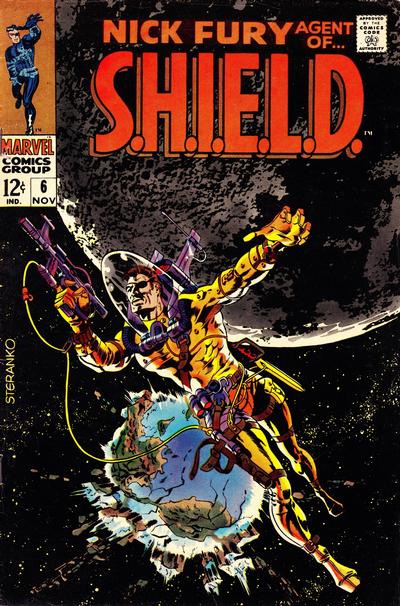
Nick Fury is swimming through space in his skintight golden space suit while the Earth explodes behind him

I certainly didn’t buy it for the story, an Archie Goodwin/Roy Thomas yarn about a group of extradimensional exiles calling themselves the Others who with their psionic powers are drawing a planetoid unto Earth to release the energy needed to return to their home dimension. Nick Fury is no stranger to sci-fi plots but this was something you’d expect to see in Fantastic Four or Avengers. The artwork by Frank Springer is good. He has a decent eye for the sort of futuristic decor that this story needed while he’s no slouch at action scenes either. Springer’s very good at ratcheting up the tension as well, as Nick has only hours to save the Earth. The resolution is a bit obvious, but the way Goodwin and Thomas increasingly corner Fury as the story unfolds, as each of his attempts to stop the disaster is foiled, is great.

No, I couldn’t care less about the contents of this issue nor even for the fact that Steranko had drawn the cover. This was simply something I purchased for nostalgic reasons. I knew that cover, had seen and admired it long before I ever laid my hands on the issue it was used on. It was all thanks to the first, 1979 edition of John Clute and Peter Nicholl’s Encyclopedia of Science Fiction, which unlike the second 1991 edition was illustrated. And one of these illustrations was this particular Nick Fury Agent of SHIELD cover.

I must’ve read every word of the encyclopedia after I had discovered it in my local library. I borrowed it for months at the time, just rereading it and learning about science fiction when I didn’t have the pocket money to regularly buy science fiction books myself. And every time I browsed through it, I would come across this picture and had to stop to admire it for a second. Of course then I bought the actual issue it was from the moment I spotted it at a convention. It turns out I wasn’t the only one enthralled by this cover either: it won an Ally Award in 1968 for Best Cover.

2000 AD prog 700 — #aComicaDay (44)

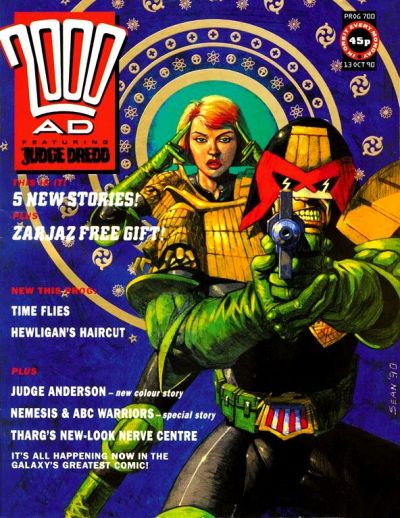
You’ll never forget your first prog as a 2000 AD reader and this one was mine.

Judge Dredd pointing his gun at the reader with Judge Anderson behind him using her psi powers

I’ve talked about 2000 AD before recently, but I thought I would mention this particular prog as this was my first ever. A good start it was too, because it did periodically the magazine had reinvented itself again with a little bit of a makeover (and a price hike, natch) and all new stories. A perfect jump on point for new readers like me.It certainly hooked me enough to keep buying 2000 AD for over a hundred progs.

The lead Judge Dredd story was the first of a two part John Wagner/Ron Smith follow-up to the Necropolis saga that had ended the previous issue, with Dredd investigating a disused holo theatre for a sign of Judge Death. To be honest it, together with the Pat Mills/C. Critchlow Nemesis and Deadlock story, is the weakest story in here. Both are more palate cleansers, just there to mark time between more substantial stories.

Much more interesting is Time Flies, which will run for 11 progs, a Garth Ennis and Philip Bond time travel comedy in which squadron leader Bertie Sharp is plucked out of time by a group of time travelers from the 35th century (and the Bros brothers) to help rescue Hermann Goering from a band of time pirates so that Adolf Hitler can get them spare parts for their own time machine. It’s a slightly overcooked zany adventure and Ennis’ first 2000 AD story.

Even zanier is Hewligan’s Haircut, by Pete Milligan and Jamie Hewlett, about the unfortunate Hewligan, a patient on a psychiatric ward who managed to cut a perfect hole in his hair that looked the same from all angles and which slightly upset all laws of physics and reality itself. For all of its zaniness it’s a story that worked rather well, more interesting than the Ennis attempt.

Rounding off the issue is the first in Psi Judge Anderson story by Alan Grant and Arthur Ranson, whose art is just gorgeous. None of the artists in this issue are bad, but his is just on another level. Shamballa is a psychic adventure in which Anderson teams up with a Sov Bloc Judge as various psionic breakouts around the world spell out that the end times are near. A far more serious to end on.

As a whole, for somebody who had only read some Judge Dredd and was only vaguely aware of other 2000 AD this was a good start even if two out of the five stories were middling. There was enough there that was completely new to me that I looked forward to the next issue.