Shogun Warriors 17 — #aComicaDay (43)

This cover caption has lived rent free in my heads for decades. You’re a kid… You’re flying a Shogun… And it’s really fun…. RIGHT? WRONG!
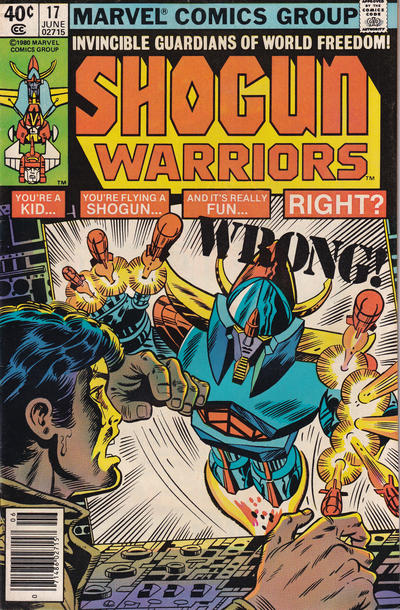
You're a kid... You're flying a Shogun... And it's really fun.... RIGHT? WRONG! is the caption as a terrified boy looks at a giant robot flying at him firing missiles

The local comic shop in my hometown started stocking American back issues sometime in the late eighties and every Wednesday I would go there and browse through to see what caught my eye. Shogun Warriors 17 was one of those. Not just one of the first American comics I ever bought, it may very well have been the very first mecha story I ever read.

Because that’s what Shogun Warriors was, a comic book based on a toy line that took the lead mecha from three different anime (Wakusei Robo Danguard Ace), Brave Raideen and Chōdenji Robo Combattler V) in an attempt to sell them to American children. Marvel was asked to create the comic as an advert for the toys and with only the toys as a reference, writer Doug Moench and artist Herb Trimpe invented a whole new story to go along with them, Trimpe also inventing the monsters the Shogun Warriors would fight. Nothing was carried over from the original stories these mecha appeared in; this isn’t even a Macross/Robotech situation.

What Moench and Trimpe invented was a story of a long ago war between the Followers of Light and the Followers of Dark, which the latter lost and after which they were sealed in a volcano. When its eruption threatened to revive the evil Follower of Dark Maur-Kon, a neat multinational three person squadron was formed to combat them, each given their own giant robot. Stuntman Richard Carson got Raydeen, test pilot Genji Odashu got Combatra and oceanographer Ilongo Savage got Dangard Ace, the coolest of the three. I’m not sure how much Moench and Trimpe knew about mecha anime or super sentai live action series, but the series sure reads like one, with the Warriors having to fight a series of monsters sent their way by Maur-Kon.

Shogun Warriors was created in 1978, at a time when Marvel did a lot of titles based on licensed properties and usually stuck them somewhere in the Marvel Universe. Moench and Trimpe had already done that with Godzilla before, while Micronauts, Rom, The Human Fly and Team America were launched at roughly the same time or slightly later. You could even argue that it all started with Conan the Barbarian: not explicitly set in the Marvel Universe at first, but once he got his first team-up with Spider-Man…

Shogun Warriors greatest contribution to the Marvel Universe was Doctor Demonicus, a super genetic engineer making giant monsters out of mutated animals. He would later pop up in Roy and Dann Thomas’s Avengers West Coast as a major villain. The final two issues of the series had the Fantastic Four as guest stars and the Warriors would return the favour in a later issue of Fantastic Four in which the robots were destroyed to tie off all the loose ends from the series.

Issue 17 though is a simple story of a young boy who discovers Combatra having been hidden in an abandoned building in San Francisco and accidentally triggers the mechanism that transports him into the cockpit. Not knowing how to operate it, the poor kid is along for the ride as Combatra goes on a rampage and Raydeen has to stop him… The cover was probably more exciting than the actual story, but it hardly mattered at the time.
Luc Orient 03 — De Meester van Terango — #aComicaDay (42)

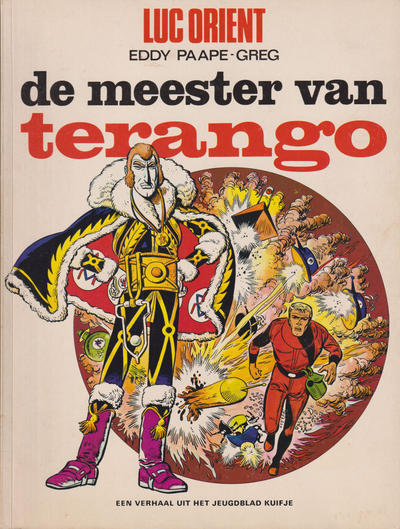
Luc Orient and pals are brought to the planet Terango to dispose of its tyrant before he can invade the Earth!

A literally white man with red hair wearing a opera style military custome complete with cape is standing in the foreground while behind him a blonde man in ajump suits runs towards the camera while things explode around him

From one of my favourite childhood sf series to another: Luc Orient. Another series I first read in my local library and this particular story was one of the first I can remember reading of it. Written by Greg, who seemed to have written almost every series published in Tintin between 1957 and 1993 or so. The art is by Eddy Paape, another Belgian comics veteran but who had mainly worked for Tintin rival Spirou before Luc Orient.

Luc Orient‘s titular protagonist is a blonde, brawny troubleshooter for Eurocristal, a fictional super science organisation. His best friend is professor Hugo Kala, leader of the lab and his girl Friday is Lora, who luckily does more than just playing the damsel in distress. Together they go on various science fictional adventures and managed to do so for some 18 albums, the first published in 1969, the last coming out in 1994.

What set Luc Orient apart from similar series is its remarkable use of continuity. European heroes tend to have their adventures in neat, 48 page album sized chunks, each a standalone story. Unlike American superhero stories continuing subplots are rare nor is there even the illusion of change most of the time. Tintin kept running around in his plus fours from 1929 to 1976 and the only thing that changed were the types of cars and air planes he used after all. But Luc Orient was different, as the first five stories did have a continuous plot.

In the first two albums, Luc Orient and co are on an expedition to Borneo to investigate the mysterious valley of the three suns, were ultimately they discover a crashed spaceship with a cargo of aliens in cryosleep onboard. After saving them in the second album, this story sees them return to Earth to call on Luc Orient to help them save their planet from its oppressor, the tyrant Sectan. The two volumes after that tell the story of how they managed to do so, after having struck the first blow in this one.

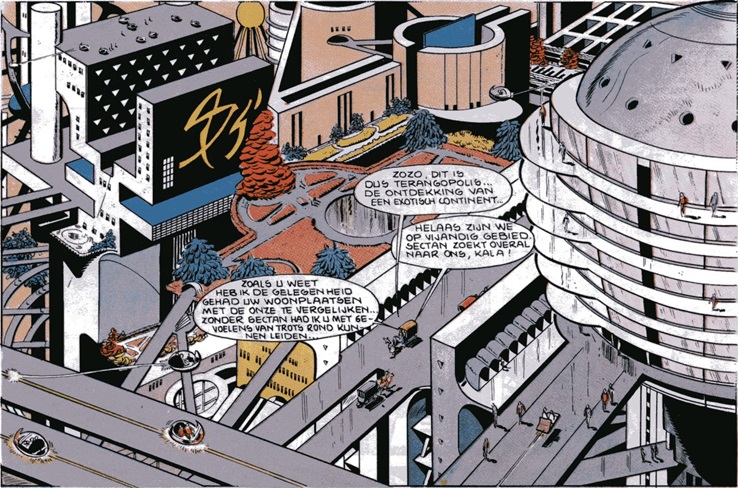
An aerial view of a futuristic city

As a young boy reading this somewhere in the late seventies/early eighties, some of the very first science fiction I ever read this was mind altering. Especially the way Paape depicted Terango, this alien planet. Having discovered Isaac Asimov and his vision of a planet wide super city, the way Paape depicted Terangopolis is how I imagined Asimov’s Trantor would look like.

Ravian 01 — Het Woedende Water — #aComicaDay (41)

It’s 1986. It’s the end of the world and time/space agent Ravian has to find his way through a flooded New York to find his nemesis, the mad scientist Xombol, before he changes the future forever!

Ravian, Laurentine and Sun Rae navigate a small boat through the flooded streets of Manhattan

Considering New York didn’t flood thirty eight years ago because an arsenal of hydrogen bombs accidentally exploded at the North Pole, not only melting the ice caps but also setting lose a wave of seismic and volcanic activity, maybe Xombul did manage to change the future?

Or more likely, this was originally written in 1968 so 1986 was a safe near future year to set the story in. After all, it was just the first full length story for the new Valérian series created by Pierre Christin and J. C. Mézières in Pilote. Who knows if it would be a success or how long it would last, right? Fast forward a fifteen years ago and a young Martin was reading this in the local library one or two years before it would be 1986 for real and he found himself wondering if and how Christin and Mézières would fix this…

Spoilers: they did, but that’s a story for another time. All I’ll say here is that Valérian was popular enough that it would become a problem for the series by the early eighties and that it was resolved in a very comprehensive manner, completely revamping the series as it had been. But all that’s still in the future at this point.

Het Woede Water (original: La Cité des eaux mouvantes, The City of Shifting Waters) is a fairly straightforward story. In a previous adventure, Ravian had had to catch Xombol who had taken a time machine and travelled to the Middle Ages. It’s here that Ravian also met Laurentine and took her with him to his future. Now Xombol has escaped, yet again stolen a time machine and travelled back to 1986, as the disaster that ended civilisation for four centuries was still in progress. He arrives at the time travel station in the cellar of the Statue of Liberty, just in time for it to collapse due to the storm battering New York, to be rescued by a gang of plunderers led by one Sun Rae, a Black flute playing gang leader/intellectual. Everybody else has long abandoned the city.

Some picaresque adventures in the ruins of New York later, he, Laurentine and Sun Rae are captured by Xombol’s cyborgs and transported by atomic hovercraft to a secret government lab in Yellowstone park, by way of Washington DC — any Americans wanting to tell me if that’s a logical route? There they manage to escape again with the pet scientist Xombol rescued, have some adventures in what’s left of civilisation around Yellowstone before going for the final confrontation with Xombol. They manage to stop him and in a neat bit of symmetry realise the images shown at the start of the story were actually taken from the space station Xombol had moved to…

It all reads like a good sci-fi b-movie, especially the first part, set in New York. There are anachronisms of course: the Empire State Building is referred to as the tallest building, Sun Rae and his gang look like late sixties hippies rather than anything you’d find in the real 1986 New York, but those are quibbles. Both Christin and Mézières had live in the US before they’d went to do comics: the first as a teacher of French literature in Salt Lake City, the latter because he wanted to be a cowboy. Their version of America therefore doesn’t look inherently strange. One minor detail I wonder about is how many readers would’ve had a clue about the real Sun Ra: was this Christin paying homage to one of his jazz idols?

As a child I ate this all up; this was the first I’d read of Ravian and it hooked me for life. The series would continue until 2019, after which both Christin and Mézières retired from it, the latter passing away in 2022, while Christin only died early this month. Valérian and especially Mézières’ artwork was incredibly influential; it’s alleged the Millennium Falcon was based on the spaceship used in the series frex. Why the Dutch publisher found it necessary to change the title to Ravian I have no clue.

The Best of Cat Girl — #aComicaDay (40)

Cat Girl will never look as cool inside this book as she does on the cover of it. Leave all your preconceptions about sultry cat ladies behind; this is a very different cat heroine!

A girl in a black cat suit complete with tail and cat mask with whiskers, only her hands and lower half of her face left bare, in mid jump from roof top to roof top.

Cat Girl is Cathy Carter, whose father was a somewhat bumbling private investigator. One day while she was in their attic to look over hetr father hard at work guarding a nearby insurance building from a suspected break-in, she stumbled over a casket her father’s African friend had sent and found a cat suit. She put it on, went on to the roof to look over her father and saw him being beaten up by a couple of thugs. With all the grace and instincts of an actual cat, she didn’t hesitate and immediately jumped over to save him.

That’s how she debuted in the first issue of weekly girls comics magazine Sally, in June 1969. She would continue her adventures there in weekly installments of two and a half pages until Sally was merged with Tammy, then continued there until 1971. Because the UK comics industry was even more amateurish than its US counterpart, its writer remains unknown, but the artist is Giorgio Giorgetti. Giorgetti was an Italian who migrated to the Uk after the war to become an hotelier but ended up being an IPC cartoonist. He sadly passed away in 1982 due to cancer.

With each installment of Cat Girl being barely two and a half pages long, running for six to ten or so issues, the stories are stripped to their essentials. What with each part having to end on some sort of cliffhanger as well, it’s a testament to the qualities of both the unknown writer and Giorgetti’s drawings that they read as coherent as they do in this collection. Each story starts with Cathy’s dad getting some sort of job offer and Cathy deciding to help him. Thanks to her cat instincts and abilities it’s never long before she finds a clue to solve the crime, or tracks down the crooks responsible. But these can also land her in trouble, for example when her instincts force her to flee from a couple of guard dogs in one story. The crooks in these stories are ruthless: in her first case she’s caught, wrapped in a net and thrown in a river to drown; in another put on top of a chimney stack to slowly roast to death. She saves herself in that one by howling like a cat, attracting every feline in the neighbourhood and alerting people to her plight…

Cat Girl falling happily

As I said at the start, Cat Girl is not an especially cool or sexy superheroine. Giorgetti consistently drew her acting as a real cat, in the way she moved and behaved. It’s all done in a similar way as to how e.g. a Ditko would draw Spider-Man in action, moving in a way that invoked the animal he was named after. Giorgetti also has a sense of humour about it, as Cathy gets into a literal cat fight with another girl wearing a cat suit and then has to take a job in a local panto as Dick Whittington’s cat!

Like dozens if not hundreds of other British series, these Cat Girl stories were trapped in mouldering back issues of Sally and Tammy for decades before Rebellion published this anthology in 2022, having bought the rights to all IPC properties they could get their hands on. Part of the Treasury of British Comics imprint, the Best of Cat Girl also has the Cat girl story from the Tammy and Jinty Special 2020, which introduced a new Cat Girl. The costume is slightly redesigned, losing the whiskers but keeping the tail. The story’s by Ramzee and Elkys Nova and I wouldn’t mind them doing more of this modern Cat Girl.

Suicide Squad 50 — #aComicaDay (39)

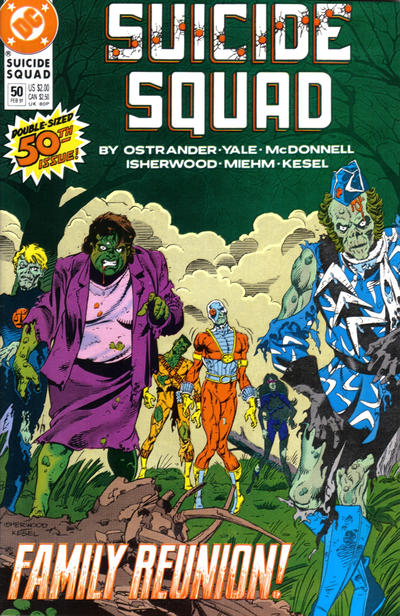
Rick Flag’s unknown son is kidnapped by one of his old team mates turned zombie master in this double sized extravaganza told by John Ostrander, Kim Yale, Luke McDonnell, Geoff Isherwood, Grant Miehm and Karl Kesel.

Captain Boomerang, Amanda Waller, Nemesis, Deadshot, Bronze Tiger and Nightshade stumble towards the reader, each a zombie

It’s a tribute to all involved that this story, which leans heavily on knowledge of not just all previous 49 issues, but also on that of the original Suicide Squad, was so readable even to a new reader like I was at the time. The Suicide Squad had been a classic The Brave and the Bold feature. The Jack Kirby created Challengers of the Unknown had set a vogue for four person adventure themes and over the years DC would introduce Rip Hunter and his team (time travelling Challengers), Cave Carson and co (cave digging Challengers), Seadevils (underwater Challengers) and the Squad itself (paramilitary scientist Challengers). They got six appearances in The Brave and the Bold but didn’t do much and were forgotten until Rick Flag was brought back in a Superman adventure as one of the Forgotten Heroes. That’s where I knew him from.

I bought this new when my local comic shop started carrying it as it expanded the American comics it carried. It was the first ever Suicide Squad issue I bought. It took me a couple of issues to get used to the series. Issue 53, which started the Dragon’s Hoard story that ran for several issues, was the one that hooked me. A story not unlike the one that hooked me on Captain America, with multiple dangerous groups fighting over the same treason and the Squad caught in the middle. If issue 50 left me a bit confused and unsure about the Squad, it was still good enough to let me keep buying it. and once issue 53 hooked me completely, I kept buying until the end and started buying the back issues, filling in pieces of the puzzle that issue 50 had presented.

What made suicide Squad so good was the simple fact that John Ostrander and Kim Yale were the sole writers for the entire series and had a coherent vision of it from the start. The Squad fit in with the more cynical nature of the Post-Crisis, mid-eighties DC Universe. You had an ambitious bureaucrat/politician, Amanda Waller, looking for a way to get ahead in the Reagan administration, coming up with a plan to use convicted supervillains on missions for the government. You had a good mix of actual heroes like Rick Flag, Bronze Tiger and Nightshade riding herd on a mix of outright villains and amoral scum like Captain Boomerang, Deadshot, the Enchantress and others. They weren’t shy about killing off characters either, with every mission leaving at least one member dead behind (the odds increased whenever a Firestorm villain was involved). By issue 50 the Squad had been exposed, cut loose from the government and now operating as out and out mercenaries.

A fun series that quickly became one of my favourites. In general I liked that whole dark corner of the DC Universe the Squad operated in. One of these days I should write more about it.