Abide with me


Like me, Sandra had long put away the religious faith she was raised in, but, again like me, had kept her appreciation for some of the hymns she had grown up with. One of those hymns was Abide With Me, which she had been talking about only days before her death. Last night at the Olympics it was used in the tribute to the victims of the 7/7 bombings. Even without that personal connection the performance would’ve given me goosebumps, now it was enough to make me tear up.

The icing on the cake is that this hymn has a political meaning as well. It has been used at every Rugby League Challenge Cup final since 1929 and rugby league is the northern, working class version of rugby, a song held deeply by generations of miners. Using it is therefore a subtle rebuke to the legacy of Thatcher, whose heirs now rule the UK again, just like the use of Jerusalem, another of Sandra’s favourites, could be seen as a clarion call for English socialism. Whether or not this was Danny Boyle’s intent…

London can take it


In less than five minutes the Olympic Games officially start and we’ll find out if all the obnoxious security measures and corporate corruption was worth it. I don’t think there will be any great disaster, just the usual crap associated with the modern Olympics. There will be debts and white elephants and all the nuisances you get from hosting the Olympics, but as the Public Broadcast Service say, “London can take it”.

(The original WWII propaganda film)

“Boobs boobs everywhere, and not a one to honk”

Some douchenozzle thought it was up to him to decide who was a geek or not; Nick Mamatas sets him straight:

The same is true in the sexual realm: geek boys weren’t being rejected in high school because they liked Star Wars, or because it’s impossible to find a girl who also liked Star Wars. They were being rejected because of their appearance, weight, smell, attitude, visible handicaps, foreign accents, failure to own a car, general “creepy” vibe, failure to be interested in women as human beings, difficulty in carrying on a conversation, an annoying giggle, slouchy and asocial demeanor, etc. And it’s not like geek boys stared across the classroom at the geek girls, with their braces and weird jutting chins and nose-picking habits and horse books, and declared undying love over mid-afternoon Legos either. Indeed, one reason why sexist attitudes toward attractive women are so prevalent in geekdom is because of the mix of shame and desire attractive women represent to men who feel excluded from the supply of sexual encounters out there in the world. It’s abjection—one wants what one cannot have because one is revolting, so one projects that same revulsion on the object of their desire. Some geek men want these booth babes so much that they can’t stand them.

Of course, most geek men also grow up eventually, find lovers, comb their hair, take up exercise and get over junior high. They don’t need “geek” as some sort of badge of honor. The ones that do, well, they’re the ones I suspect are most likely to accept sexist ideas about attractive women, and fearlessly promote them online, where they’re safe from reprisals by the jocks of the adult world. (HR departments and the like.) That is, they become bullies. Why does a bully pick on a dork? Because it’s safe—there’s no downside to doing it. Why does a dork pick on a woman? Because it’s safe—there’s no downside to doing it. I mean, it’s not like the “booth babe” was otherwise going to go back to the geek’s hotel room (which he is sharing with four other smelly weirdos) with him, right? So, rage rage, on and on, and all to protect geek culture from the endless horrors of non-dorks and big tits?

It can be annoying to see the “cool kids” jump on a subculture bandwagon, but I’ve never understood the visceral hatred some socalled geeks have to people new to fandom, to everybody who isn’t just like them. Perhaps because I grew up in an environment that was both far less poisonous than the American school system, where you don’t have all that jocks v. nerds nonsense, I don’t have the resentment some of these idiots have carried with them from high school, certainly not against women, “hot” or otherwise. It’s dumb, it’s sexist, it doesn’t make you a better geek.

In the ensuing comment thread at Nick’s, quite a few people make good points which I’ll copy here shamelessly:

Hal Duncan:So, yeah, my message for the once-bullied male geek: welcome to the shitty end of the stick we call heteronormativity; please to not reinforce it with misogynist douchebaggery.

Kermit:
Well, again, if you have no foundation (because somewhere along the line in your family your original culture was renounced), then you’re an even bigger sucker for the capitalist-imperialist pseudo-culture, and whatever part of it you embrace, you’re going to embrace HARD. This is what produces the fanatics, whether they’re sports fans (and I’d challenge you to find a better metaphor for imperialism than pro-sports) or fantasy/sci-fi geeks. And damn if so much of our entertainment doesn’t fully embrace and propagate those “American” values. I mean, shit, a lot of the comic books were made as a sort of USAmerican propaganda. And Wrestling, with its depictions of “American Hero” vs. the evil Russians and Arabs? And there was also a strict gender divide in Wrestling (GLOW, anyone?) but that’s aside from the point I’m making.

Seth Ellis: It’s the relentless relationship of subcultural identity to product, and hardly anything but product, that continues to get me down. It’s like the message is, dear fans: please be suckers forever.

La fields: In conclusion: I didn’t go on any dates in high school either, but being a geek was the one thing that gave me a social life, a sense of camaraderie, and the perspective to realize that there were more people like me out in the world, and I could find them if I managed to survive high school (so you know, a real incentive not to kill myself or others!). It made the bullying I got just for walking around as myself in that viper’s nest bearable.

Sonya: I understand how moderately attractive or homely gals would find these Booth Babes perpetually irritating. Women can be scary. Scary mean, scary judgmental, scary impulsively ostracizing, etc. The more confident a woman is about her sexy body (or at least the more believable her portrayal of confidence) the more intimidating she becomes. Women perceived as visual appealing tend to land at the top of the heap due to the culturally normative value placed on sexual desirability and the more perceived power she will hold within the hierarchal social structure.

Troubler: So it is entirely consistent to criticize companies’ use of booth babes, and at the same time argue that booth babes are people and should be treated with respect. In fact it is the companies who hire them who are not treating them with respect because the job itself is objectifying and dehumanizing.

And always remember: it’s not up to any man to decide which women are the real geeks. Think otherwise and you’re a sexist numbnut.

Trouble in atheist paradise

What, a social movement inspired by the excesses of Anglo-American Protestantism and promoted by middle-aged blowhards is not terribly inclusive, caring, or supportive itself?

I came by my atheism the honest way, by getting doubts about the religion I’d grown up in, reading about all the miracles and wonders of the universe we live in, getting into rows with my very religious and constantly worrying grandmother. Granted, my church was not the most oppressive or backwards church in the world and nobody actually much cared about what you did or didn’t believe. It’s one of the reasons why I’ve always been a bit wary about the militant atheist movement that has started up in the last five years or so. Atheism alone is not a broad enough base for a political/ideological movement.

It doesn’t help that its two most prominent public figures — Richard Dawkins and Christopher Hitches — are both professional arseholes. The latter was a not very intelligent leftwinger when leftwing politics were in fashion, became an even dumber rightwinger when fashions changed and helped cheerlead the War on Iraq. The former, though no doubt a good biologist and science writer, always had a nasty streak in him. I don’t think he’s ever written a book without putting in a dig at somebody.

But the real problem with militant atheism is that it operates in an ideological vacuum. Atheism, though it has been historically associated with the left, with socialism, is not a left nor rightwing thing anymore. Which means that in the professional atheist movement you have people who agree with each other on nothing but the idea that god doesn’t exist. And since it’s largely an internet movement, it is taken its shape from the biggest loudmouths on the web, which more often than not are rightwing/libertarian blowhards.

It’s no wonder that sexism, rape jokes and assorted bad behaviour is rampant in the “community”.

Power Girl

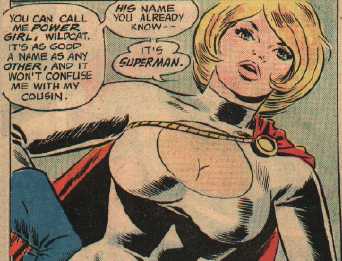
Power Girl as drawn by Wally Wood

Power Girl: A New Beginning — Justin Gray, Jimmy Palmiotti (writers), Amanda Conner (art)

As a character, Power Girl was always something of a joke. First introduced in the seventies as a young, militant “feminist” character by Gerry Conway to spice up his Justice Society series in All-Star Comics as Earth-2 Superman’s cousin, a copy of a copy (Supergirl). It didn’t help that the then artist on the series, Wally Wood, allegedly had a bet to make her breasts bigger each issue until somebody noticed — and nobody did. Once the series was cancelled, she did the guest star routine, showing up with the Justice Society or on her own, got her own not very interesting mini series in the mid-eighties, a new origin courtesy of Crisis on Infinite Earths doing away with Earth-2, then finally a regular spot on Justice League Europe as the house nag, where it was also revealed she had a bit of a personality disorder due to drinking too much diet cola.

All of this started to change with the Geoff Johns’ Justice Society series, where she got a bit more respect, but it still wouldn’t fill you with much hope that any regular Powergirl series would be any good. But it was.

I got the trade paperback of the first six issues cheap because I’d heard good things about the series and it was indeed much better than I would’ve expected. Jimmy Palmiotti and Justin Gray wrote a perfectly nice, decent Bronze Age superhero series with stories that are actually dealt with in two-three issues, a few slowly developing subplots, even some attention to Powergirl’s private life, something that never was developed much before. There are some decent fights, good villains and they write with a bit of humour and in all do a not too shabby job.
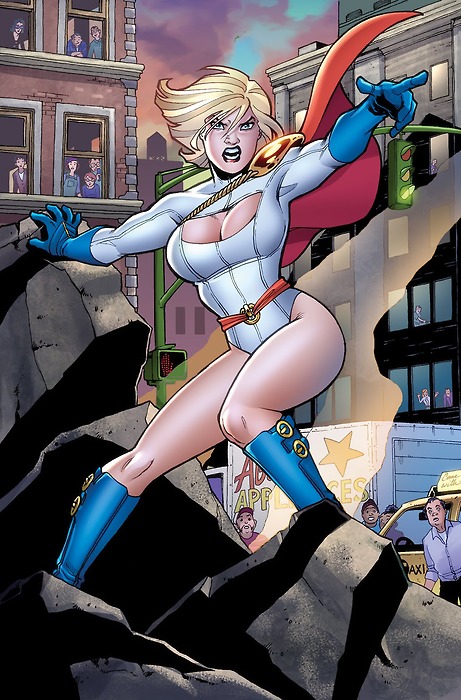
Power Girl as drawn by Amanda Connor

But the real star of the series however is the artist, Amanda Connor. It’s always been the case that bad art can sink good writing much more easily than bad writing can sink good art and what we have here is excellent art uplifting a decent series into something much better. Connor’s art style is semi-realistic, slightly cartoony when needed, rather than the stilted realism that’s in vogue for superhero comics this past decade. The colouring, by Paul Mounts, reinforces this as it’s bright and poppy, not so muddy-brownish as seems to be the norm now, with Kara/Karen/Power Girl the brightest thing in the comic.
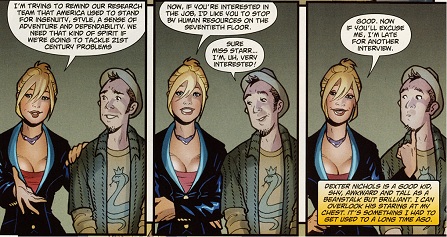
Power Girl subtly deals with somebody ogling her

Connor is an accomplished artist, doing her fight scenes very well, but where she really shines is in the quieter scenes, the character building scenes like the one above, which really didn’t need the caption box to explain what’s happening there. The faces, the hand gestures, all feel perfectly natural and right, though they’re obviously somewhat exaggerated for effect. This is on even better display in the page shown below.
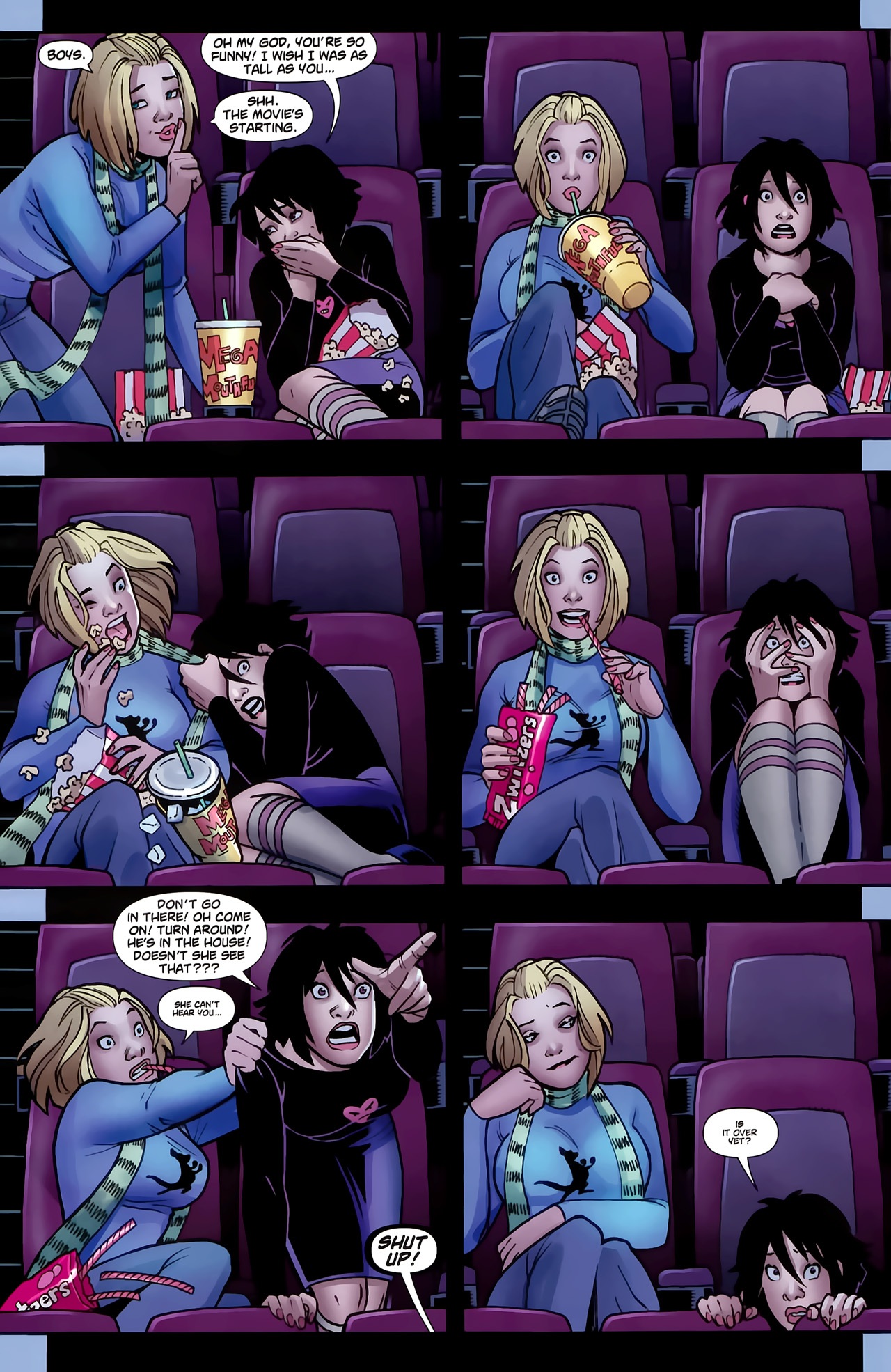
Power Girl and Terra enjoy a movie

It’s just a page of Power Girl and her friend/fellow superheroine Terra enjoying a movie, but I love the acting and the facial expressions on both of them. But I also like the dress sense Connor has, as what both are wearing fits their characters and backgrounds. They’re clothes you could actual women wearing, not sexytimes comics clothing. Which is the best part of Connor’s art of course: no porn faces, no moronic fan service or broken spine crotch shots. Power Girl’s breasts are still there, are part of her, but no longer the whole of her and she actually wears clothing that doesn’t always draw attention to them.

It’s a shame the series never quite got the audience it deserved and what with the New DC and it’s focus on just the sort of moronic pandering this series didn’t lower itself too, it’s unlikely we’ll soon get a new Power Girl series even half as good as this one.