Bruuuce

The New Yorker has an excellent profile of the Boss:

The songs were a way of talking to the silent father. “My dad was very nonverbal—you couldn’t really have a conversation with him,” Springsteen told me. “I had to make my peace with that, but I had to have a conversation with him, because I needed to have one. It ain’t the best way to go about it, but that was the only way I could, so I did, and eventually he did respond. He might not have liked the songs, but I think he liked that they existed. It meant that he mattered. He’d get asked, ‘What are your favorite songs?’ And he’d say, ‘The ones that are about me.’ ”

One of the few genuine regrets in my life is not having seen Bruce Springsteen with the complete E-Street band when I had the chance.

Biking in Portland

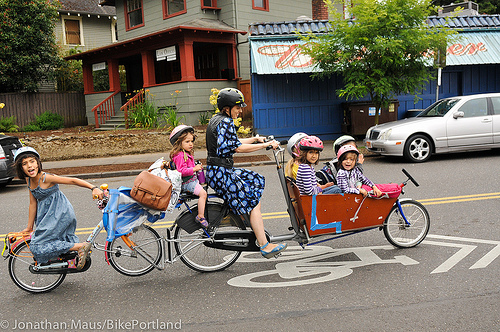
how one mum and her six kids get around in Portland

The first thing that came in my mind when reading this story about the ingenious biking solution one Portland mother uses to transport her children was, christ, who has six children anyway? If you’re worried about sustainability, this is not the way to go about it. But never mind that. What I really found strange is the following:

Before we rolled out, I met the young Finches: Nathan, 11; Mary, 9; Lucy, 7; Ben, 5; Olivia, 4; and Maya, 2.

Emily’s usual set-up is three kids up front, one on the child seat, one pedaling an attached bike (usually Mary), and Nathan riding by himself. As we set off toward OMSI, I got to observe the Finch-mobile in action. It was massive and it was alive with sounds and movement. Heads and arms bobbled while music blared from the on-board sound system.

By my count that’s at least three kids who could ride their own bikes rather than hitch a ride with mumy: Nathan, Mary and Lucy, with Ben on the cusp. So why go through all this rigomarole? Is it just American paranoia about child safety and kids biking through traffic, or is there something more going on?

Where’s dad in this story anyway? Oh, wait: “The Finch family owns a car. It’s a sedan and only Mitch drives it. He takes it work everyday.” Hmmm…

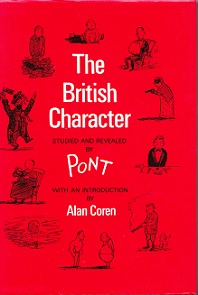
The British Character — Pont

Cover of The British Character


The British Character
Pont
120 pages
published in 1938

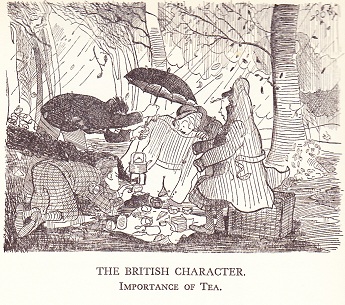
It must’ve been a decade ago that Sandra found this book in a secondhand bookstore in Middelburg. She liked the cartoons, but since she had read it by the time I was done browsing, she didn’t think it worth buying. I disagreed and bought it for her as a present. She took it back to Plymouth with her, brought it back over when we started living together and today my eye fell on it when I was looking for something to read from among her books. It reminded me of how she liked several of the cartoons enough to make high quality copies of them, to hang on our walls. She recognised herself in them, some essential quirks of the British character she also possessed. Looking at these cartoons now I can’t help but seen Sandra in them.

The importance of tea

Pont is a pseudonym for Graham Laidler, a cartoonist who mainly worked for Punch, starting his “British Character” series there in 1936, with this collection first having been published two years later, and multiple times since. He himself had only a short time to enjoy his success, as he died in 1940 at age thirtytwo. He had been ill a long time, his sickness being the reason he turned to cartooning in the first place, rather than the architectorial drawing he had been trained for. Though his cartoons are very much of his time, they do touch on universal aspects of the British character.

Read more…

Kickstarter: threat or menace?

Tom Spurgeon is uneasy with traditional publishers using Kickstarter to fund their projects:

I’m really uneasy about publishers using that mechanism, and I’m not even sure I can explain all the way why. It’s almost like that I feel the old model of doing things is being circumvented, somehow. Like these publishers are switching over to that mechanism because they’re not doing the other one well, not because the new one presents specific opportunities. I’m not sure, I’m really inarticulate on the subject and I need to firm that up because that moment in history is here. What makes it difficult is there are things I’m thinking about trying to crowdfund, too, which I’m not sure should make my opinions suspect but it should make them open to extra self-scrutiny.

The first worry with a publisher (or any other established business for that matter) using a mechanism concieved for independent creators to get funding is that it doesn’t inspire confidence in their financial state. If you have to get your readers to fund you in advance, you’re doing something wrong as a publisher. It feels like a flight forward, rather than a well thought out attempt to make use of new possibilities.

The second worry is of course how stable the Kickstarter funding model is. There is always the possibility that one or two high profile disasters will turn off people and, let’s face it, the possibility of such a disasters is always much higher in comics than anywhere else. Worse, what with fan dollars not being inexhaustible, there’s also the possibility that crappy, greed driven projects will push out more worthwhile, creative endeavours.

Which brings us to the feeling that using Kickstarter this way is cheating, that companies like this aren’t supposed to use this, that it should be kept for struggling young cartoonists. I’m not sure that’s a reasoned objection though, even if I share this feeling.