Nicola Griffith talks about Slow River

So about a week ago, on my booklog, I wrote the following about Nicola Griffith’s Slow River:

What I only noticed about a quarter of the way in is that these three interwoven stories are actually written in three different viewpoints. There’s the first person point of view for the present, tight second person focus for the years with Spanner, while the chapters focusing on her family are in a much looser second person focus. The difference is that in the first form of second person focus we’re still inside Lore’s head most of the time, with the text refering her as “she”, while the second form, we see her from the outside, as “Lore”. It is of course symbolic for her growing up, maturing, going from what others see her as, to what she sees herself as. A coming of age story that is not nearly as obvious as most such are in science fiction.

I also wrote that it had been first published in 1991 rather 1995, which prompted Nicola herself to correct me in order to be polite and in passing she also explained about how Slow River is arranged (all quoted by permission, natch):

The three narrative layers/POVs (I think of them as points-of-view lacquered on top of each other so that the imagery and emotion bleed through) are formally arranged in an ABA C ABA C ABA pattern:
– C = Lore age 5 to 18 in third person, past tense
– B = Lore age 18 to 21 in third person, past tense
– A = Lore age 21 and up in first person, present tense

I’ve talked in various places (I really should pull it all together at some point, but haven’t yet) about why I chose the POV and tenses. Short version: present tense is an indicator of a dream-like state, which is what childhood is; third person, like past tense, is the traditional POV and tense; first person is my way of signifying that this is the narrative present, this is the Now of the book, telling the reader “You are here.” At the same time, I really wanted the emotions to form an easy narrative through-line so the reader never feels confused.

It worked for me and I’m not the only one who noticed this structure; so did Russ Allberry for example. What struck me about it is that this works even if you don’t notice it consciously, which is the hallmark of a good writer.

If you want to read more about how Slow River was written, the essay layered cities about the city at the heart of the story, as well as writing Slow River, an interview, are highly recommended. Nicola Griffith’s latest novel is the historical novel Hild, which won’t come out until next year unfortunately.
QotD: Harry Redknapp

Proof that football writers can have a poetic turn is delivered by Barney Ronay, writing for The Grauniad‘s sportsblog about the contrast between Spurs new and old managers, ‘Arry Redknapp and Andre Villas-Boas:

It is genuinely ennobling, this belief in the basic sanctity of the managerial mission. “We must build on Harry’s great work,” Villas-Boas said this week, bestowing an unexpected gravity on the legacy of a manager who has traditionally been a kind of footballing Cat in the Hat, a tousled and infectious improviser who could probably cook you the most brilliant meal you’ve ever tasted simply by hurling everything in the fridge into a massive bowl and then flambéing it over a raging fire built from every stick of furniture you own, before abruptly disappearing just as you come round, dazed and hungover, face down in the ashes of what was once your kitchen.

One for Pseuds’ Corner, eh lads?

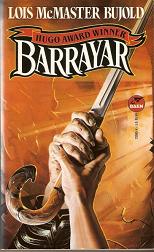
Barrayar — Lois Mc Master Bujold

Cover of Barrayar


Barrayar
Lois McMaster Bujold
386 pages
published in 1991

Barrayar was actually the first ever Bujold story I ever read and I hated it. That’s because it was the last part of its serialisation in Analog that I read and I had no idea of what was going. Coming back to it now, after having read all the Miles Vorkosigan books at least once, I enjoyed it much more. Like any prequel Barrayar depends for some of its impact on the reader’s knowledge of the main series. If you don’t know who Miles Vorkosigan is and why he is the incredibly determined little mutant runt that he is when we first met him in the Warrior’s Apprentice, the details of how he got to be that way won’t matter all that much.

Chronologically, Barrayar takes place almost immediately after Shards of Honor and is the second and so far last novel to star Cordelia Vorkosigan/Ransom. Cordelia and Aral are settling in to newly married live on Barrayar, with Cordelia pregnant with Miles. Then the old emperor dies and Aral becomes regent to his young grandson and he and Cordelia are soon plunged into the dangerous, still very medieval politics of the Barrayaran court and nobility. How dangerous Cordelia only realises when they’re the victims of an assasination attempt, with poison gas grenades thrown into their house.

Read more…

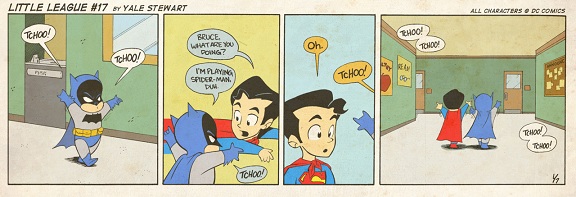
Little League

A Little League strip by Yale Stewart

Now here’s something cute. Little League is a comic strip written and drawn by Yale Stewart that puts DC’s Justic eLeague characters back in kindergarten, then has fun with it. It’s a perfect example of what you can do with fan fiction. It’s cute, funny and does things with these characters DC itself wouldn’t do that easily. Sure, it depends on the reader knowing and liking the original characters this is based on, but the same goes for any official Batman or Superman or JLA series.

Love it.