Science Fiction: The 101 Best Novels 1985-2010

It’s been a while since we’ve done a booklist meme, but the recent publication of Science Fiction: The 101 Best Novels 1985-2010, as determined by Damien Broderick and Paul DiFilipo gives a good excuse. Which one of those below have you read (italics), do you own bold or dislike (struck through)?

  • The Handmaid’s Tale (1985)
  • Ender’s Game (1985)
  • Radio Free Albemuth (1985)
  • Always Coming Home (1985)
  • This Is the Way the World Ends (1985)
  • Galápagos (1985)
  • The Falling Woman (1986)
  • The Shore of Women (1986)
  • A Door Into Ocean (1986)
  • Soldiers of Paradise (1987)
  • Life During Wartime (1987)
  • The Sea and Summer (1987)
  • Cyteen (1988)
  • Neverness (1988)
  • The Steerswoman (1989)
  • Grass (1989)
  • Use of Weapons (1990)
  • Queen of Angels (1990)
  • Barrayar (1991)
  • Synners (1991)
  • Sarah Canary (1991)
  • White Queen (1991)
  • Eternal Light (1991)
  • Stations of the Tide (1991)
  • Timelike Infinity (1992)
  • Dead Girls (1992)
  • Jumper (1992)
  • China Mountain Zhang (1992)
  • Red Mars (1992)
  • A Fire Upon the Deep (1992)
  • Aristoi (1992)
  • Doomsday Book (1992)
  • Parable of the Sower (1993)
  • Ammonite (1993)
  • Chimera (1993)
  • Nightside the Long Sun (1993)
  • Brittle Innings (1994)
  • Permutation City (1994)
  • Blood (1994)
  • Mother of Storms (1995)
  • Sailing Bright Eternity (1995)
  • Galatea 2.2 (1995)
  • The Diamond Age (1995)
  • The Transmigration of Souls (1996)
  • The Fortunate Fall (1996)
  • The Sparrow/Children of God (1996/1998)
  • Holy Fire (1996)
  • Night Lamp (1996)
  • In the Garden of Iden (1997)
  • Forever Peace (1997)
  • Glimmering (1997)
  • As She Climbed Across the Table (1997)
  • The Cassini Division (1998)
  • Bloom (1998)
  • Vast (1998)
  • The Golden Globe (1998)
  • Headlong (1999)
  • Cave of Stars (1999)
  • Genesis (2000)
  • Super-Cannes (2000)
  • Under the Skin (2000)
  • Perdido Street Station (2000)
  • Distance Haze (2000)
  • Revelation Space trilogy (2000)
  • Salt (2000)
  • Ventus (2001)
  • The Cassandra Complex (2001)
  • Light (2002)
  • Altered Carbon (2002)
  • The Separation (2002)
  • The Golden Age (2002)
  • The Time Traveler’s Wife (2003)
  • Natural History (2003)
  • The Labyrinth Key / Spears of God
  • River of Gods (2004)
  • The Plot Against America (2004)
  • Never Let Me Go (2005)
  • The House of Storms (2005)
  • Counting Heads (2005)
  • Air (Or, Have Not Have) (2005)
  • Accelerando (2005)
  • Spin (2005)
  • My Dirty Little Book of Stolen Time (2006)
  • The Road (2006)
  • Temeraire /His Majesty’s Dragon (2006)
  • Blindsight (2006)
  • HARM (2007)
  • The Yiddish Policemen’s Union (2007)
  • The Secret City (2007)
  • In War Times (2007)
  • Postsingular (2007)
  • Shadow of the Scorpion (2008)
  • The Hunger Games trilogy (2008-2010)
  • Little Brother (2008)
  • The Alchemy of Stone (2008)
  • The Windup Girl (2009)
  • Steal Across the Sky(2009)
  • Boneshaker (2009)
  • Zoo City (2010)
  • Zero History (2010)
  • The Quantum Thief (2010)

A decent enough list, with only two books I hate. There are the usual sort of problems with any such list, in that the more recent choices are also more debatable as not enough time has passed since they were published. The Quantum Thief was enjoyable, but one of the best books of the last twentyfive years, or even one of the best books of 2010, I’m not sure. It also overrates decent efforts by mainstream novelists when similar efforts by science fiction writers would not have been included. Some choices are also strange: Barrayar instead of e.g. Komarr or A Civil Campaign? But still, a decent enough list on the whole.
It’s super crip!

You know how sometimes you notice something interesting but can’t really talk about it because you don’t have the right words for it? From an Canadian course about disability in the media:

The second disability stereotype that will be explored is “disability as hero by hype”. This stereotype is more commonly referred to as “the super crip” pereception. When not pitied, persons with disabilities are sometimes seen as “heroes,” or in other words, outrageously admired for their “courage” and determination. This stems from the belief that life with a disability must necessarily be horrific and unsatisfying, and as such, we must admire persons with disabilities for being able to live “the way they do.” Much like portraying disability as a form of lesser self-worth (as is often the case with the “disability as pity” stereotype), placing persons with disabilities on a pedestal is another way to denote this social group as “other”. This particular stereotype is also linked to the idea that disability in one area is complimented with superior abilities in another area (for example, the misconception that people who are blind have superior hearing)

“Super crip” is a good term for an phenomenon that has long irritated me, the way in which certain disabled or chronically ill people are periodically held up by the media as heroes for “overcoming” their disabilities. It’s always some nice middle class boy who got paralysed in a car accident but doesn’t let that stop him from fullfilling his dream of going white water rafting in the Amazon or mountain biking off Everest or whatever, who always take pains to distinguish themselves from all those other disabled people by showing how little they let their disabilities dictate their lives.

To be fair, it’s not so much those people themselves, though they can be annoying, as the narrative in which they are placed, which is threefold. On the one hand, it’s all about how, if only you believe hard enough, you can overcome any adversity and still be what you want to be, as a moral example for all us ablebodied people struggling with our petty problems. On the other hand, these are also stories about assuaging our own fears about becoming disabled and worthless, by showing disability as just another obstacle to overcome, rather than something that shapes your day to day life. Finally, on the gripping hand, it others all those disabled or chronically ill people who can’t or won’t fit the super crip profile, who just live ordinary lifes of quiet desperation like the rest of us. If you’re not hang gliding off the Niagara Falls you’re just not trying.

The super crip than is the other side of the coin of the stereoype of disability as pity, the idea that if you’re disabled or chronically ill your life is basically worthless and you’re very brave if you haven’t killed yourself yet — “in your place i’d killed myself! — cheers. Sandra, who of course had been chronically ill in one way or another, hated that. She was very firm in insisting that she wasn’t a hero, she was just an ordinary person dealing with life just like everybody else, even if she had to be more aware of her limitations than a temporarily able person need be.

The super crib stereotype is a stick to cudgel both temporarily able and disabled people for not being good enough to be as wonderful as them, yet another tool to keep the status quo. Clearly if Oscar Pistorius can compete in the regular Olympics on prostathic legs, surely you in your wheelchair are able to make your way through everyday life without our help and we don’t need to worry about ways to make society as a whole more accessible, physically and mentally, for people with disabilities. Similarly, why are you, a perfectly healthy worrying about your trivial problems when heroes like Pistorius can make history? Surely there’s no need to do anything for you, when he can pull himself up by his bootstraps and he doesn’t even have feet!

(Nothing against Oscar Pistorius, who seems a perfectly decent chap and who I hope will do well in his races.)

A simple demonstration of a complex problem


Take a staircase in an underground station in New York with one step slightly higher than the others, point a camera at it, then watch as one after another people stumble over it. Et voila: a ready made metaphor for the uselessness of discussing social problems in terms of individual merit. For any given person walking up those stairs it is true that, if they knew about that step in advance, or paid attention to the people stumbling in front of them, or just looked a little bit closer at the steps, they wouldn’t have stumbled, as you can see many people didn’t in that video. But it is not true that everybody can do that: people don’t pay attention, misjudge why the people in front of them stumbled, are new to staircase and so on.

So it goes too for e.g. the recession. If there are three million people chasing two million jobs it is arguably true that any of those three million could get a job if they just made the right decisions, put more effort in it, knew the right people, did everything right, but you’re still left with one million people unemployed who did do everything right but still couldn’t get a break. Therefore, any unemployment policy that doesn’t take into account this simple fact, but is based on trying to spur individual people back into work, is doomed to fail.

It’s left to the reader to extend this analogy to other societal problems like the obesity epidemic, ballooning student and mortgage debts, and so on, as well as to explain why consumer action is not enough to end child labour, exploitative business practises or make companies green.

Translate this: Bernard Prince

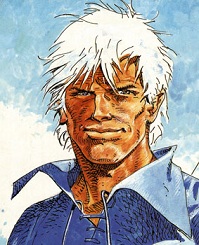
Bernard Prince

Though it has been getting better in the last decade, there are still huge amount of European comics that have never or only been sporadically been translated into English, even though these series were hugely popular all over the world. A publisher like Cinebook is doing its best to remedy the situation, but it’s still only a drop in the ocean. So I thought I’d spotlight some deserving series here every now and again. First up, Greg and Hermann’s Bernard Prince.

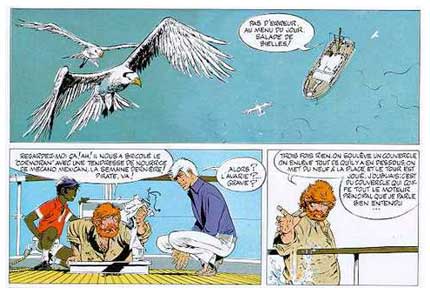
Bernard Prince is one of the classic adventure series from the groovy age of Franco-Belgian comics, created by two mono monikered top cartoonists. Greg was an editor/writer who had worked his way up through the pulp comic magazines to creating several series for the French Pilote, before becoming editor of Tintin in 1966. At the time this was an increasingly old fashioned, somewhat staid magazine overtaken by younger competitors. Greg turned it around by bringing in new artists and writers, creating several new series himself, one of which was Bernard Prince. As his partner he chose Hermann Huppen, a young new artist for whom this would be his breakthrough series.

a sequence from Bernard Prince

Together they would create some thirteen full length adventures, plus several short stories, with the series running from 1966 to 1978, after which Hermann quit the series to work on his own creations. Over the course of the series you could see his artistic talent grow and grow, as he evolved his art away from the somewhat flat, smooth. clear line inspired Tintin house style towards his own much more craggy look.

Only one short story of Bernard Prince has ever been published in English, in the august 1973 issue of a short lived comics zine called Wonderworld. Luckily, one Harry Lee Green has scanned it in and saved it for posterity. It’s as good an introduction to the series as any, even if the main character is slightly more passive than normal. Pay no attention to the translation, which is servicable at best.

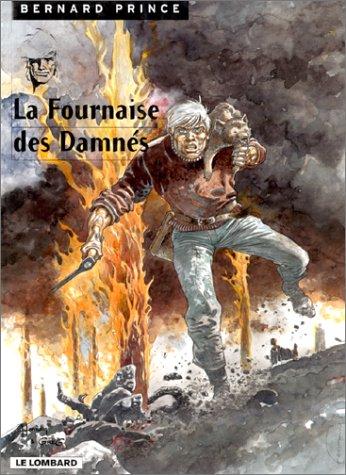
La Fournaise des damnés

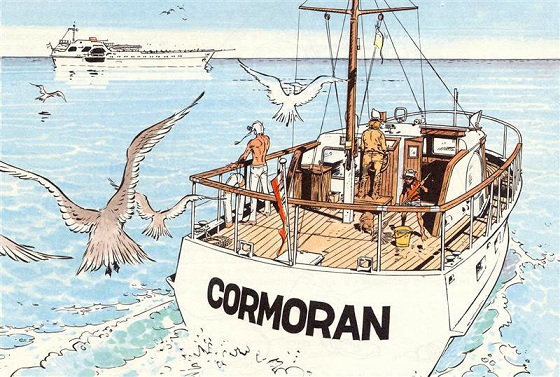
As you can see Bernard Prince is a traditional three man band strip, with Bernard Prince himself as the rugged hero and straight man, his best friend Barney the elder, fattish comic relief and cabin boy Djinn as the younger sidekick. There were women in the series, but these came and went as the plot demanded. The stories were largely the same: Prince and co would travel somewhere exotic in his yacht the Cormoran, get involved in whatever local difficulties were going on, then win the day through a combination of brain and brawn. Perhaps the best story in the series is “La Fournaise des damnés” (The Scorched Land), which sees Prince having to fight his way through a Canadian forest fire.

What makes Bernard Prince such a good series, head and shoulders above contemporary action-adventure series like Bob Morane or Bruno Brazil is both that Greg is always cleverer and more interesting than he needs to be to tell the story, as well as the evolution of Hermann from just another promising young cartoonist to one of the giants of the European adventure comic. In the end he was too good for the series and he moved on to his own creations. But Bernard Prince is where he got his start and developed his chops and fpr that reason alone it should be translated.

The Cormoran

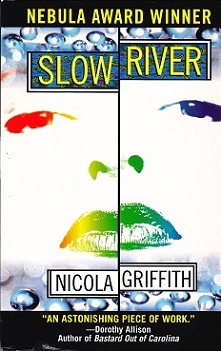
Slow River — Nicola Griffith

Cover of Slow River


Slow River
Nicola Griffith
343 pages
published in 1995

Everybody knows about the Bechdel test now, don’t they? Introduced in Dykes to Watch out For, it’s a test to see if a given story meets a minimum feminist standard: a) does it have at least two women, who b) talk to each other about c) something else than a man? It’s a good way to think differently about the movies you see or the books you read, to see how common it is for a story to have only male characters, or only a token female character, sometimes as prize for the hero. Having a story with only male characters is normal, having one with all or majority female characters is the outlier, can get you shoved into a women only ghetto like romance or feminist literature.

This is true in science fiction as well as mainstream literature, which made reading Nicola Griffith’s Slow River so interesting. It’s her second novel, also the second of her’s I’ve read and like the first, the cast is almost exlusively female. But where that one was set on a planet where men had died off due to some handwaved plague, this one takes place in near-future English city that for once isn’t London. I’m not sure whether Nicola Griffith made this choice of cast deliberately, or it just happened naturally because of the story she wanted to tell, but it works.

Read more..