Without the balloons! Via.
We Who Are About To… — Joanna Russ
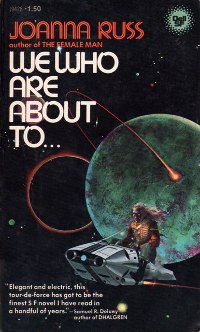
We Who Are About To…
Joanna Russ
170 pages
published in 1975
We Who Are About To… is arguably Joanna Russ’ most famous and controversial novel after The Female Man. That novel became famous because of its outspoken feminism, still rare in science fiction at the time; if we’re honest, still somewhat rare today. We Who Are About To… comitted a greater sin however, by attacking the optimistic, can do attitude of classic science fiction, the belief that any adversity can be overcome by man’s unique fighting spirit. It’s not just that the protagonist doesn’t win in the end; even Asimov the arch-optimist had written “Founding Father” ten years earlier, a story in which four astronauts fight but fail to terraform a planet before it kills them. No, the real problem is that she rejects the choice out of hand and choses not to fight, not even to try.
That of course went against the grain, with plenty of science fiction fans being outraged about it, if I can believe the contemporary fan publications. But We Who Are About To… is about more than just rejecting science fiction’s traditional morality, it’s also a novel about how die. Slightly over half way through the story the central conflict of whether or not to fight has already been resolved, in favour of not to. The rest of the story is all about how you die. This part of the book has received less attention than the first half.
Books read June
Seven books this month, mainly fiction:
Intrusion — Ken MacLeod
What if the power to make the wrong decisions is taken from you, what if you want to make your own decisions without justifying yourself to others, not want to take up the shield of a religion to justify refusing what’s for your own good?
Something Wicked this Way Comes — Ray Bradbury
Sandra gave me this as a present some years ago, because we had been talking about Bradbury for some reason; I read it after his death. A great American fantasy/horror classic, full of his peculiar brand of nostalgia without his sometimes cloying sentimentality
Testament of Youth — Vera Brittain
A book drenched in grief and sorrow from the first page, though still with somewhat of a happy ending. Vera Brittain’s autobiography centers on the Great War and the men she lost through them: her lover, her brother, her friends as well as her struggle to live with these losses. Its matter of factness is what gives it its power.
Tsing-Boum — Nicolas Freeling
The French wife of a Dutch military man is murdered in her flat, shot six times with a machine pistol, as a gangster serial is playing on the tv, drowning the noise. A professional killing, but why this woman?
Cop Killer — Sjowall & Wahloo
Gloomy seventies Scandinavian police procedural, the ur-well of all those Hennings and Bridges and other fashionable Nordic thrillers.
Criminal Conversation — Nicolas Freeling
A highly placed banker accusses an equally highly placed doctor of murder and inspector van der Valk has to play a psychological game to find out the truth.
We Who Are About to… — Joanna Russ
When a starship crashlands on an alien world far from home, all but one woman see it as their duty to restart civilisation there. This is the story of that one woman.
Bambi
Why always Balotelli?
Tom Spurgeon reports about an unfortunate Mario Balotelli cartoon with racist overtones:
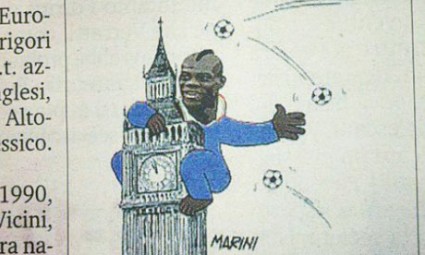
This is the soccer player Mario Balotelli, a very talented and I’d say charismatic player — I know who he is, and I get lost with those guys all the time — who plays in the Premier League for current champions Manchester City and is part of the Italy team currently playing (last I checked) in the Euro 2012 tournament. As one of the spokespeople quoted mentions, his being on the Italian team at all is a big deal, and symbolic, and encouraging for a lot of people, which makes this depiction a bit tragic, really. The usual course of dialogue is taken, it looks like, which makes me think we need a new way to talk about this kind of thing. I wish there a way to cop to the ugliness of depicting someone in that matter that didn’t turn on there not being a machine out there that lets us know what’s in someone’s heart. I don’t see that happening any time soon, though.
You can’t really say much about situations like this. A cartoon is published with, deliberate or accidental racist (or sexist) overtones, people point out that “dude, that’s a bit racist”, cartoonist or newspaper either gets defensive and deny the charges, or get defensive but apologise, people rant about it all on the internet. I’m not sure there is a new way to talk about it, even using Jay smooth’s advice on how to tell people they sound racist, people and institutions both will still get defensive. But it might be interesting to take a stab at how this cartoon was created.
The first thing to remember that this comes from an Italian newspaper and though it may be hard to believe, there is a far greater awareness of racism and racist tropes in America (and to a lesser extent, Britain), than there is in continental Europe. Sure, there are plenty of people who hold ghetto parties with no idea that these are incredibly racist, but there is at least some awareness of what would make for an offensive cartoon; there are also more people willing to complain about it. In short, Americans have been more educated to spot these racist tropes and be offended by them.
Meanwhile, Mario Balotelli is somewhat of a loose cannon. A brilliant strike when wants to be, as witnessed by his performance against Germany tonight, he can also do things like throw darts to his teammates, set fire to his bathroom or wear an A. C. Milan shirt on telly when playing for Inter, somewhat like wearing a Yankees Jersey in Boston, only worse. He’s a great, instinctive football player, but seems to lack smarts some of the time. Which is of course somewhat of a stereotype for talented Black players in any sport, that idea it’s all instinct or innate physical and athletic ability, rather than hard work and intelligence that makes them great.
In any case, the combination makes Balotelli an easy target for jokes at his expense, especially as he often looks a bit of a beleagured figure, wondering “why always me”. So I can see where the King Kong idea comes from: the noble, misunderstood giant harassed by, in this cases, flying footballs. It’s a nice cartoon, if not for the simple fact that equating a Black football player with a giant ape is just a little bit racist. That’s something an American cartoonist would’ve recognised earlier.