Ype + Willem: a funny fumetti

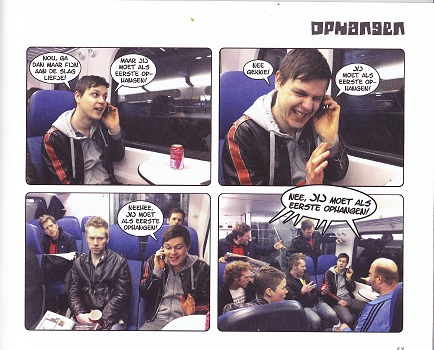
comic strip from Ype+Willem


Panel 1: Well, better go back to work then darling — But you have to hangup first.
Panel 2: No silly, you hang up first
Panel 3:Noooo, you hang up first
Panel 4: (entire train): NO, you hang up first

So earlier this month I went to my first comics con in twelve (!) years and the best part of a con is always finding new, interesting comics and cartoonists. Ype Driessen was my biggest discovery of the Haarlem con, even though he’s been active for years, having had a comic in the Dutch newspaper NRC Next for some time. Shows how much out of the loop I am. Luckily his publisher had a stand in Haarlem, the cover of his book caught my eye and I started reading, and, almost immediately, giggling. If reading four strips in a row makes me giggle three times, it must be good.
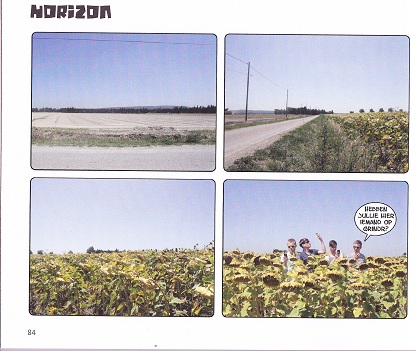
comic strip from Ype+Willem

Can you get anybody on Grindr here?

As you can see from the examples above, Ype Driessen makes fumetti, or photo comics, according to him largely because he can’t really draw. There is a minor tradition in Dutch comics of fumetti gag strips, most notably by Hanco Kolk and Peter de Wit in the eighties, with Mannetje and Mannetje, in which Ype fits nicely. There’s something inherently funny in seeing those hugely exagerrated poses and emotions acted out, but Ype has a sense of humour that would’ve worked just as well in more traditionally, drawn strip. He’s not afraid to make fun of himself or his boyfriend, can be slightly bitchy, but on the whole isn’t very mean and occasionally it’s corny; very corny.

In the interview/mini documentary Ype did for a Dutch broadcaster, shown below, he shows how he creates his comics, with the interviewer as the straight man.


.
Quoted for Truth: Nicolas Freeling, Criminal Conversation

Nicolas Freeling’s hero, inspector Van der Valk of the Amsterdam recherche, meets up with a woman who might have been blackmailed and gives a short description:

She was a solid, well-constructed woman, not fat at all but all curves, with the very fine-textured, pearly skin that goes so well with dark chestnut hair. Small good teeth, quite rare in Holland, where the women have excellent teeth looking like a well-polished row of marble gravestones.

From 1965, but as Sandra often noticed, Dutch women, especially young Dutch women, do tend to have huge perfect white teeth, though her comparison was more to do with horses than marble gravestones. A very Dutch mouth that.

I love Nicolas Freeling’s mysteries, another writer Sandra turned me on to, as he has a knack for getting Dutch people right: his Holland is one that’s still a ways behind the modern world, though getting there, a Holland gone some time I was born, but one I still recognised if only from period fiction.

Dutch Pirate Party does well in the polls

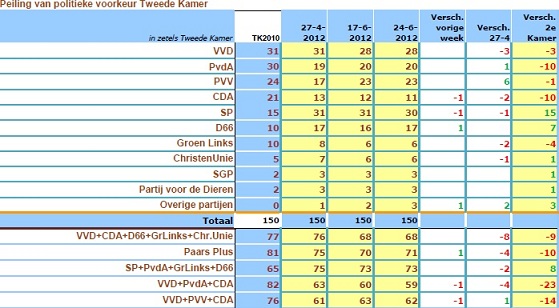
Dutch election poll results 24-06-2012

You may have missed it, but Holland is slowly but surely being gripped by election fever as election night creeps closer. It’s still a while away though, as they’re being held on 12 September. Yet the electioneering battle has already started, still low key, as the various parties position themselves. The mainstream parties (social-democrat PvdA, Christan Democrat CDA, right-liberal VVD, and for now, the xenophobic PVV of Geert Wilders) are not doing well for the moment, with the last three of course hindered by their involvement in the current, disastrous government, while the PvdA still hasn’t learned to meaningfully oppose. Instead, as you can see the voters have polarised, with the echt-socialist SP winning big, while the centrist-liberal D66 also profiting; they always do if they haven’t been in government for a while, only to lose again once in office.

But the biggest news is hidden under the heading “Overige partijen” — “other parties: the Dutch branch of the Pirate Party would’ve been elected to parliament with one seat had elections been held today! That’s quite impressive for an internet only (so far) party with very little name recognition so far. It’s also a sign of health for our democracy if they do manage to get a seat in parliament; even better if they get a couple more, as they themselves are hoping.

The Dutch political system is one that naturally drives parties to the centre, as no party is ever capable of securing a majority in parliament on its own. This leads to periods of bland conformity as the rightwing parties get a little more leftist and the leftwing parties get a lot more rightwing; the nineties were like that, when VVD, D66 and PvdA outmanoeuvred the CDA to rule for most of the decade. For every action there’s a reaction and that gets you periods of greater polarisation as well as the rise of new parties. D66 got its start as the first of them, wanting to break open the cozy relationships between the old parties, but has long since been captured by the system; various other parties didn’t last long or became “confessional”, splinter parties you voted for to be ideologically pure but with no real hope of ever winning power.

Lately of course, with the near-simultaneous rise of the SP from small leftwing to largest leftwing opposition party and the xenophobic and populist movements of first Pim Fortuyn, then Geert Wilders polarisation has come back with a vengeance. This in turn naturally offers changes for new parties that deliberately refuse to place themselves on the old left-righ axis: the Partij voor de Dieren, the animal rights party managed this during the last elections, might the Piratenpartij follow them during this one? I hope so, because the system needs new blood and ideas.

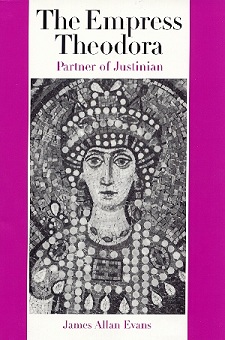
The Empress Theodora — James Allan Evans

Cover of The Empress Theodora


The Empress Theodora
James Allan Evans
146 pages including index
published in 2002

Ken MacLeod once said that “history is the trade secret of science fiction”, but sometimes it’s abused and nowhere more so than in the cribbing from early Byzantine history that has been ongoing ever since Isaac Asimov first put in thinly disguised expys of emperor Justinian and general Belisarius in his Foundationtrilogy. Largely overlooked in these sort of appropriations is the empress Theodora, who as James Allan Evans shows in The Empress Theodora – Partner of Justinian was just as important as her husband in determining the course of the Byzantine empire.

There were quite a few strong woman emperors in Byzantine history, but most of them either ruled through their weak husbands, or as regents ruling in place of their still minor children. Theodora on the other hand ruled together with Justinian, a strong emperor himself. Their rule was a true partnership and it’s this relationship and Theodora’s role in it that Evans wants to examine here. At the same time The Empress Theodora is also a concise biography/history accessible to lay people like me.

Read more.