Goukon ni Ittara Onna ga Inakatta Hanashi — First Impressions

It must be easy to be a trans man in anime Japan. Just cut your hair short and wear masculine coded clothing and people just think you’re a hot guy.

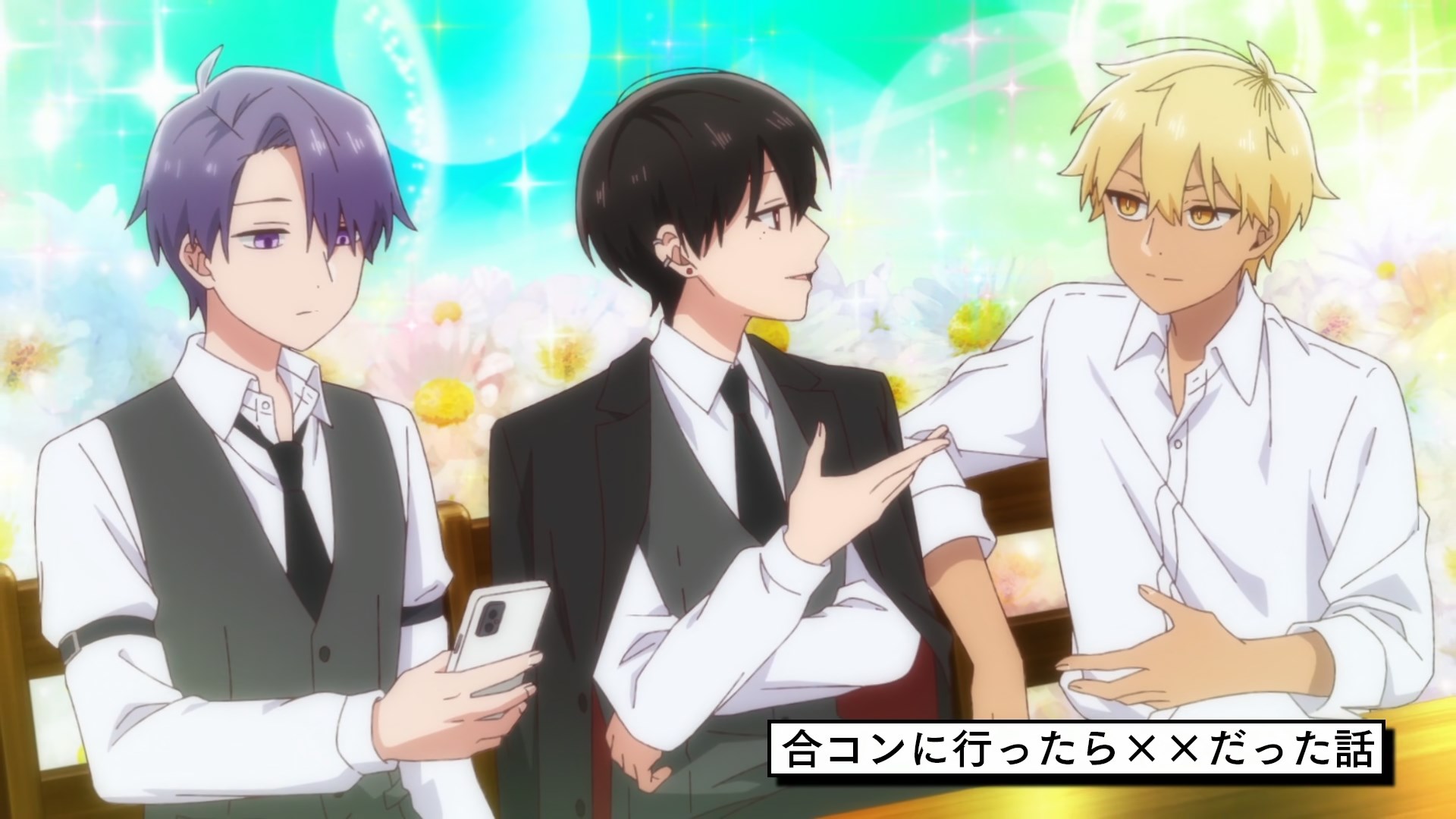
three women with short hair and dressed in masculine clothes

Goukon ni Ittara Onna ga Inakatta Hanashi is about three guys going to a mixture and expecting the usual girly girls who go to these things, instead ending up with three women who work in a drag king bar, who dressed up look cooler and hotter than them. It’s a Boys Love anime but the boys to love are girls who are better than you at being masculine love interests for other girls. Do we call this queer, or queer baiting?

Oriental Heroes 16 — #aComicaDay (37)

Imagine as if you started watching a kung-fu movie never having seen one before, just as the climactic fight scene at the end starts and you have no clue who any of these people are or why they fight. But at least the fights are very cool.

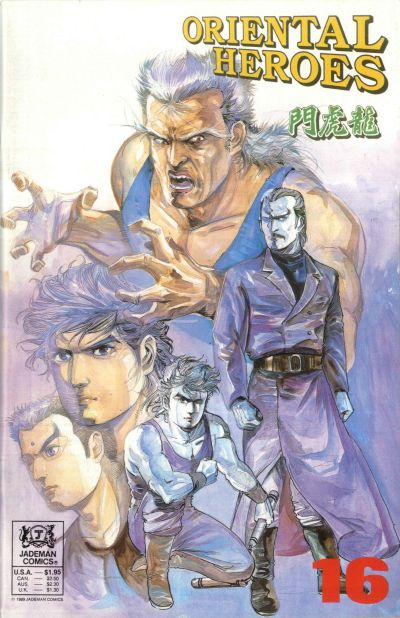
A white haired man is snarling at the top of the cover. On the right a sharp dressed man is standing, next to a guy in a wife beater, jeans and combat boots crouching. Two constipated looking faces to the left round off the cover.

Which I guess is why I bought this, one of those weird, anomalous comics you get because you probably won’t see it ever again if you don’t. Probably at that time when I was really into Dough Moench & Paul Gulacy’s Master of Kung Fu which I was buying from a market stall as black and white Dutch reprints. Anything that scratched that same itch I’d snatch up.

Oriental Heroes is an interesting title, part of the short lived Jademan Comics line. Originally a Hong Kong publisher owned by Tony Wong, who created Oriental Heroes back in 1970 and his company on the back of its success. It’s still being published today though he is no longer involved. Hugely successful in Hong Kong, Wong decided in 10988 to try his luck on the American comics market, turning Oriental Heroes and three other titles (Blood Sword, Drunken Fist and Force of Buddha’s Palm into proper US style comics, with Mike Baron and Roger Salick providing scripting/adapting duties for them at first. The latter two, like Oriental Heroes were also created and drawn by Tony Wong, who must’ve been the most productive comics publisher who ever lived if he did all that and run his company at the same time.

As you may guess from the titles, all four are kung-fu series. Oriental Heroes is set in contemporary Hong Kong and the overall plot as far as I could make out is the fight between a loose band of good kung fu artists and the evil Global Cult, who uses “an army of kung fu assassins to protect its illegal drug, gambling and slavery operations”. In episode 16 the two sides clash, which is unsuprisingly structured like a kung fu movie, with lots of individual battles between the two sides’ heavy hitters. Lots of punching and kicking of course, but there are also a lot of special techniques each given its own powerful name. In English it’s all slightly awkward but it works nevertheless.

Jademan comics lasted until 1993, when it ceased publication on all its titles, promising to return with new ones but that never happened. Either they were another victim of the superhero boom and burst of that time or developments in Hong Kong put a stop to their American adventures, as Tony Wong had been ousted from his company not long before. Apart from the original four Jademan also published two other kung fu books, Iron Marshal and Blood Sword Dynasty, all of which lasted until the end. They also put out an anthology book that was more like a regular manga/manhua style magazine and a horror anthology but neither lasted long. An interesting experiment to sell manhua to America at a time when country was barely even aware Manga existed.

An interesting footnote is that, according to a news report in The Comics Journal 120, the coming of Jademan in 1988 caused a bit of controversy. Not only was the company promising steep discounts to distributors if they bought enough, it seems two distributors even bought shares in the company, on “a personal base”. Both Bud Plant and Diamond distributor’s owner Steve Geppi bouhgt shares at the time, but both said that was done as a gesture of goodwill…

Jippo 18 — #aComicaDay (36)

Back in the seventies and eighties Dutch kids got to read Joost Swarte comics for free at school.

A mouse is playing a much too big tuba while  Katoen in a Pierrot costume is blowing a far too small trumpet as the dog face Pinbal is conducting

A bit of a cheat as Jippo wasn’t a comic so much as a magazine that also featured comics. It and its stablemates Okki (for children just starting primary school) and Taptoe (for the oldest primary school students) were edutainment magazines sold directly to schools, orginally started as proper Catholic publications but by the seventies this was long gone. Of the three, only Okki is still being published; Jippo only lasting to 1984, Taptoe to 2016. Because there was a bit of a gap between Okki and Taptoe, in 1974 Jippo was created for children in the middle years of primary school. Joost Swarte was there from the start with his series Katoen en Pinbal.

Katoen en Pinbal was a comedy series about the clown in Pierrot costume Katoen and the dog in tuxedo Pinbal, who get into various adventures, as in this issue where they are in the middle of a story in which they got suddenly incredibly rich and no longer like it. If you’ve seen any of Swarte’s more adult work, this is pretty much a version aimed at children. Some of it has been translated into English by Fantagraphics; it’s worth checking out if you like Swarte.

All these three magazines were a lifeline for a lot of Dutch cartoonists like Swarte for decades. Not only did it provide a steady paycheck for those featured in it, certain authors like Fred Julsing did some of their best work for them. As a kid I read all three of them because my school had a subscription, even after I graduated, through my younger siblings. Though I don’t necessarily consciously remember much of the comics in them, I’m sure it has been influencing my taste at least subconsciously…

Peacemaker 01 — #aComicaDay (35)

The only superhero whose father was a Nazi death camp commandant he would follow in the footsteps of by massacring a village during the Vietnam War.
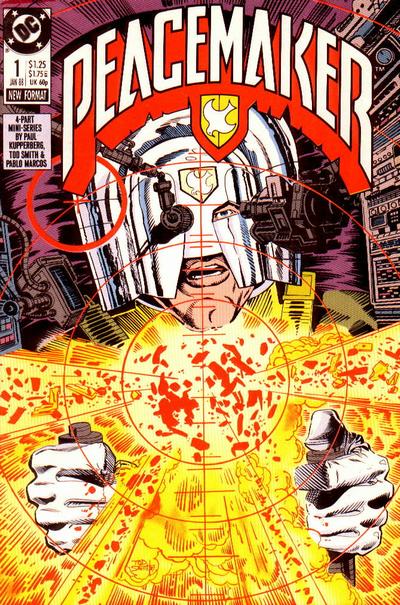
A close up of Peacemaker at the controls of his helicopter as he blows something up

Created by Joe Gill and Pat Boyette for Charlton Comics in 1966, Peacemaker is Christopher Smith, “a diplomat who loves peace so much that he’s willing to fight for it”. That sort of made sense in the glamorous sixties spy thriller world he operated in. When Charlton went under in the 1980s, DC bought the rights to most of their Action Heroes, including him, as a present for their then editor in chief Dick Giordano, who had had the same role at Charlton in the sixties. Nothing was done with him until Paul Kupperberg brought him back in Vigilante for two stories in issues 36-38 and 42-43. Now he was still fighting for peace, but obsessed with terrorists and more than willing to kill whoever got in his way, which included the then Vigilante, who he killed the very first time they met.

Paul Kupperberg had taken over Vigilante from Marv Wolfman from issue 20. Under Wolfman Adrian Chase, the titular hero had not been a well man already, obssesed with his quest for vengeance agains the sort of criminals that had murdered his family, but Kupperberg upped the stakes drastically. Int he first part of Kupperberg’s run Chase quits being the Vigilante only to see two others take up the mask, the second one being the one who got murdered by Peacemaker, leading to Chase to return to the role. It doesn’t do his mental health any good and the series ends with issue 50 and his suicide…

Peacemaker’s appearances therefore fit in quite well, having become convinced that the souls of the people he killed reside in his helmet. His appearance also transforms the series from a straight out crime series to a more Tom Clancy-esque spy thriller one. Chase is outed as the Vigilante and becomes an agent of the same agency Peacemaker nominally works for. For some reason that was the sort of story Kupperberg found interesting at the time, both in his work on Doom Patrol a bit earlier and in Checkmate a bit later. Together with John Ostrander and Kim Yale on Suicide Squad he was one of the architects of the dark underside of the DC universe post-Crisis. Peacemaker fits right in.

Peacemaker 01 was the first of a four issue miniseries and the first time his new origin was told. Unlike previously, he no longer hears the voices of the people he killed, instead he hallucinates the presence of his father, clad in SS uniform, who constantly berates him for being weak and too kind, goading him on to be more ruthless and kill more. Both in the story itself and the briefings at the end of the issue we learn his father was an Austrian weapons merchant who in 1951 committed suicide after the Soviets revealed he had been a camp commandant responsible for the murder of 50,000 Jews. His mother took the young Christopher to America, her home country but he was already damaged by his father’s actions. Expelled from several schools for antisocial behaviour he joined the army at eighteen, just in time for ‘Nam, where he committed his own war crime in a My Lai style massacre. Sentenced to life in prison, under Nixon he was selected for a programme to create anti-terrorist supersoldiers, but with the chaos of his resignation the project was terminated and he just vanished, only to re-appear as the Peacemaker.

It’s an interesting origin to say the least, a bold move to make him the mentally ill war criminal son of a Nazi mass murderer. It’s far more interesting than the overall plot of the miniseries, some nonsense about a Fu Manchu like supervillain wanting to use terrorism to collapse the USSR and or most of Europe to create his own state. Even for that post-Watchmen grim ‘n gritty ear of DC deconstructionist superheroes this is way over the top. Somehow it worked though. Tod Smith’s art, inked by Pablo Marcos, helps here in that its rough, no-nonsense style suits the crudeness of the story. I’m not sure if you can call this series and this origin good, but at the very least it’s not dull.
Richard Dragon Kung-Fu Fighter 03 — #aComicaDay (34)

That time Jack Kirby did a random issue of Richard Dragon Kung-Fu Fighter and didn’t even get to do the cover.

Richard Dragon wiping the floor with some half clad thugs, he himself only wearing a pair of speedos, while a girl is bound and gagged hanging from the ceiling

Not that Dick Giordano is anything to sneeze at, but it’s still strange to have Kirby do the interior but not the cover. This is from 1975, at the tail end of Kirby’s involvement with DC, the only issue of the series he worked on. DC had brought Kirby in back in 1970 with a lot of fanfare, but after his New World series were all cancelled they really didn’t have much of an idea of what to do with him. He created several other series like Kamadi and OMAC but none of them really caught fire and by the end he was doing stuff like this. Doing a martial arts comics is not really his forte if we’re honest. Richard Dragon here just looks like one of his working class thugs in jeans and wifebeater.

Worse, Kirby is the third artist in three issues, following Leo Durañona on issue 1 and Jim Starlin on two. It’s only with the next issue that the series would get Ric Estrada as the regular penciler, who would stay until the last issue. The writer for the entire run is Denny O’Neil, “based on a novel by Jim Dennis” (actually a pseudonym for O’Neil and James R. Berry). Richard Dragon Kung-Fu Fighter was DC’s equivalent to Marvel’s Master of Kung Fu, but the source material was worse.

Richard Dragon himself for a start is a white dude, unlike MOKF Shang Chi, who got taught by one of those wizened old masters that was all the rage in kung fu. For some reason, this time it’s a Japanese master, O-Sensei, who teaches Richard the Chinese martial art of kung fu, but that’s a minor quibble. There is an overarching plot about an evil pupil and his revenge which takes all eighteen issues to resolve. It never received the same heights as MOKF or even Iron Fist, but seems to have been a fairly decent series.

It’s certainly has had an outsized influence considering its short run, partially due to O’Neil reusing his characters in other series. Richard Dragon debuted two characters who became much more important than the protagonist in the wider DC universe: the villain Lady Shiva and Bronze Tiger, who’d become an essential part of Suicide Squad. Richard himself would show up in O’Neil’s Question series as a mentor to that series protagonist.