The Life and Loves of Cleopatra — #aComicaDay (33)

Created in 1967 after R. Diggs had seen Elizabeth Taylor in Cleopatra (1963), The Life and Loves of Cleopatra is prove positive horny fanfiction is not a modern invention.

The sarcophagus of Cleopatra boobs out and all

According to the foreword in this 1991 Rip-off Press reprint, this was never intended for publication originally since it was far too filthy to not fall foul of obscenity laws. It was purely made for his own pleasure and maybe that of a few close friends. Somebody snatched it though and started selling duplicates. Fast forward a few years and Diggs met Don Donahue of Apex Novelties, who published a lot of the riskier underground titles and would also publish Cleopatra.

Originally published in oblong format, this reprint puts two of the original pages on each standard comics sized page. Each half page has a drawing with some accompanying text, the text telling the story of Cleopatra. The drawings themselves need no narration, being mostly Cleopatra in various compromising situations. The art is great and Digg has a sense of humour about it all which explains why it was popular. Not necessarily a book you want to read one-handed though.

Because the story only runs to fifteen pages, the book is rounded off by three stories featuring one “Easy Lickens”, your typical sex crazed blonde nympho. Each story has her trying and mostly failing to find a man who can satisfy her, going so far as to tie herself up so she can be molested in the park. These are okay, not that funny and a bit cliche.

I got this at a local con only a few weeks ago because I came across it in a bargain bin and I liked the cover. Not an essential underground comic, but nevertheless glad I did come across it.

Lobo’s Back 01 — #aComicaDay (32)

Alan Grant and Simon Bisley bring a bit of British class to the DC Universe, with the help of Keith Giffen, using their understated 2000AD honed style humour.

Lobo with his back to the reader clad in a sleeveless jean shirt with a text that says bite me fanboy

So Lobo eh? Exactly the sort of over the top parody of a cool, violent antihero that appeals to sixteen year old comics nerds as a cool, violent antihero. Got his start as a villain in Roger Slifer and Keith Giffen’s Omega Men, DC’s eighties science fiction superhero series set in the Vega System. He bounced around a bit and got a steady gig in L.E.G.I.O.N., the post-invasion series that was basically Hill Street Blues meets Legion of Superheroes, in space. But it was with the first Lobo miniseries, also by Giffen, Grant and Bisley that he really became popular. Lobo’s Back was the followup to that, but you don’t need to know anything about him to understand it.

The plot is simple: Lobo’s bored and out of cash so is looking for an easy way to make money. He bumps into an old mate and when he trades him in for the bounty on his head, he runs into an old flame, who hires him for a job on Dooley-7, to bring back a ‘client; named Loo. A few pages and a lot of gratuitous but cool fight scenes later and he has found him. In a fight to the death Lobo looks to have the upper hand until Loo’s brother, Feces, kills him in a surprise attack…

The rest of the series is Lobo fighting his way through an afterlife that’s a mix of a generic sort of heaven with some public domain, non-descript pagan elements to get back to life. He wants to be reincarnated into his own body. Heaven’s bureaucracy doesn’t allow that. Quite a lot of gory, senseless violence and several failed reincarnations (as a woman during the Blitz, as a squirrel just before he actually died) later he gets his wish. The end.

At the time Lobo was exhibit number one in the degeneration of modern comics, of how the post-Watchmen, post-Dark Knight grimdark trends were ruining superhero comics. Rereading this that’s just obvious bollocks. Even back then I couldn’t take these, the first Lobo series I read, serious nor were they ever intended to be taken serious. This is cartoon violence, Loony Tunes violence. There’s no real deep satire to it, it’s just Giffen and Grant enjoying themselves, with Bisley’s art — grotesque, gory, in your face, a sort of milder Kevin O’Neill –selling it all.

DC would bring out a slew of miniseries and specials with Lobo, usually written by Grant and Giffen before doing a regular series, which was a bit of a mistake to be honest. He’s not the type of character that can keep a regular series going after all, but something you should take in small doses. But that was nineties comics for you: if it paid to do it, it paid to over do it until the little fuckers get sick to the back teeth with it.

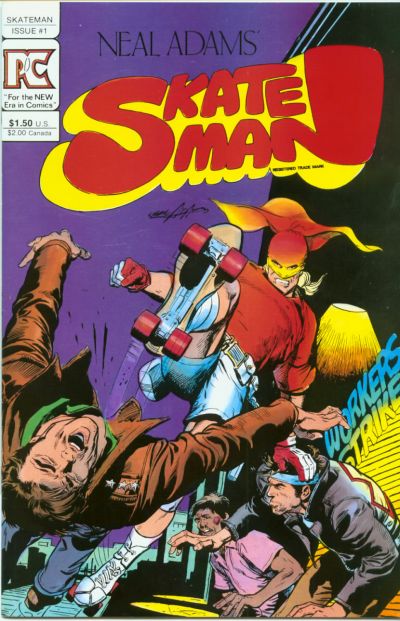
Skateman 01 — #aComicaDay (31)

Stupid comics are a dime a dozen (Just ask Mister Kitty) and most are not really worth discussing. But when it’s a comic created by the Neal Adams, it’s a different matter.

A masked man in white booty shorts and a red t-shirts beats up several ethnic looking thugs.

Neal Adams is of course best known for his gorgeous work on Batman, where together with Denny O’Neil as the writer, he dragged the Caped Crusader out of his late sixties camp era. His was a more grim, realistic Batman, better suited to the time. With O’Neil he also the classic ‘relevant’ era of Green Lantern/Green Arrow in which social justice topics rather than space aliens were fought. Working for Marvel, his biggest story ironically was all about those space aliens, doing the art for Roy Thomas’ Kree/Skrull War in Avengers, while also doing some of his best work on X-Men before that was cancelled. Then there was Deadman, one of his signature characters at DC as well as the horror work he did at Warren at the same time. By the early seventies he waa arguably the most well loved comics artist in the business, a perennial fan favourite.

By the late seventies however he’d largely stopped doing work for mainstream comics, having started his own company, Continuity, which did a lot of illustration work and the like outside of comics, while also working as packager, where they created comics for other people to publish. A huge number of artists would come up through the Continuity studios throughout the decade. At the same time he was also active in securing creative rights for cartoonists, being e.g involved in an attempt to unionise the industry as well as the fight to get Siegel and Shuster recognised as the creators of Superman.

Not surprising then that in the eighties, with the establishment of the direct market, he started thinking about creating and publishing new titles with his own characters. For Pacific Comics he would created two titles this way: Ms Mystic and Skateman. A few years later, after Pacific Comics had gone bankrupt, he would turn Continuity in its own publisher, which would exist from 1987 to 1994, dying during the great superhero glut of the mid-nineties. You’d expect a company based on Adams art and creativity would have a good reputation, but little of what Continuity produced was good and all of it suffered from bad editing and production issues.

Some of these problems are already present in Skateman. The plot is a mishmash of cliches: a Vietnam vet and live long martial arts user gets into roller derby but has to quit when he accidentally causes the death of his best friend. When his girlfriend is senselessly murdered, something snaps and he becomes a vigilante, using his martial arts and roller skating prowess to become Skateman, dressed up in white shorts, a red t-shirt and mask. Most of this is told in a long flashback after a fight against some motor cycle thugs, which end with him being badly wounded. Then his new girlfriend gets kidnapped and he uses the local skaters to get her back and the end.

Adams’ art is serviceable but noticeably worse than his earlier work. It’s not helped by the atrocious colouring, something that would be a trademark of any Continuity series. In all, there’s just no joy in any of this. no sense that Adams felt any pride in his creation. It could’ve survived the story being meh if the art was any good, but it isn’t really. The whole concept of a roller skating superhero as some sort of urban vigilante just doesn’t work. Even reading this to make fun of is a chore.

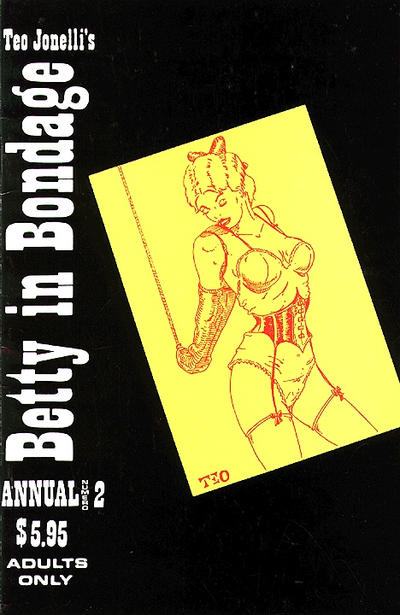
Betty in Bondage Annual 2 — #aComicaDay (30)

Is it good if your comic has to start with a disclaimer that the characters in it are at least eighteen years old?

A girl in corset and stockings with her hands tied behind her back

We briefly met Bettie Page when talking about Starslauyer and Rocketeer, but Dave Stevens use of her is not the end of comics obsession with her. If you don’t know her, she became famous as the “Queen of Bondage” for her pinup work in the fifties. Not because it was all that extreme but mainly because of, well, her smile. She had a charm to her that elevated her beyond the tawdry material she appeared in. The sort of innocent, vulnerable sexuality that maladjusted asocial comics nerds can just about handle. It’s an obsession I never quite understood but it has provided many a mediocre comics artist with a bit of pocket money drawing her.

Betty in Bondage Annual 2 is a case in point. What we have here is a comic that chronicles “Betty” making a photo set in which she pretends to be after a ring of white slavers. Most of the ‘plot’ such as it is consists of various bondage scenes in which she either tortures another girl or is tortured instead. This torture mostly consist of being tied up and then mildly whipped or spanked. I’m sure it appeals to fetishists but it’s all fairly tame for something that comes with that disclaimer. The art by Teo Jonelli is decent but nothing spectacular. Nevertheless there were three annuals of this stuff and the publisher, Shunga Comics, had two other series starring “Betty”. Somebody must’ve liked it.

I’m not sure when or why I bought this myself, but it must’ve been as some random cheap back issue bought at a con or something. If you like this sort of stuff, Eric Stanton is much better and has some actual artistic merit.

Cerebus: High Society — #aComicaDay (29)

Though we may not like that, sometimes good art is created by bad people or rather, people with bad worldviews. Cerebus: High Society is one example. Do you still read it?
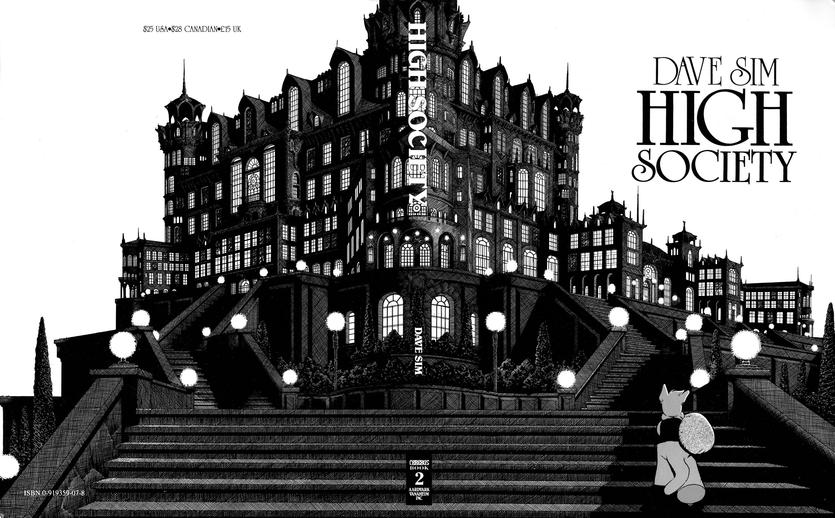
Cerebus the Aardvark walking up the steps of a posh hotel in this wraparound cover

Cerebus started off in the late seventies, part of a wave of creator owned self published titles made possible by the rise of the direct market. At the time it was a simple Conan the Barbarian parody, with an Aardvark as stand in for Conan as the joke. But as Dave Sim went on he became more ambitious, his stories more complex and interesting and eventually he created a single, five hundred page story told over twenty issues: High Society. Nobody else had done this at the time and Sim went even further and decided that from then on Cerebus would be one continuous story, one that would end with issue 300 and the Aardvark dying alone and unmourned.

Gone were the simple adventure stories and parodies, instead Cerebus went for cerebral plots revolving around political intrigue and religion and all that good stuff, the next two storylines continuing where High Society had started. As Cerebus evolved and Sim’s own interests changed, the series shifted further, into a more personal as well as more philosophical story. Which is where the trouble began. Because in issue 186 Sim set out his personal philosophy, his view of the world, through the text pages that had been part of Reads, the then running storyline which were written by his alter ego “Viktor Davis”. This positioned a creative, rational “Male Light” versus an irrational, emotional and devouring “Female Void”. As The comics Journal put it in issue 174:

A justification of — even, call for — misogyny as a philosophical stance, “Reads” comes on like a combination of a bitter post-breakup barrooom rant, biologic conspiracy, and bizarre male Objectivism (in the Ayn Rand sense of the term).

Things didn’t get better from there and Cerebus from Reads is dominated by Sim working out the ramifications of this philosophy. This, for most readers, did not make for a more interesting or entertaining series, regardless of the revulsion they might have felt for this stance in the first place. Though Sim did succeed in reaching issue 300 and Cerebus’ Demise, right on schedule in March 2004, the bloom had gone of it. What had once been seen as one of American comics’ greatest achievements was now an embarrassment. But what about the bits that, like the curate’s egg, were still good, not tainted by this misogyny? What about High Society?

For me, High Society was the first Cerebus I read, when I came across the phonebook version in my then regular comics shop. I knew about it, but had never read it or even seen an issue, so when I came across it I couldn’t help but read it then and there. I started buying the other then released collections, up until Melmoth. This was sometime in the late nineties, when the controversy had already erupted. I must’ve seen it discussed online, in the Usenet comics groups or the comix-L mailing list I was subscribed to. But at that point I knew too little of it to let it stop me from reading Cerebus. But looking at it twenty years after the series was finished, knowing Sim was and is still serious about this, it’s hard not to feel reluctant to reread even the good bits of Cerebus.

For me, this is not a case like that of a Neil Gaiman or Warren Ellis, who have had creditable accusations of sexual harassment brought against them. Those I find easy: regardless of how much these writers mattered to me (Ellis more than Gaiman), they won’t get my money anymore, nor am I inclined to reread or discuss what I’ve already bought from them. But Sim, to his credit, is ‘just’ a misogynist philosopher with as far as I know no such accusations brought against him. while his philosophy is revolting, he lacks the influence to be dangerous in the way an influencer like Andrew Tate is. Cerebus is just too impenetrable, too obscure outside a smallish circle of comics nerds to be dangerous.

And that’s due entirely to the fact that most people did stop buying Cerebus after this all came out. Cerebus may have reached its end as planned but by that time nobody cared anymore. Two decades on from that I personally don’t feel the need to continue this boycott anymore. (Confession time: I did actually buy the entire series in ebook form when it came up on Humble Bundle.) I think it is possible to read and examine the entirety of Cerebus again, something Tom Ewing has been doing recently. I don’t feel guilty for having High Society or any other Sim work in my collection, even if it is irredeemably tainted now.