Dandadan — First Impressions

If you like the opening, you will like the rest of Dandadan:

Nothing much to say about this one because it sells itself. Nerdy UFO obsessed otoko clashes with heartbroken gyaru who believes in ghosts. They each set out to proof the other wrong by going to the respective UFO/ghost activity hotspots. He gets his dick stolen by a creepy grandma ghost, she gets almost raped by aliens with metal drills for penises. In the end they save each other. Science Saru is doing the adaptation and it looks good.

The one caveat is that sexual assault. It’s deeply creepy and uncomfortable as it should be, but you still have a high school girl getting her legs spread open clad only in her underwear. I don’t think it’s intended as fanservice but honestly, the whole alien attack could’ve been done differently. It was unpleasant in the original manga and it’s not improved in anime. This is the sort of thing that could’ve been changed for the adaptation.

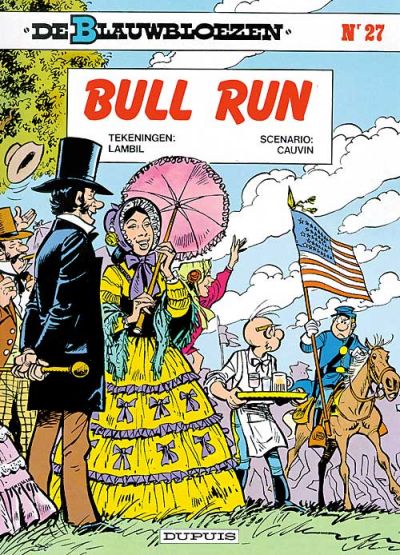
Les Tuniques Bleues: Bull Run — #aComicaDay (28)

Everything I know about the American Civil War I learned through reading the big nose adventure humour series Les Tuniques Bleues.

A group of civilians is watching a sergeant holding an American flag move past on horseback

Has there actually been any American comics series about the Civil War? I can’t think of any off the top of my head. Usually when it comes up it’s to give some antihero like Jonah Hex his background, preferably as some traitor who failed to defend slavery and now is sad the South lost the war or something. Not so much here. As you may expect from something called Les Tuniques Bleues (“the Bluecoats”) its protagonists are on the right side, the Northern side. Though that doesn’t stop it from taking the mickey out of war in general or the stupidity of the Northern commanders either.

Created by artist Louis Salvérius and writer Raoul Cauvin in 1970, the former sadly died a few albums in and he was replaced by Lampil,w ho has done the art ever since. Cauvin himself died in 2021 but the series has continued with new writers. Les Tuniques Bleues stars the hopelessly naive sergeant Chesterfield, proud to be a soldier and a true believer in his cause and government. He’s partnered with corporal Blutch, much more cynical, much smarter and not intending to sacrifice his own life for any cause, no matter how noble. It’s a classic combination you see a lot in Franco-Belgian humorous adventure comics like this. The series actually started as a more generic western comic, with Chesterfield and Blutch part of that famed institution that always arrives too late to be useful in other western comics: the cavalry. It’s only in the second album they move back east to the war.

As a child I loved this series, one of my favourites along with Asterix and Tintin. We even played Civil War soldier with my younger brothers and such. Most of the stories were set in a more or less generic Civil War scenario, but a lot also took place during actual historical events, as you should be able to guess from the title of this particular one, telling the story of 1st Bull Run. Along the way Blutch and Chesterfield also participated in the battle of the monitors, had to escape the Andersonville prison camp and witnessed the siege of Vicksburg.

Not that you could pass a history test by just reading this series, but it did mean that I could recognise various events when I came across them reading James M. McPherson’s Battle Cry of Freedom: The Civil War Era…

A Farewell to Anime Summer 2024 — Part I

Another season of anime has come to a close. Light on shounen crap but like last year strong on romcoms, this was a fairly decent season even if there were no truly outstanding series.

Elf-san wa Yaserarenai. Fantasy creatures trying to diet and exercise after being exposed to the temptations of our world. This ended as it started, with no real plot but the introduction of a new character every second episode or so. Animation got progressively worse over the course of the series. Lots of nudity but a lot of it was on a level of a documentary on obsesity — vulgar, juggling bellies and such — rather than anything actually sexy. The manga is better. 5/10

Rin and Eiji are finally getting married.

Giji Harem. Two theatre kids fall in love. She’s an aspiring actress who uses her talents to provide him, her decor building senpai, with his own pseudo harem. The manga on which this was based came to a satisfying conclusion, moving beyond the usual high school romcom setup and the anime version was able to do so to in 12 episodes. I liked the way their actual confessions were not shown until the very last episode even though it was clear they had become a proper couple some episodes earlier. 8/10

Saki and Yuuta holding hands having come to an understanding

Gimai Seikatsu. A high school boy suddenly acquires a step sister when their parents remarry to each other. The foundation of many an ‘edgy’ romcom where it’s all about the taste of forbidden love, here handled extremely maturely. By the end of the series their mutual attraction to each other has not so much been resolved, as acknowledged. Taking place over just a couple of months, Gimai Seikatsu has them first grappling with having become family, before each in their own way realises that they are in love with the other. What helps is that the animation, lightning and character acting is so strong. 8/10

Katsute Mahou Shoujo to Aku wa Tekitai shiteita. The lack of progress in this romantic comedy between a magical girl and the lieutenant of the evil organisation she fights as well as the magical girl’s passivity was disappointing. It didn’t help that the mascot characters were so annoying. The animation reminded of a consistently high quality throughout the series. 6/10

Dahliya and friends celebrating her success.

Madougushi Dahlia wa Utsumukanai. Like her father Dahlia is a magical engineer creating various magical tools, but she draws inspiration from memories of her past life living in Japan. This started out as being about how Dahlia was slowly ground down under the insecurities of her fiancee, losing her independence and self worth, but this was burned through and resolved in the first four episodes. The rest of the series was spent just hanging out with her as she went about her daily life with no real conflict left to drive the story. This is a failing you see a lot in these wishfulfilment fantasy series, that the actual conflict setting up the series is resolved quickly and then it has no idea what to do afterwards. 5/10

Grendel – Devil by the Deed — #aComicaDay (27)

What in the hands of any creator could’ve been an entire series, the rise and fall of Grendel, Matt Wagner tells in just 37 pages. Not necessarily by choice though.

Grendel in tuxedo with a red rose on his lapel.

Because this was the second attempt to tell the story of Hunter Rose, the first person to take on Grendel’s mask. Grendel had debuted in Comico Primer 2 and then got his own series. This only lasted three issues before financial difficulties at Comico (a recurring problem) put a halt to it. Instead, Wagner reworked the story, considering what had already been published as a “rough draft” and published it as a series of backups in his other series, Mage. And instead of doing it as a straight comic, his new approach was to do it as more of a picture book, with the gimmick being that these were extracts from a book published in universe long after Grendel’s death.

It works surprisingly well. The story is stripped to its essentials while it gives Wagner room to play around with the art layout and composition. Wagner’s art has also improved drastically in the meantime, which helps. Int he earlier series it already had the fluidity that is its hallmark, but it was uneven and clearly a product of a talented amateur. In Devil by the Deed it has matured and is on a par with the work of similar artists like Steve Rude or Dave Stevens. There’s also an ineffable mangaesque quality to his art style which I’ve never been able to quite understand where it came from.

Devil by the Deed was originally published by Comico in 1986 as a collection of those Mage backups, then after Comico’s inevitable bankrupcy, reprinted with a new cover and added pinup gallery by Dark Horse, for which Wagner would create more Grendel stories. The gallery has some great artists in it, including Tim Sale, Guy Davis and Kelley Jones. This is the edition I have.

After the success of the Mage backups, Wagner started a new Grendel series for Comico, for which he wrote the stories but the art was done by others, each new arc having a new artist. The first twelve issues had the Pander bros on art, followed by Bernie Mireault, Hannibal King, Jay Geldhof, John K. Snyder and others, with Wagner occassionally taking his turn as well. The series lasted for forty issues after which a new series, Grendel Tales was planned, which would feature stories both written and drawn by others, but again Comico’s bankrupcy put an end to this. Instead these would be published a few years later by Dark Horse. The first series they published, Grendel: Warchild, was also the first Grendel series I bought.
Makes my own projects look a little more reasonable

So I was googling the other day for Steve Gerber and Val Mayerik’s ill fated Void Indigo series for Epic Comics as you do and found a review from somebody who had started a project to read every comic Epic ever published. What’s more, that’s not the only company Lars Ingebrigtsen has done this for. He has done similar projects for:

As well as projects documenting the work of Elaine Lee and the alternative eighties RAW crowd. Every one of these projects require a level of obsession and sheer graft that’s hard to imagine, making my own pet projects seem reasonable by comparison. Hats off for Lars for doing this. It can be hard to find any discussion of pre-internet comics online, especially from now defunct publishers and he not only reviews them, he also provides context by looking at contemporary fanzine reviews and such. Very helpful indeed when I was interested in why Void Indigo only lasted two issues.

One of his projects deserves a special mention: Kwakk.info, a “research site for magazines and fanzines about comics” which allows you to search the content of a rather large selection of English language comics zines. Again, this has already proven its worth to me because I needed to find some information on Michael Thibodeaux, somebody obscure enough to not have even a Wikipedia page stub. Just knowing where to read an interview or review means I can dive into my own pile of yellowing fanzines to read it rather than having to first flic to all of them to find it.