How can you be anything if you can’t be yourself?

If you have ten spare minutes, this extract from the 1977 queer documentary Word Is Out: Stories of Some of Our Lives featuring theatrical actress Pat Bond is well worth watching:

Pat Bond tells about how she joined the army during World War II because she was in love with a girl who wouldn’t fall in love with her, how widespread gay and lesbian soldiers actually were at the time, semi-tolerated when the army still needed them. She also talks about what happened when they weren’t needed anymore, the witch hunts that kicked everybody suspected of being queer out with a dishonourable discharge. She also tells about having to fit into a certain role even as a lesbian, that you had to be either butch or femme and how that was both a comfort (as long as you knew the rules you could act the part) and how she never felt herself fitting in her role. Slightly nostalgic as well for when being lesbian meant being part of an incrowd, different from the norm, something she felt had disappeared with the greater openness of the seventies. But she wouldn’t go back: “how can you be anything if you can’t be yourself”?

Prescient too in worrying that the new tolerance might not last. With the twin disasters of the AIDS epidemic and the Reagan presidency only few years away, it’s hard not to look at her worries as prophetic. The eighties really did saw a backlash against queer rights.

Captain Americ 358 — #aComicaDay (26)

It took me just one issue to fall in love with Mark Gruenwald’s Captain America. This was the issue.
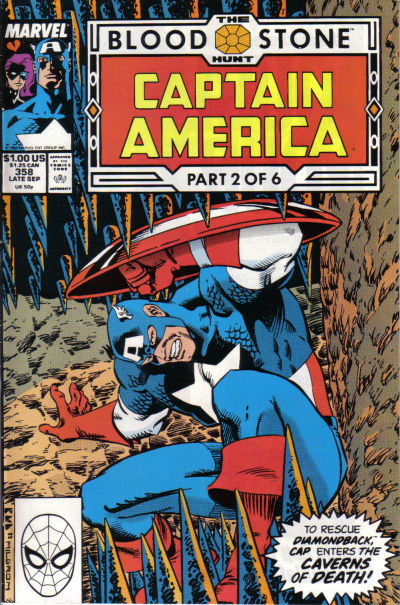
Captain America is trapped between two slowly closing walls of spikes, using his shield to hold off one.

Part two of the Bloodstone Hunt opens with Cap descending into a subterranean cavern to find the source of an annoying little transmission. Running and diving his way through a series of traps, he comes in a ritual chamber that has the skeletons of “three dead men, one dead woman, one dead dolphin”. Descending even further he finds the source: a crate containing the equally dead Ulysses Bloodstone and a very alive Diamondback. He quickly takes her back to Avenger island, where we just have time to realise John (son of Jonah) Jameson is the new Quinjet pilot before a quick radation meter has been rigged up using Bloodstone’s skull and it’s off to South America to find the first of the fragments of the jewel that gave Bloodstone his powers. They get there, are immediately taken prisoner by an unknown Inca tribe and find Baron Zemo and his stooges — Batroc, Zatran and Machete — all trussed up on a ceremonial sacrifice wheel. Whew. All that and an US Agent backup that has him going up against the Scourge.

That really was the perfect comic for fifteen year old Martin, who never liked a superhero comic better than if it had loads and loads of unknown characters. The whole Bloodstone Hunt was basically an excuse for Gruenwald to do an Indiana Jones style adventure serial set in the more obscure parts of the Marvel Universe, with each issue ending on a cliffhanger, natch. The very next issue they’re off to the Bermuda Triangle, diving into a wrecked airliner (probably the one which got Skull the Slayer his origin), getting into an underwater fight with Zemo’s henchmen and that leading to (of course) a shark attack. The next issue: Egypt and The Living Mummy. Then finally, Tokyo where a yazuka gang has the final piece. Fifteen year old me ate that shit up. Kieron Dwyer’s art didn’t hurt either, nor did M. D. Bright’s on the US Agent backup.

What made it even better, but that would only become apparent in the issues directly after this, is that The Bloodstone Hunt saw the debut of a major new Captain America villain: Crossbones, who later turns out to work for the Red Skull, Cap’s greatest enemy. And who may also share a past with Diamondback, as established in the very next issue. For somebody who until this point had barely read any Captain America stories, as few had been published in the Netherlands, all of this made me fall in love with Cap and especially Gruenwald’s idea of who Cap was. It was his writing that made Captain America my favourite Marvel hero.

Gruenwald of course stayed on the title until it was cancelled under him for Heroes Reborn. You could argue that even at the time I started reading it, he had already written his best stories (Serpent Society, the Scourge of the Underworld, the replacement of Cap by a rightwing zealot), but to me the run from #358 to #386, with first Kieron Dwyer and then Ron Lim on art duty is the classic Captain America.

And leave my cat behind? — Kekkon suru tte, Hontou desu ka — First Impressions

The setup for this series is that Ohara and Honjoji, two low ranked staff members at a travel agency, decide to fake a marriage so they won’t be sent to the new branch in Anchourage, but I’m more impressed by the huge number of people their one branch employs.

A group of office workers stand around worried they'll be sent to Alaska

A dozen or so employees for one branch? Talk about over staffing. The whole setting is strange to me to be honest. I think the last time I personally used a travel agency, as in went physically to one of their offices to get advice, was around the turn of the millennium. I think they’re still around, but who uses them these days? even if you insist on using a travel agency, you’d do it online right, not by going to one of their branches, unless you want to do something really out of the ordinary. Even then, I doubt any Dutch agency would have this much staff. Stranger still, having them open a branch in Alaska because they want to sell more holidays there. I understand wanting somebody there to represent your agency at the holiday destination, but wouldn’t you hire locals instead? Sometimes Japan really is a foreign country, even in anime, in a way e.g. the UK isn’t.

A blue eyed siamese looking cat sits on top a glasses wearing, shaggy haired dude in lounge wear

Ohara’s motivations for not wanting to go are much easier to understand. Who’d want to leave their cat behind? I’ve actually been in a similar situation, when the company I was working for at the time needed more IT people for their Australian operation and was looking for volunteers to go to Sydney for a year or two. Setting aside all the other hassle, learning it could cost thousands of dollars and take months to get my cat shipped over, robbed me of any incentive to do so. Couldn’t do that to her.

Honjoji too is understandable. She loves reading about travel and collects maps, she just doesn’t want to do so herself. That it’s her that comes up with and proposes the fake marriage planfits what we see of both her and Ohara this first episode. Ohara is a bit slow, always getting scolded for being slow to respond when it’s more that he needs to take that little bit extra time to be able to respond correctly. Honjoji meanwhile has the sort of resting bitch face the Japanese in particular seem unable to handle, but has alittle bit more initiative to her. Both read as maybe a little bit neuroatypical, but in as how far that’s intended is anyone’s guess. They do get treated a hell of a lot better the moment they announced their fake engagement though; suddenly they fit in with their coworkers expectations in a way they individually did not. They’re now “the office couple” rather than a pair of weirdos.

An interesting first episode so far, let’s see if it can keep it up.

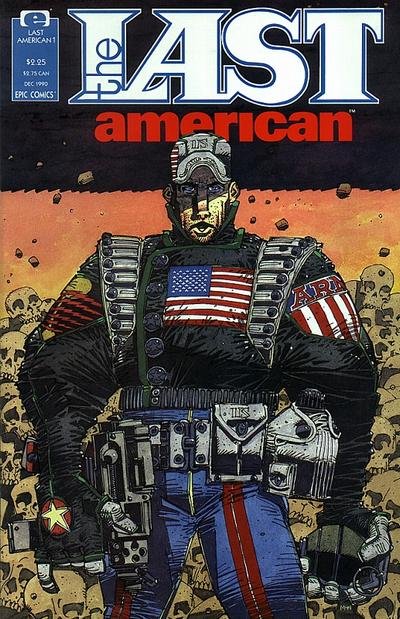
The Last American 01 — #aComicaDay (25)

Just as the Cold War was finally ending, here come Alan Grant, John Wagner and Mike McMahon to remind us how very different, very bad it could’ve ended.

A man in uniform with an American flag on his chest is looking at the reader, gun in one hand, grenade in the other

Twenty years after the nuclear war ended, Ulysses S. Pilgrim is awoken from cryogenic suspension to find out what’s left of America. It will take him four issues to discover that he is indeed The Last American. You might think you’re in for a fun post-apocalyptic romp, but every time the story seems to veer that way it sucker punches you to drill home the message that nuclear war is no fun.

Nuclear annihilation was a very popular theme running through eighties pop culture, as fitting for the decade that was arguable the most dangerous of the entire Cold War. Forget the 1963 Cuban Missile Crisis, we came much closer to the brink in 1983, multiple times.

And while in America you could still sort of pretend that the worst that could happened would be a couple of hundred million deaths and the survivors having to fight off mutants and bandit gangs, over here in Europe we full well knew that it would be the end of everything. If you’d survive the initial exchange, you’d die of radiation poisoning soon after; if not that, than through illness or starvation. It’s that nihilism, that certainty that The Last American captures so well.

Which is no surprise considering Grant, Wagner and McMahon were all British and should’ve been fully aware of what a nuclear war would mean to the UK. As a series, it really is relentlessly grim, with little even of the black humour Wagner and Grant put in their Judge Dredd stories e.g. McMahon’s art is gorgeous as usual, but it’s still oppressive for all its beauty.

Originally the series was supposed to come out in the mid-eighties, but McMahon fell ill and only recovered in 1990. Somewhat serendipitously it means it was a fitting coda for the end of the Cold War.

The geek fallacy — 2.5-jigen no Ririsa

Look, it works here because this is fiction, but thinking that just because you all share the same hobby you all should be friends is asking for trouble:

Close-up of Ririsa saying 'I mean, cosplayers all love the same thing! We're all on the same team!'

2.5-jigen no Ririsa episode 14 is about Ririsa wanting to befriend another girl doing cosplay, who in turn wants to befriend her too but is just incredibly socially awkward to the point of disability. In this case therefore thinking that “we should be friends because we both cosplay” works out. In real life, just sharing a hobby doesn’t mean you have anything else in common or even like each other. I’m glad some of the other characters at least pointed this out to Ririsa, that others may dislike her and that this is okay, that she doesn’t have to force herself to like somebody else because they’re also cosplayers. It’s a lesson any baby geek or otaku needs to learn.