Phantom 32 (Charlton) #aComicaDay (24)

Sometimes you luck out when you see a cool looking cover in a bargin bin and end up buying a Jim Aparo drawn issue of Charlton’s The Phantom.
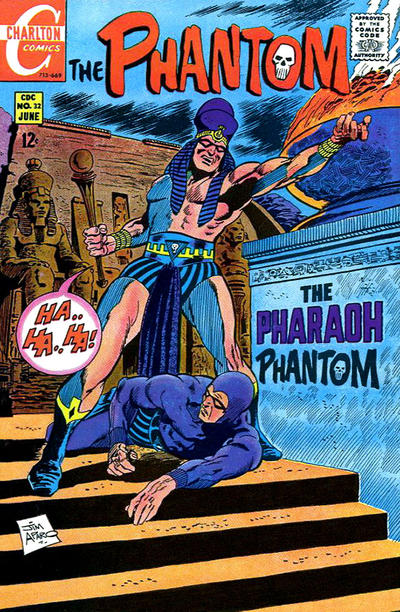
Against the background of an Egyptian temple, a man in a pharao costume is standing legs akimbo over a prone Phantom

This is actually some of Aparo’s earliest work, from just before he became a mainstay at DC Comics. He had actually attempted to join EC Comics in the fifties, but had been rejected and did advertising work until Dick Giordano brought him to Charlton. When Giardano moved on to DC, so did Aparo.

I’ve always had mixed feelings about Aparo’s art: I disliked much of his work in the eighties and nineties on Batman and the Outsiders and the core Batman titles. Yet his earlier work on Brave and the Bold and especially Aquaman I love, possibly because I read much of it in black and white Dutch reprints. Certainly the colouring in the deluxe Outsiders series did his art no good. Or maybe it was the improved paper quality that ill suited his artstyle. His art here is gorgeous though, with no qualifications. I like his Phantom, a bit beefier than I’m used to.

Not that I’ve read many Phantom stories. As you might know, The Phantom started out as a Lee Falk created adventure newspaper strip, about “the Ghost Who Walks”, a vigilante in a fictional African country who has been keeping the peace for centuries, withthe mantle of the Phantom being handed over from father to son for generations. He got a few serials back in the days, the inevitable radio show, a nineties blockbuster movie when Batman was the rage and Hollywood though any old pulp hero would be as big. As well as a lot of comics adaptations over the years. For some reason The Phantom was incredibly popular in Sweden and they did their own version there. Here in the Netherlands he never quite made it. There have been a few reprints of American comics over the years but that was it.

Over the years bought some of those when I found them secondhand, mainly because he was another superhero than for any intrisic interest in the Phantom as a series. The notion of a great white protector of an African country is rather old fashioned and somewhat orientalist after all. On the other hand, the idea of an unbroken lineage of superheroes 21 or 22 generations long is great. Just the setting is a bit sus…
XIII 01: Black Friday — #aComicaDay (23)

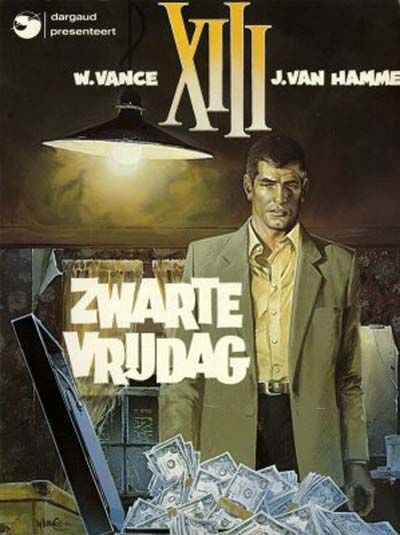
An amnesiac is washed on shore near a small village, where a kindly doctor nurses him back to health. After he recovers he discovers he’s the target in a massive complot and may be involved in the murder of the US president. His name? Not Jason Bourne.

XIII, a dark haired man with a white streak on his left temple where a bullet destryed the pigment, dressed in a cheap suit, looks at an opened suitcase from which money spills out.

I’m not saying that Jaan van Hamme and William Vance looked a bit too closely at Robert ludlum’s The Bourne Identity (1980) for their adventure spy thriller series XIII (1984) but it wouldn’t be the first comic inspired by a popular novel or movie, eh? It’s practically a tradition to take something popular and create your own twist on it and van Hamme and Vance certainly did. Over the course of twenty albums they set up and then unravelled the mystery of XIII’s true identity, his role in the murder of the president, the conspiracy behind this murder and once that was all resolved, dove into the older history of him and his family.

Hugely popular in Europe, the series survived the departure of its writer, van Hamme, who felt he had done everything he wanted with it and its artist, Vance, forced to retire from it due to medical problems. It spawned not only a spinoff series, but also a computer game and a French television adaptation. For me, it was one of the few European comics I kept reading when I was obsessed with superheroes for a couple of years.

Both van Hamme and Vance were well established when they started XIII. The first had already had been succesfull with the fantasy viking series Thorgal, drawn by Polish cartoonist Grzegorsz Rosinski and had also written the critically acclaimed Histoire sans héros (Adventure without Heroes), drawn by Dany, as well as more mainstream fare like the short lived Arlequin, also with Dany, which was the first series I read of him.

William Vance had broken through as the artist on the Bob Morane series of sci-fi thrillers as wellas Bruno Brazil, a more harder edged crime and spy thriller series which ran in Tintin. His passion however lay more with historical series. Westerns like Ringo, medieval series like Ramiro and Roderic but especially Age of Sail series like Howard Flynn and Bruce J. Hawker, his pet project. Sort of ironic then that his most well known series is a hard boiled modern thriller. But honestly, while he’s never a bad artist, his work on XIII is a cut above most of his older work.

Don’t threaten me with a good time, Mickeysoft!

For those who don’t like paying licence fees, Microsoft is offering a new version of Office, but it comes with some limitations:

Office 2024 packs all the modern features Microsoft has added to its popular apps in the past few years, but that’s about it. The suite comes “locked in” and won’t receive any further upgrades. Users will also miss out on real-time collaboration and Copilot AI integration, which are available with Microsoft 365.

No AI? Oh no! How ever will I cope?

Avengers 167 — #aComicaDay (22)

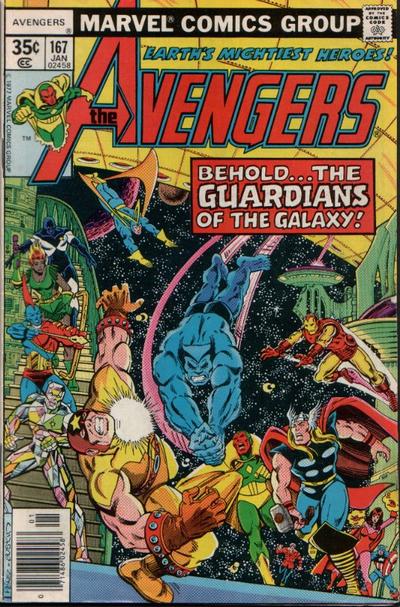
Thirteen heroes on one cover? Some artists would struggle, for George Pérez it’s Tuesday.

The Guardians of the Galaxy coming down the stairs as the Beast wallops Charlie 27 and the rest of the Avengers enter from stage left

A sentimental choice this time. This was one of the very first superhero comics I remember reading, in Dutch translation as Vergelders 01. As a child we’d often spent our Sunday afternoons visiting my maternal grandmother, who still had her youngest son, my uncle, living with her. This uncle had a smallish collection of various comics left over from when he was younger and that included a few superhero comics, of which this one and the first issue of the Stan Lee/John Buscema’s Overmind saga in Fantastic Four were the ones I remember. Though I wouldn’t get into superhero comics properly until a few years later, this sure planted a seed in young Martin. As I’ve mentioned before, these stories stuck in my head even though they were steeped in a continuity or history I knew nothing about yet, with a cast of dozens of unfamiliar heroes and villains.

Avengers 167 was the start of the Korvac Saga, written by Jim Shooter on request of Pérez himself for a good solid story with a lot of characters. In many ways it’s a perfect example of Bronze Age (or Shooter Age?) Marvel. The start of a new story, but subplots from previous issues are still mentioned. Captain America and Iron Man are in conflict over the latter’s leadership. Wonder Man, recently defrosted, is worrying about whether he can be a hero, while Thor is feeling out of place, as if a mysterious force has been toying with him. When the Avengers meet the Guardians halfway through the issue and the misunderstandings are revolved, we get two pages recapping their history with Korvac and why they’re here, in 1977.

And then we change scenes entirely and are at a fashion show on Park Avenue, that’s being robbed by the Porcupine. But if you say fashion, you know the Wasp will be in the audience and so is her then hubby, the Yellowjacket. They make short work of the Porcupine and his men, aided by yet another hero, Nighthawk. The issue ends with the latter making a terrible pun and that was my first encounter with The Avengers and superheroes.

Thrown in the deep end so to speak, but at no point was I lost or confused about what was happening. Shooter had a knack for introducing all those myriad characters naturally through the course of the story, not surprising since he started as a writer for the Legion of Superheroes. And Pérez is of course, even then, a master in both depicting action and through it showing each hero’s personality. The opening splash page e.g, which shows the Scarlet Witch and Captain America racing to the monitor room to answer an alert, with the Beast bouncing over their heads to get their first. Or the encounter between Charlie 27 and the Beast a little later, the first confident he can handle this weird ‘space monkey’, the latter outraged at being called that. Pérez was, is and will always remain my favourite superhero artist because of things like this.

Hero Alliance — End of the Golden Age — #aComicaDay (21)

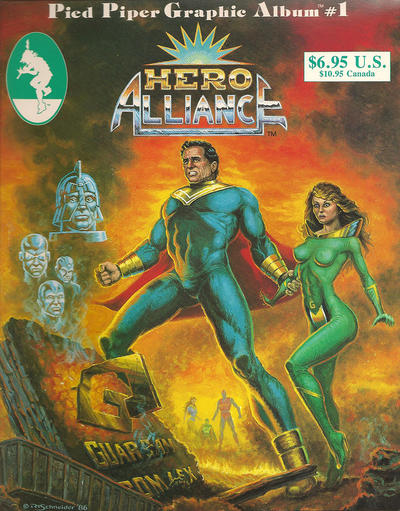
The World Greatest Hero stares at the ruins of the headquarters of his ex-team. They’re dead, murdered by an old enemy nobody had taken seriously in years. Meanwhile, unknowing, his best friend lies dying in a hospital.

A painted cover showing the ruins of a building in the foreground with a hero and heroine looking constipated behind it while some disembodied heads float in the background

If this had been Superman and say the Detroit area Justice League this would have had some emotional impact. However instead it’s Victor, the heroes murdered were the Guardmen. You don’t know any of these people, why would you care about them when there’s three pages of backstory, then a splash page with the ruins of the team’s headquarters and that’s the last we’ll see of them. It’s purely setup for the rest of the Hero Alliance “End of the Golden Age” graphic novel, which is really about Victor and his relationship with that old friend, the Golden Guardsman, the Batman to his Superman. The Guardsman disappeared years ago and now lies dying of cancer, his son decides now it’s a good time to steal the source of his powers and become a supervillain while his daughter tries to stop him, calling on Victor to help her. In the end they succeed, but now Victor has to choose what to do next as the story is to be continued in the Hero Alliance regular series.

A bold gamble to launch a new superhero series in 1986 through a $6.95 graphic novel; toob old a gamble as Pied Piper didn’t last long beyond its publication. Another victim of the 1987 Black and White Comics Boom, when the direct market was overflowing by all sorts of amateurish crap hoping to be the next Teenage Mutant Ninja Turtles. When that fever broke a lot of shops and publishers went bankrupt. Hero Alliance only got one issue and that was at Wonder color Comics. But the story doesn’t end here.

My personal copy of Hero Alliance “End of the Golden Age” has a sticker over the price tage you see, “Distributed by Innovation”, raising the price with two bucks. What had happened there was that David Campiti, who had written the story together with Kevin Juaire, had started his own comics company in 1989, Innovation, and immediately restarted the Hero Alliance series. He also got the stock from Wonder and Pied Piper and resold it a few years later, taking old issues, ripping their covers off and bundling them together in 100 pages specials under a new cover. There must’ve also been a far few copies of the original graphic novel laying about for Innovation to resell them as is. Especially since Innovation had also reworked it into a three issue miniseries with the same title, adding that first issue from Wonder Color to it as well as extra material.

Now you may have noticed that the cover painting, by one R. T. Schneider, is, to put it bluntly rather ugly. Especially Victor and Kris’ facial expressions are terrible. Have no fear though, as the interior artwork is in much more capable hands, being some of the very first work done by one Ron Lim (with inking by Bart Sears even). Neither Lim nor Sears would make the jump to Innovation, having moved on to bigger and better things, but it is worth seeking out the graphic novel and that very first issue for their art.

Is Hero Alliance as a whole any good? Probably not. To paraphrase David Campiti, the intent was to “show the scenes between the fight scenes” and created a more mature sort of superhero series. In practise this meant second rate soap opera and a lot of t&a. Kris especially could not wear her costume without her nipples poking through. None of the characters got that much of a personality and it all remained stuck in them being obvious stand-ins for better known heroes. Nevertheless, the series lasted 17 issues, followed by a second, quarterly one that lasted four. Somebody must’ve liked it.